CCSS.
The Standard
Make formal geometric constructions with a variety of tools and methods (compass and straightedge, string, reflective devices, paper folding, dynamic geometric software, etc.). Copying a segment; copying an angle; bisecting a segment; bisecting an angle; constructing perpendicular lines, including the perpendicular bisector of a line segment; and constructing a line parallel to a given line through a point not on the line.
Common Core State Standards for Mathematics
Teacher's field guide
What This Standard Means
What Students Need to Do
- Students use geometric tools to create exact segments, angles, bisectors, perpendicular lines, and parallel lines. They follow a clear sequence and preserve construction marks. They explain why each result is accurate.
What Mastery Looks Like
- Students complete accurate constructions without measuring angles or lengths. They leave clear marks, label the result, and explain why the method guarantees the required relationship.
Common Misconceptions
- Students often sketch by eye or rely on ruler measurements instead of using construction marks. They may confuse an angle bisector with a perpendicular bisector. Some erase arcs, making their method impossible to check.
How to Assess It
- Give students segment AB and point P outside line AB. Ask them to construct the perpendicular bisector of AB and a parallel line through P, leaving all arcs visible.
Lesson moves
Ways to Teach It
Have students fold paper to bisect segments and angles, then reproduce each fold using a compass and straightedge.
Ask students to write why equal-radius arcs locate an angle bisector rather than merely estimating its position.
Run a construction relay where teams draw task cards and complete accurate constructions with all arcs visible.
Use a simple street map to construct a parallel bike route and a perpendicular crossing through marked locations.
Free download
Printable HSG-CO.D.12 Worksheet
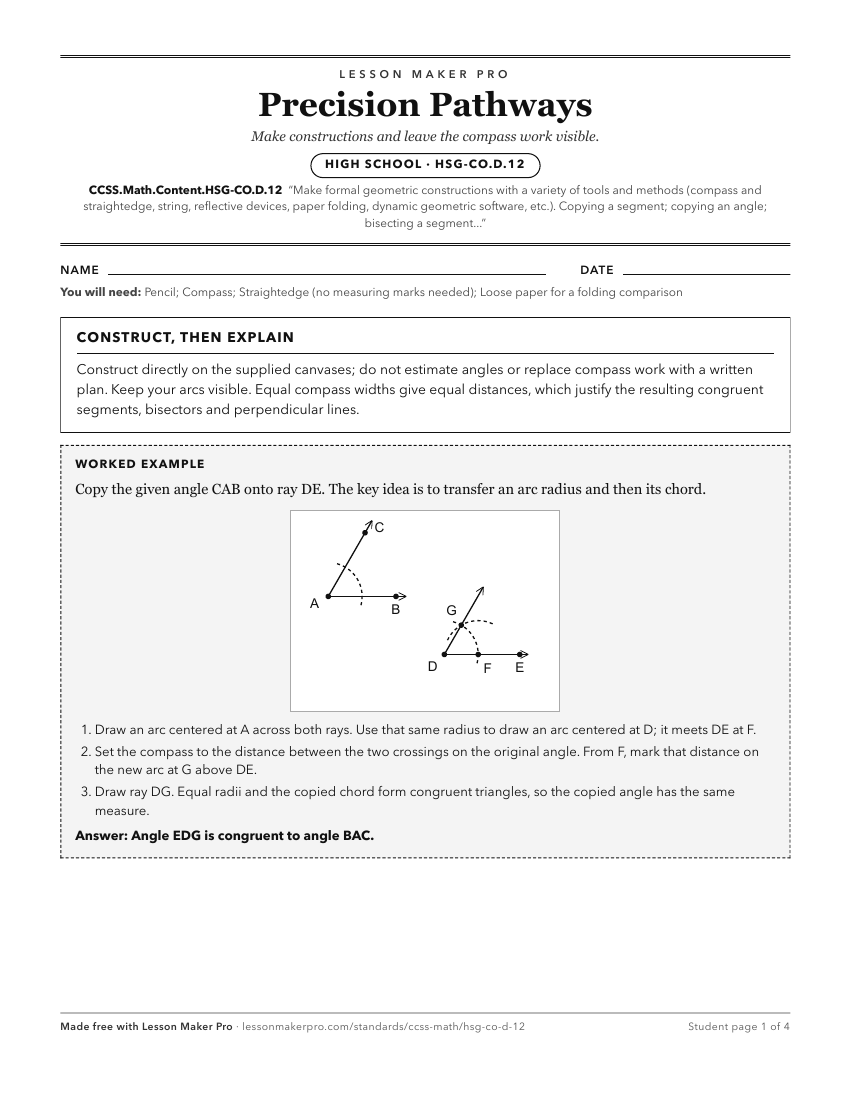
A ready-to-print activity worksheet aligned to CCSS.Math.Content.HSG-CO.D.12, with an answer key for the teacher on its own page. No account needed.
PDF, US Letter, prints cleanly in black and white.
Download the worksheetLearning progression
Where This Standard Sits
Before This Standard
If students are struggling here, check these first.
- CCSS.Math.Content.HSG-CO.A.1
Constructions require recognizing segments, angles, perpendicular lines, parallel lines, and circles as the objects being copied or created.
- CCSS.Math.Content.8.G.A.5
Angle relationships with parallel lines help students justify angle copying and constructing a parallel line through a point.
- CCSS.Math.Content.7.G.A.2
Interpreting geometric conditions and drawing figures with tools supports later exact constructions, though the high school routines are more formal and specific.
What This Unlocks
Mastery here sets students up for these next.
- CCSS.Math.Content.HSG-CO.D.13
Basic compass and straightedge skills, especially copying lengths and making perpendiculars, support constructing regular polygons inside a circle.
- CCSS.Math.Content.HSG-C.A.3
Angle and perpendicular bisector constructions carry directly into locating a triangle’s incenter and circumcenter for the required circles.
- CCSS.Math.Content.HSG-C.A.4
Constructing an outside tangent uses formal construction moves like making a midpoint or perpendicular bisector before drawing the tangent lines.
Keep exploring
Related Standards
- CCSS.Math.Content.7.G.A
Draw, construct, and describe geometrical figures and describe the relationships between them.
- CCSS.Math.Content.HSG-CO.D
Make geometric constructions
- CCSS.Math.Content.HSG-MG.A.3
Apply geometric methods to solve design problems (e.g., designing an object or structure to satisfy physical constraints or minimize cost; working with typograp...
Turn this exact standard into a lesson
Grade, subject, topic, and the complete standard are prefilled. Create one free, no account needed.
Also for this standard:Make a WorksheetMake a QuizMake a Sub Lesson