CCSS.
Standard Cluster
Apply geometric concepts in modeling situations
Common Core State Standards for Mathematics · High School — Geometry
Cluster contents
Standards in This Cluster
CCSS.Math.Content.HSG-MG.A is a cluster heading. These are the individual standards under it.
- CCSS.Math.Content.HSG-MG.A.1
Use geometric shapes, their measures, and their properties to describe objects (e.g., modeling a tree trunk or a human torso as a cylinder).
- CCSS.Math.Content.HSG-MG.A.2
Apply concepts of density based on area and volume in modeling situations (e.g., persons per square mile, BTUs per cubic foot).
- CCSS.Math.Content.HSG-MG.A.3
Apply geometric methods to solve design problems (e.g., designing an object or structure to satisfy physical constraints or minimize cost; working with typograp...
Teacher's field guide
What This Cluster Means
What Students Need to Do
- Students represent real objects with flat figures or solid shapes, then use scale, area, volume, and density to solve practical problems. They explain their assumptions and judge whether each result makes sense.
What Mastery Looks Like
- Students can choose a reasonable shape or combination of shapes for an unfamiliar object. They calculate with correct units, explain assumptions, and check whether the result is realistic.
Common Misconceptions
- Students often treat real objects as exact geometric solids and forget to state simplifying assumptions. They may confuse area with volume, ignore scale or units, or give answers with unrealistic precision.
How to Assess It
- Exit ticket: A cylindrical tank has radius 1.5 meters, height 4 meters, and is 80 percent full. Find the water volume in liters and state one modeling assumption.
Lesson moves
Ways to Teach It
Measure a soup can, model it as a cylinder, calculate label area and capacity, then compare capacity with water from a graduated cylinder.
Ask students to write which shapes best model a tent, including parts they would ignore and why.
Give teams object cards and formula cards, then score points for matching each object to a useful geometric model.
Use measurements from a school entrance to design a wheelchair ramp that meets a given slope limit and fits the available space.
Free download
Printable HSG-MG.A Worksheet
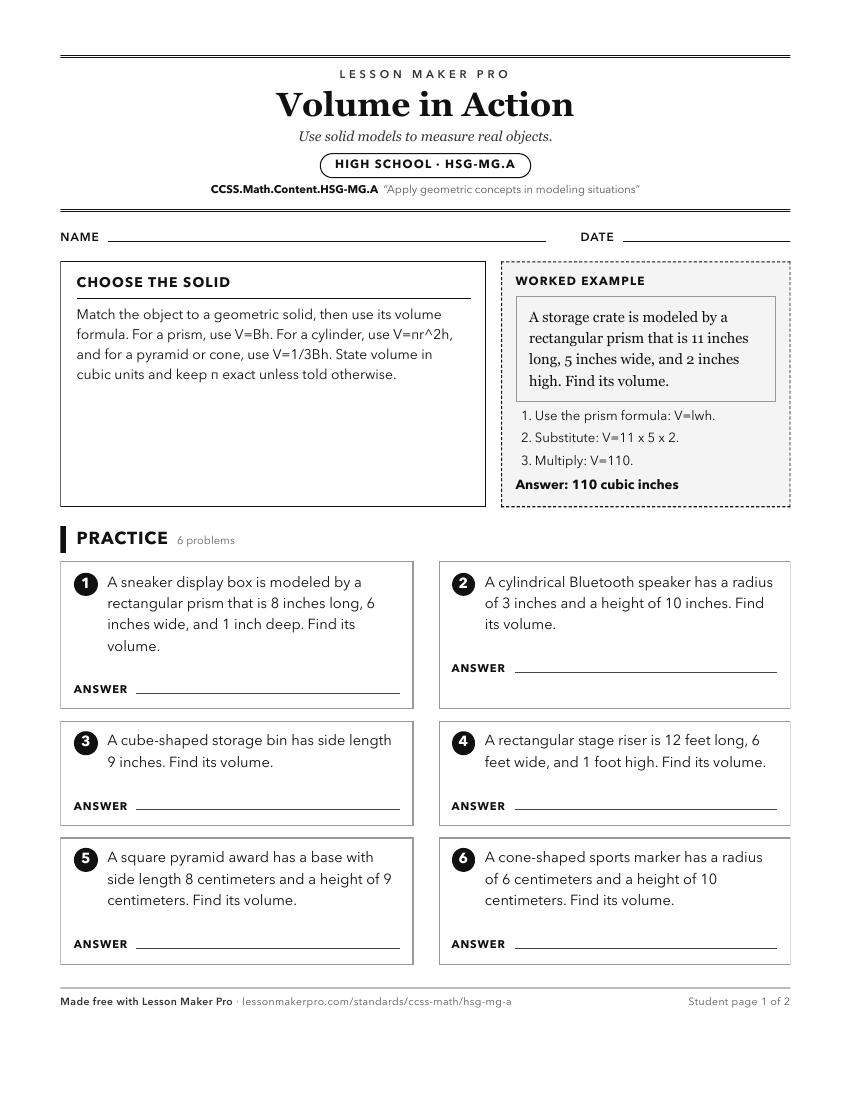
A ready-to-print activity worksheet aligned to CCSS.Math.Content.HSG-MG.A, with an answer key for the teacher on its own page. No account needed.
PDF, US Letter, prints cleanly in black and white.
Download the worksheetKeep exploring
Related Standards
Turn this cluster into a lesson
Grade, subject, topic, and the complete cluster are prefilled. Create one free, no account needed.
Also for this cluster:Make a WorksheetMake a QuizMake a Sub Lesson