CCSS.
The Standard
Define appropriate quantities for the purpose of descriptive modeling.
Common Core State Standards for Mathematics · Quantities
Teacher's field guide
What This Standard Means
What Students Need to Do
- Students decide what measurable features of a situation are needed to build a useful model. They name those quantities clearly, choose units, and connect them to the question being studied.
What Mastery Looks Like
- Students choose quantities that match the question and leave out unrelated information. They define clear variable names, assign sensible units, and explain how each quantity helps describe the situation.
Common Misconceptions
- Students may list every available measurement instead of choosing quantities tied to the question. They may confuse a quantity with its unit, or name variables too vaguely to use in a model.
How to Assess It
- Exit ticket: To model cafeteria wait time, define three useful quantities, give each unit, and explain why each belongs in the model.
Lesson moves
Ways to Teach It
Give groups cups of hot water and ask them to define the quantities needed to model cooling over ten minutes.
Ask students to write which quantities would help predict concert ticket revenue and explain why each one matters.
Play a sorting game where students place quantity cards under useful, unnecessary, or missing for a given modeling question.
Use a school bus route map and schedule to define quantities for modeling total travel time and fuel use.
Free download
Printable HSN-Q.A.2 Worksheet
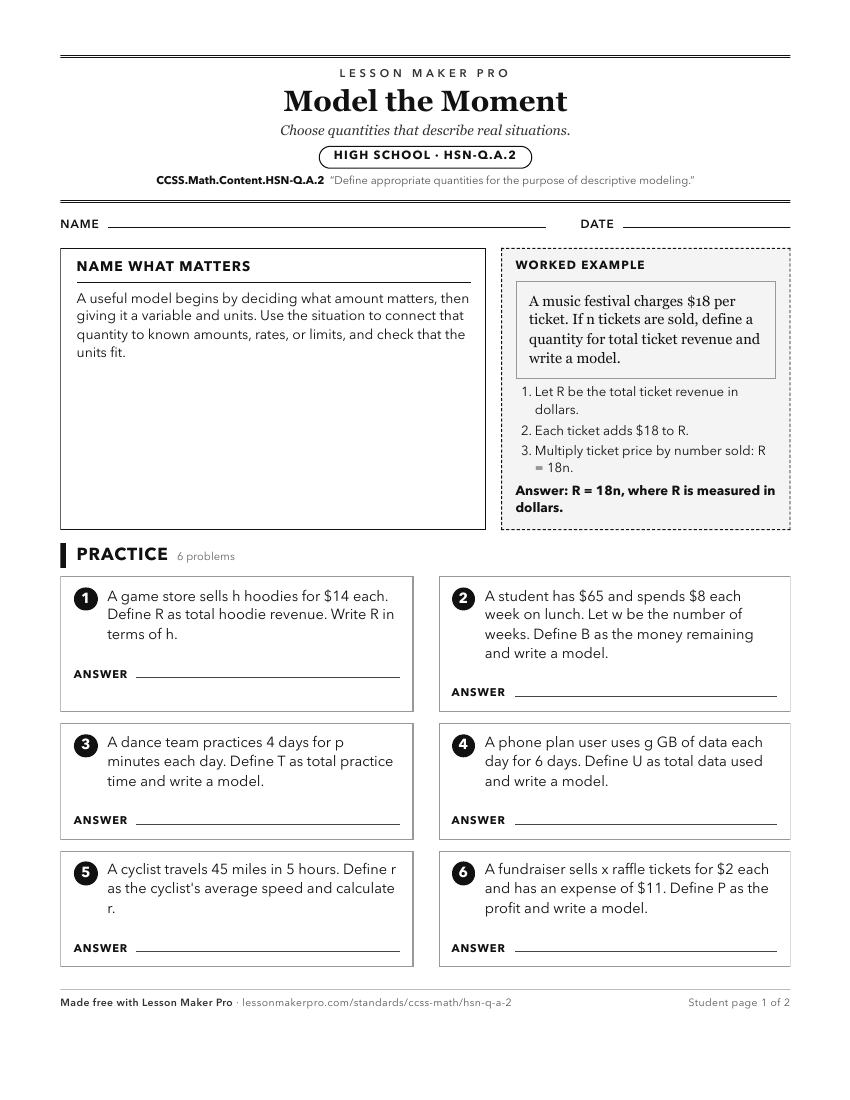
A ready-to-print activity worksheet aligned to CCSS.Math.Content.HSN-Q.A.2, with an answer key for the teacher on its own page. No account needed.
PDF, US Letter, prints cleanly in black and white.
Download the worksheetLearning progression
Where This Standard Sits
Before This Standard
If students are struggling here, check these first.
What This Unlocks
Mastery here sets students up for these next.
- CCSS.Math.Content.HSG-MG.A.1
Choosing relevant quantities such as height, radius, or volume supports representing real objects with geometric models and measurements.
- CCSS.Math.Content.HSA-CED.A.2
Choosing meaningful variables and units supports writing and graphing equations that represent relationships between real quantities.
- CCSS.Math.Content.HSN-Q.A.3
Students must identify the relevant quantities and units before deciding how precisely those measured quantities should be reported.
- CCSS.Math.Content.HSF-BF.A.1a
Choosing relevant quantities and variables supports turning a context into an explicit formula, recursive rule, or calculation steps.
- CCSS.Math.Content.HSG-MG.A.3
Choosing relevant quantities, units, and constraints supports setting up geometric design models to meet limits or minimize cost.
- CCSS.Math.Content.HSN-VM.A.1
Choosing and naming relevant quantities supports distinguishing vector quantities from scalar ones and labeling their magnitudes in models.
Keep exploring
Related Standards
Turn this exact standard into a lesson
Grade, subject, topic, and the complete standard are prefilled. Create one free, no account needed.
Also for this standard:Make a WorksheetMake a QuizMake a Sub Lesson