CCSS.
The Standard
Measure volumes by counting unit cubes, using cubic cm, cubic in, cubic ft, and improvised units.
Common Core State Standards for Mathematics · Measurement and Data
Teacher's field guide
What This Standard Means
What Students Need to Do
- Students fill or model a solid with same-size cubes, then find how many cubes occupy the space. They record the volume with an appropriate cubic unit.
What Mastery Looks Like
- Given a cube-built solid, students count every cube once, including hidden cubes, and report the total accurately. They choose and write an appropriate cubic unit.
Common Misconceptions
- Students may count only the visible cubes and miss cubes inside or behind the model. They may count faces instead of cubes, or label volume with linear or square units.
How to Assess It
- Exit ticket: Draw a 3 by 2 by 2 rectangular prism made of unit cubes. Ask, "How many cubes fill it, and what is its volume in cubic units?"
Lesson moves
Ways to Teach It
Give pairs centimeter cubes and small boxes; students fill each box without gaps, count the cubes, and label its volume.
Show a cube stack with hidden cubes and ask, "How can you prove how many cubes are inside?"
Play Volume Build: call a target volume, and teams build two different cube structures with that volume.
Compare a shoebox and tissue box using identical linking cubes, then decide which holds more and explain the evidence.
Free download
Printable 5.MD.C.4 Worksheet
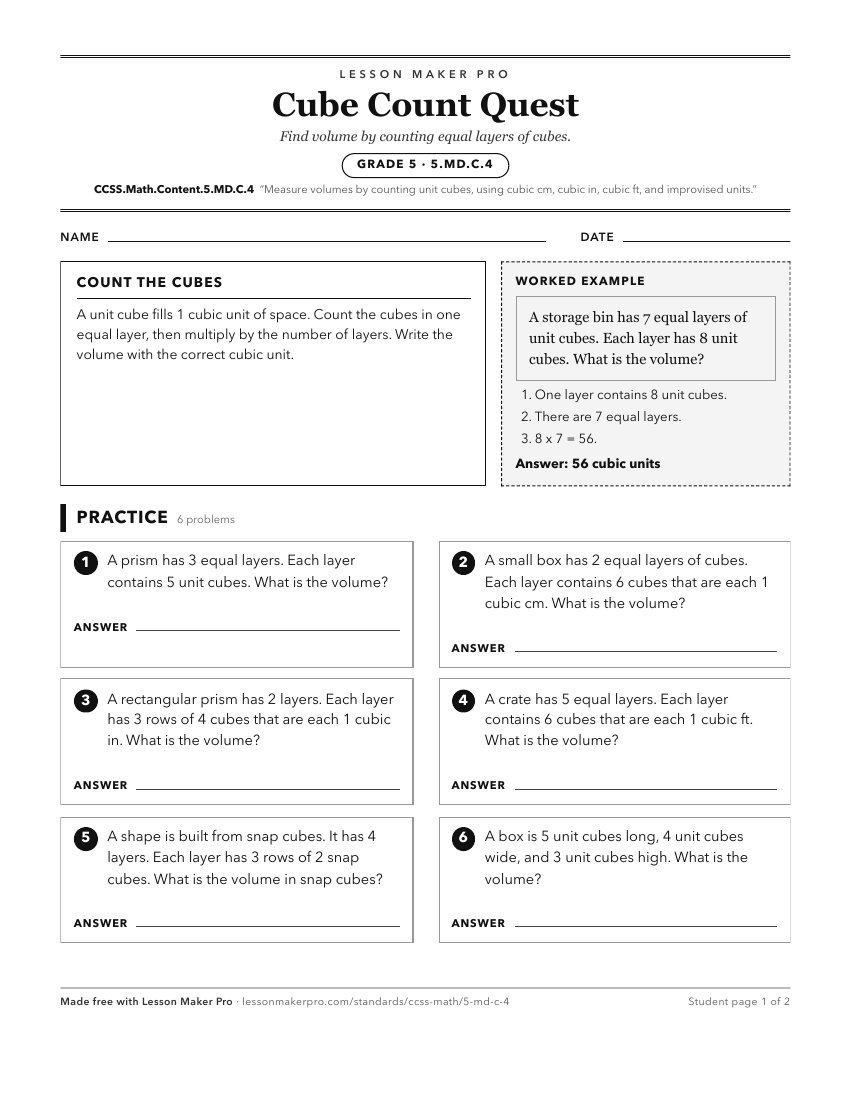
A ready-to-print activity worksheet aligned to CCSS.Math.Content.5.MD.C.4, with an answer key for the teacher on its own page. No account needed.
PDF, US Letter, prints cleanly in black and white.
Download the worksheetLearning progression
Where This Standard Sits
See the whole path on the Measurement & Data progression map.
Before This Standard
If students are struggling here, check these first.
- CCSS.Math.Content.5.MD.C.3a
Counting cubes for volume requires knowing that each unit cube represents one cubic unit of space.
- CCSS.Math.Content.5.MD.C.3b
Counting cubes to measure volume depends on knowing each gapless, nonoverlapping unit cube packing gives the solid’s cubic-unit volume.
- CCSS.Math.Content.3.MD.C.6
Counting unit squares for area carries over to counting equal-sized unit cubes to measure three-dimensional space.
What This Unlocks
Mastery here sets students up for these next.
Keep exploring
Related Standards
- CCSS.Math.Content.2.MD.A.3
Estimate lengths using units of inches, feet, centimeters, and meters.
- CCSS.Math.Content.2.MD.A
Measure and estimate lengths in standard units.
- CCSS.Math.Content.3.MD.A.2
Measure and estimate liquid volumes and masses of objects using standard units of grams (g), kilograms (kg), and liters (l). Add, subtract, multiply, or divide ...
Turn this exact standard into a lesson
Grade, subject, topic, and the complete standard are prefilled. Create one free, no account needed.
Also for this standard:Make a WorksheetMake a QuizMake a Sub Lesson