CCSS.
Standard Cluster
Measure and estimate lengths in standard units.
Common Core State Standards for Mathematics
Cluster contents
Standards in This Cluster
CCSS.Math.Content.2.MD.A is a cluster heading. These are the individual standards under it.
- CCSS.Math.Content.2.MD.A.1
Measure the length of an object by selecting and using appropriate tools such as rulers, yardsticks, meter sticks, and measuring tapes.
- CCSS.Math.Content.2.MD.A.2
Measure the length of an object twice, using length units of different lengths for the two measurements; describe how the two measurements relate to the size of...
- CCSS.Math.Content.2.MD.A.3
Estimate lengths using units of inches, feet, centimeters, and meters.
- CCSS.Math.Content.2.MD.A.4
Measure to determine how much longer one object is than another, expressing the length difference in terms of a standard length unit.
Teacher's field guide
What This Cluster Means
What Students Need to Do
- Students estimate and measure lengths with rulers, yardsticks, meter sticks, and measuring tapes. They use inches, feet, centimeters, and meters, then compare measurements and find length differences.
What Mastery Looks Like
- Students choose a suitable tool and unit, line up the zero mark, and report an accurate length with a unit label. They make reasonable estimates and explain why smaller units produce larger measurement numbers.
Common Misconceptions
- Students may begin at the ruler’s edge instead of the zero mark, or leave gaps when placing repeated units. They may mix units, omit the unit label, or assume a larger measurement number means a longer object.
How to Assess It
- Give students a pencil and a ruler. Ask them to estimate its length, measure it to the nearest unit, label the unit, and find the difference from their estimate.
Lesson moves
Ways to Teach It
Set out rulers, meter sticks, tape measures, and six classroom objects; students choose a tool, estimate, measure, and record each length.
Ask why the same desk has a larger measurement in centimeters than inches; students write and share an explanation.
Play Measurement Match: students pair object cards with reasonable estimates, then measure the real objects to score a point.
Have students measure a shelf space and three bins, then decide which bins fit and explain using recorded lengths.
Free download
Printable 2.MD.A Worksheet
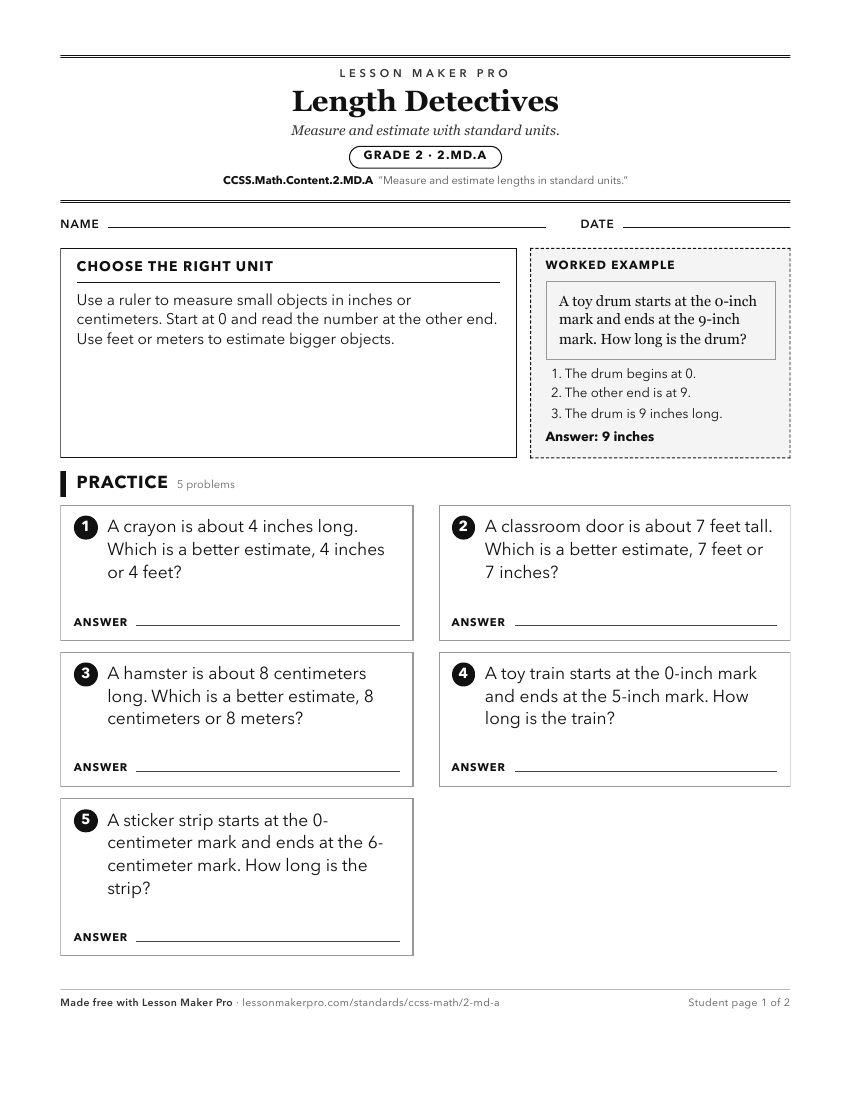
A ready-to-print activity worksheet aligned to CCSS.Math.Content.2.MD.A, with an answer key for the teacher on its own page. No account needed.
PDF, US Letter, prints cleanly in black and white.
Download the worksheetKeep exploring
Related Standards
Turn this cluster into a lesson
Grade, subject, topic, and the complete cluster are prefilled. Create one free, no account needed.
Also for this cluster:Make a WorksheetMake a QuizMake a Sub Lesson