CCSS.
The Standard
Estimate lengths using units of inches, feet, centimeters, and meters.
Common Core State Standards for Mathematics · Measurement and Data
Teacher's field guide
What This Standard Means
What Students Need to Do
- Students make sensible length estimates without measuring first. They choose an appropriate unit and compare the object with a familiar benchmark, such as a ruler or meter stick.
What Mastery Looks Like
- Students choose a sensible unit for an object and make a reasonable estimate. They use benchmarks, such as a ruler length or meter stick, to explain their estimate.
Common Misconceptions
- Students may confuse inches with feet or centimeters with meters. They may guess without using a known length, or think an estimate must match the exact measurement.
How to Assess It
- Show students a classroom book. Ask them to estimate its length in inches and centimeters, then write the benchmark they used.
Lesson moves
Ways to Teach It
Give pairs an inch tile, foot-long string, centimeter strip, and meter strip to estimate matching classroom objects before measuring.
Ask: Which unit fits a pencil, doorway, and playground, and what known length helps you estimate each one?
Play Estimate and Reveal: teams view an object, record a length and unit, then score a point for landing within a reasonable range.
Have students estimate the ribbon needed to wrap a small gift, then measure and compare the estimate with the actual length.
Free download
Printable 2.MD.A.3 Worksheet
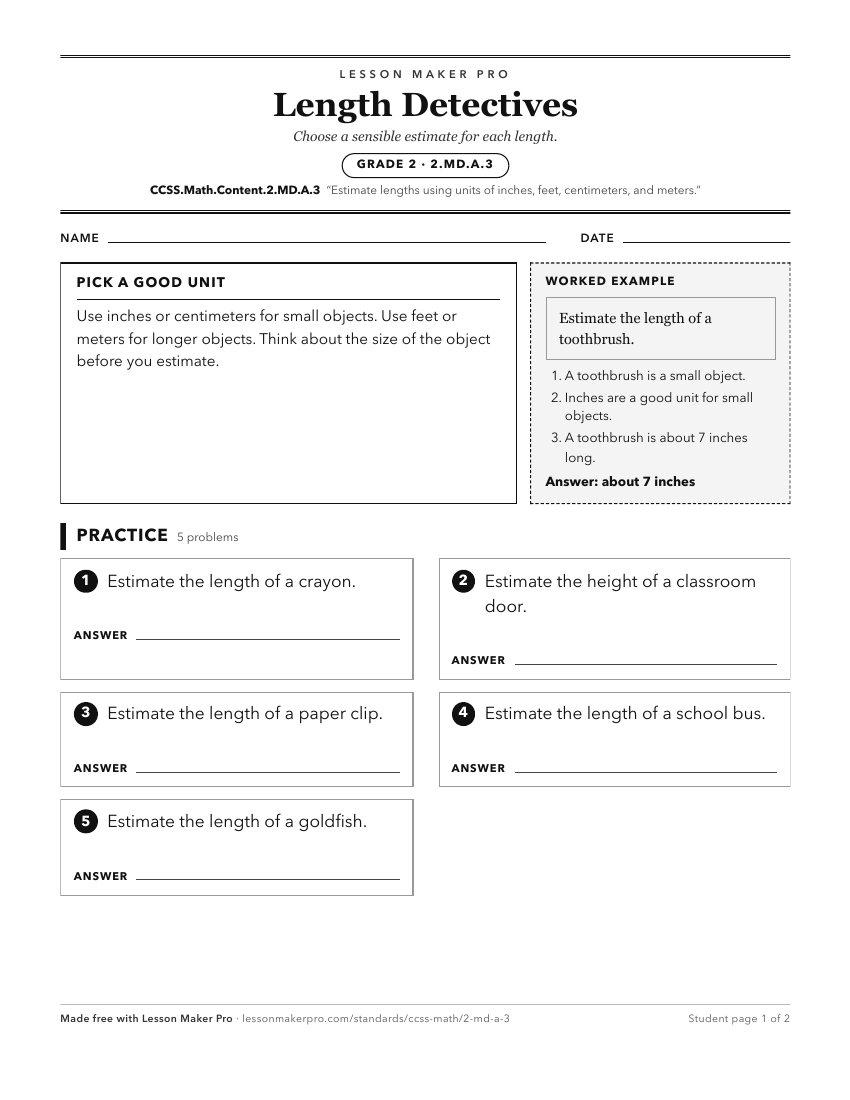
A ready-to-print activity worksheet aligned to CCSS.Math.Content.2.MD.A.3, with an answer key for the teacher on its own page. No account needed.
PDF, US Letter, prints cleanly in black and white.
Download the worksheetLearning progression
Where This Standard Sits
See the whole path on the Measurement & Data progression map.
Before This Standard
If students are struggling here, check these first.
- CCSS.Math.Content.1.MD.A.2
Estimating inches, feet, centimeters, and meters depends on knowing that length is counted by equal units spanning an object.
- CCSS.Math.Content.2.MD.A.1
Using rulers and meter sticks gives students unit benchmarks that support estimating lengths in inches, feet, centimeters, and meters.
- CCSS.Math.Content.K.MD.A.1
Recognizing length as a measurable attribute helps students make sense of estimating lengths with standard units.
Keep exploring
Related Standards
- CCSS.Math.Content.5.MD.C.4
Measure volumes by counting unit cubes, using cubic cm, cubic in, cubic ft, and improvised units.
- CCSS.Math.Content.1.MD.A
Measure lengths indirectly and by iterating length units.
- CCSS.Math.Content.3.MD.C.6
Measure areas by counting unit squares (square cm, square m, square in, square ft, and improvised units).
- CCSS.Math.Content.2.MD.A
Measure and estimate lengths in standard units.
Turn this exact standard into a lesson
Grade, subject, topic, and the complete standard are prefilled. Create one free, no account needed.
Also for this standard:Make a WorksheetMake a QuizMake a Sub Lesson