CCSS.
The Standard
Measure the length of an object by selecting and using appropriate tools such as rulers, yardsticks, meter sticks, and measuring tapes.
Common Core State Standards for Mathematics · Measurement and Data
Teacher's field guide
What This Standard Means
What Students Need to Do
- Students choose a measuring tool that fits the object they need to measure. They place and read the tool correctly, then state the length with a unit.
What Mastery Looks Like
- Students choose a ruler for a pencil, a yardstick or meter stick for furniture, and a tape for curved or large objects. They line up the zero mark, keep the tool straight, and report the length with the correct unit.
Common Misconceptions
- Students may start at the ruler’s edge instead of the zero mark. They may choose a short ruler for a long object, leave gaps when repositioning it, or mix inches and centimeters.
How to Assess It
- Give each student a pencil, a ruler, and a measuring tape. Ask, “Which tool fits best, and how long is the pencil?”
Lesson moves
Ways to Teach It
Set out classroom objects and measuring tools, then have pairs choose a tool, measure each object, and record the length and unit.
Ask students to write which tool they would use to measure a desk, doorway, and waist, then explain each choice.
Play Tool Match by having students match object cards to ruler, yardstick, meter stick, or measuring tape cards.
Measure items for a classroom reading corner, such as shelf width, rug length, and basket height, before planning where they fit.
Free download
Printable 2.MD.A.1 Worksheet
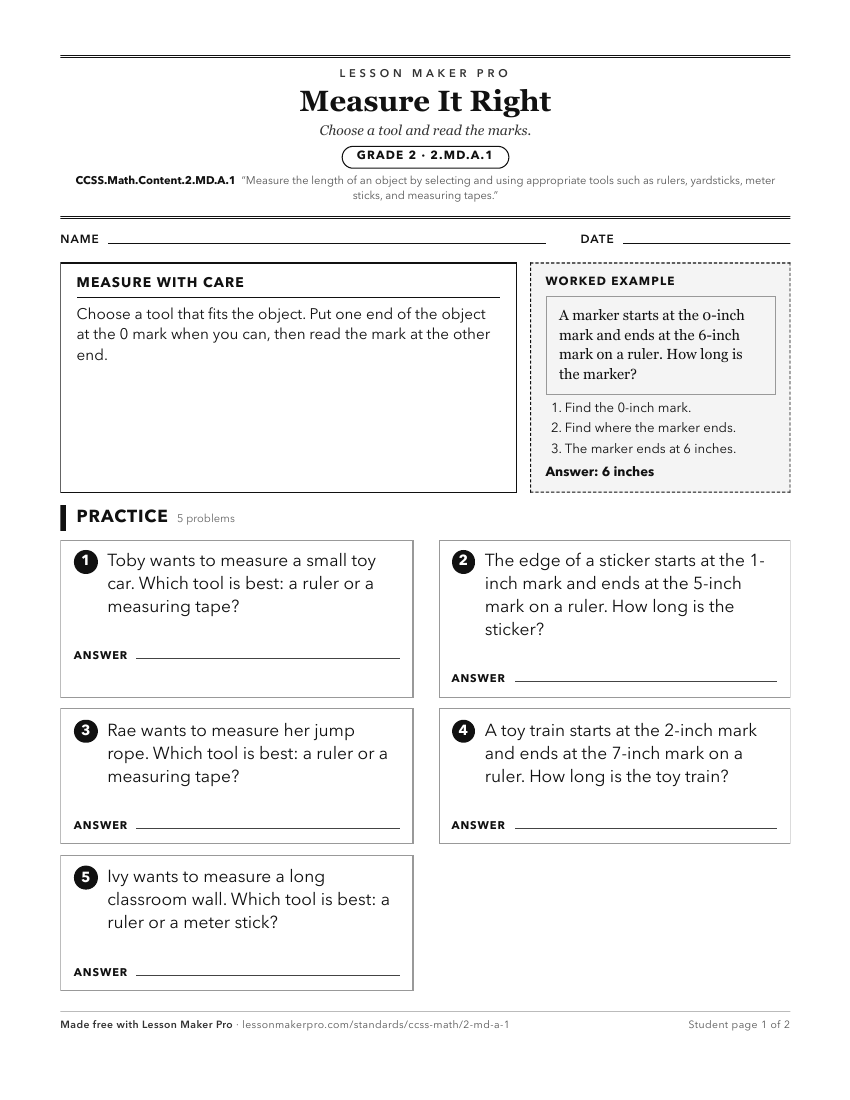
A ready-to-print activity worksheet aligned to CCSS.Math.Content.2.MD.A.1, with an answer key for the teacher on its own page. No account needed.
PDF, US Letter, prints cleanly in black and white.
Download the worksheetLearning progression
Where This Standard Sits
See the whole path on the Measurement & Data progression map.
Before This Standard
If students are struggling here, check these first.
- CCSS.Math.Content.1.NBT.A.1
Counting and reading numerals support using ruler marks and recording lengths, though tool use also requires separate measurement ideas.
- CCSS.Math.Content.1.MD.A.2
Ruler measuring depends on seeing length as equal units laid end to end with no gaps or overlaps.
- CCSS.Math.Content.K.MD.A.1
Recognizing length as a measurable attribute supports choosing a length tool and understanding what the measurement describes.
What This Unlocks
Mastery here sets students up for these next.
- CCSS.Math.Content.2.MD.A.3
Using rulers and meter sticks gives students unit benchmarks that support estimating lengths in inches, feet, centimeters, and meters.
- CCSS.Math.Content.3.MD.D.8
Measuring lengths with rulers supports finding polygon side lengths before adding them or using them to solve perimeter problems.
- CCSS.Math.Content.2.MD.A.2
Students must use length-measuring tools correctly before comparing measurements made with different-sized units.
- CCSS.Math.Content.2.MD.D.9
Students must choose and use rulers or similar tools before they can collect length data for a whole-unit line plot.
- CCSS.Math.Content.3.MD.A.2
Using measurement tools and standard units for length supports reading scaled containers and choosing units for mass and volume.
- CCSS.Math.Content.3.MD.B.4
Students must already use rulers to measure length before measuring to halves and fourths and plotting those measurements.
Keep exploring
Related Standards
Turn this exact standard into a lesson
Grade, subject, topic, and the complete standard are prefilled. Create one free, no account needed.
Also for this standard:Make a WorksheetMake a QuizMake a Sub Lesson