CCSS.
The Standard
Measure and estimate liquid volumes and masses of objects using standard units of grams (g), kilograms (kg), and liters (l). Add, subtract, multiply, or divide to solve one-step word problems involving masses or volumes that are given in the same units, e.g., by using drawings (such as a beaker with a measurement scale) to represent the problem.
Common Core State Standards for Mathematics · Measurement and Data
Teacher's field guide
What This Standard Means
What Students Need to Do
- Students estimate and measure object masses in grams or kilograms and liquid volumes in liters. They solve one-step addition, subtraction, multiplication, and division problems using measurements in the same unit.
What Mastery Looks Like
- Students choose grams, kilograms, or liters to match the item being measured. They make reasonable estimates, measure accurately, and solve one-step problems using the same units.
Common Misconceptions
- Students may use liters for mass or grams for liquid volume. They may confuse grams and kilograms, misread scale marks, or choose an answer that is not reasonable for the object.
How to Assess It
- Set out a book, a water bottle, a balance, and a liter measure. Ask students to estimate and measure each, then solve: “Three books each have a mass of 400 g. What is their total mass?”
Lesson moves
Ways to Teach It
Set up a balance, gram weights, and liter containers so students can estimate, measure, record, and compare classroom objects and liquids.
Students answer and defend: Would you measure a watermelon in grams or kilograms, and a fish tank in liters?
Play Measurement Match by pairing object cards with estimates in grams, kilograms, or liters, then solving one-step problem cards.
Use grocery packages to write and solve questions about combined mass, remaining volume, equal groups, and equal shares.
Free download
Printable 3.MD.A.2 Worksheet
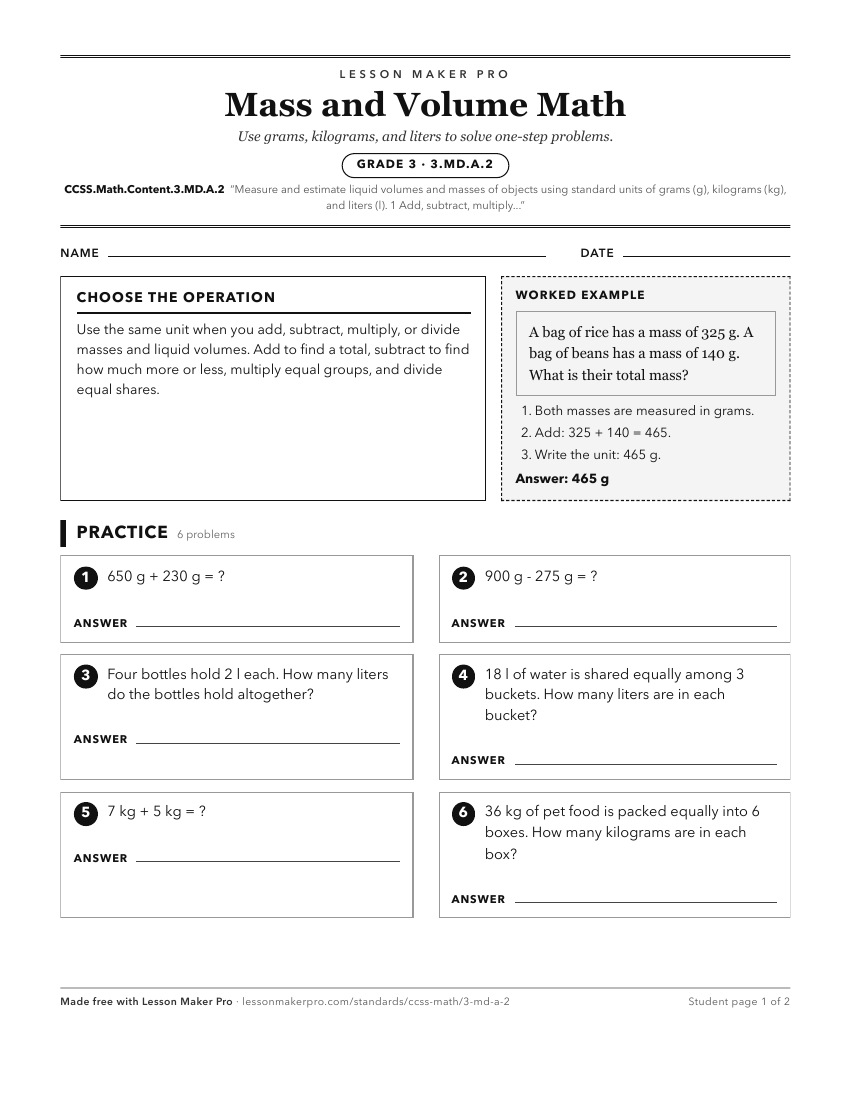
A ready-to-print activity worksheet aligned to CCSS.Math.Content.3.MD.A.2, with an answer key for the teacher on its own page. No account needed.
PDF, US Letter, prints cleanly in black and white.
Download the worksheetLearning progression
Where This Standard Sits
See the whole path on the Measurement & Data progression map.
Before This Standard
If students are struggling here, check these first.
- CCSS.Math.Content.2.MD.A.1
Using measurement tools and standard units for length supports reading scaled containers and choosing units for mass and volume.
- CCSS.Math.Content.3.OA.A.3
Multiplication and division word-problem models with measurement quantities carry over to mass and volume problems in grams, kilograms, and liters.
- CCSS.Math.Content.2.MD.B.5
Solving same-unit length problems with drawings and equations supports solving same-unit mass and volume problems with broader operations.
What This Unlocks
Mastery here sets students up for these next.
- CCSS.Math.Content.4.MD.A.1
Experience measuring and solving with grams, kilograms, and liters supports understanding related unit sizes and conversions in grade 4.
- CCSS.Math.Content.4.MD.A.2
Solving one-step mass and volume problems with scaled drawings supports later multi-operation measurement problems, diagrams, and unit conversions.
Keep exploring
Related Standards
- CCSS.Math.Content.5.MD.C.4
Measure volumes by counting unit cubes, using cubic cm, cubic in, cubic ft, and improvised units.
- CCSS.Math.Content.3.MD.A
Solve problems involving measurement and estimation of intervals of time, liquid volumes, and masses of objects.
- CCSS.Math.Content.2.MD.A
Measure and estimate lengths in standard units.
Turn this exact standard into a lesson
Grade, subject, topic, and the complete standard are prefilled. Create one free, no account needed.
Also for this standard:Make a WorksheetMake a QuizMake a Sub Lesson