CCSS.
The Standard
Express the length of an object as a whole number of length units, by laying multiple copies of a shorter object (the length unit) end to end; understand that the length measurement of an object is the number of same-size length units that span it with no gaps or overlaps.
Common Core State Standards for Mathematics · Measurement and Data
Teacher's field guide
What This Standard Means
What Students Need to Do
- Students measure an object's length by placing equal-sized units in a straight row from one end to the other. They use no gaps or overlaps, then count the units and name the length.
What Mastery Looks Like
- Students place equal-sized units end to end from one endpoint to the other, with no gaps or overlaps. They count the units once and state the length as a whole number of those units.
Common Misconceptions
- Students may leave gaps, overlap units, or start measuring past the object's endpoint. They may mix different-sized units or count boundary lines instead of the units placed.
How to Assess It
- Give each student a pencil and identical connecting cubes. Ask, “How many cubes long is the pencil?” and have students show the placement and write the measurement.
Lesson moves
Ways to Teach It
Have students measure classroom objects with identical connecting cubes, checking that each cube touches the next without overlapping.
Show two cube measurements, one correct and one with gaps, then ask students to explain which measurement is accurate and why.
Play Measure and Check: partners measure an object with tiles, then inspect each other's unit placement and recorded length.
Measure a book, lunchbox, and shoe with paper clips, then compare which object needs the most equal-sized units.
Free download
Printable 1.MD.A.2 Worksheet
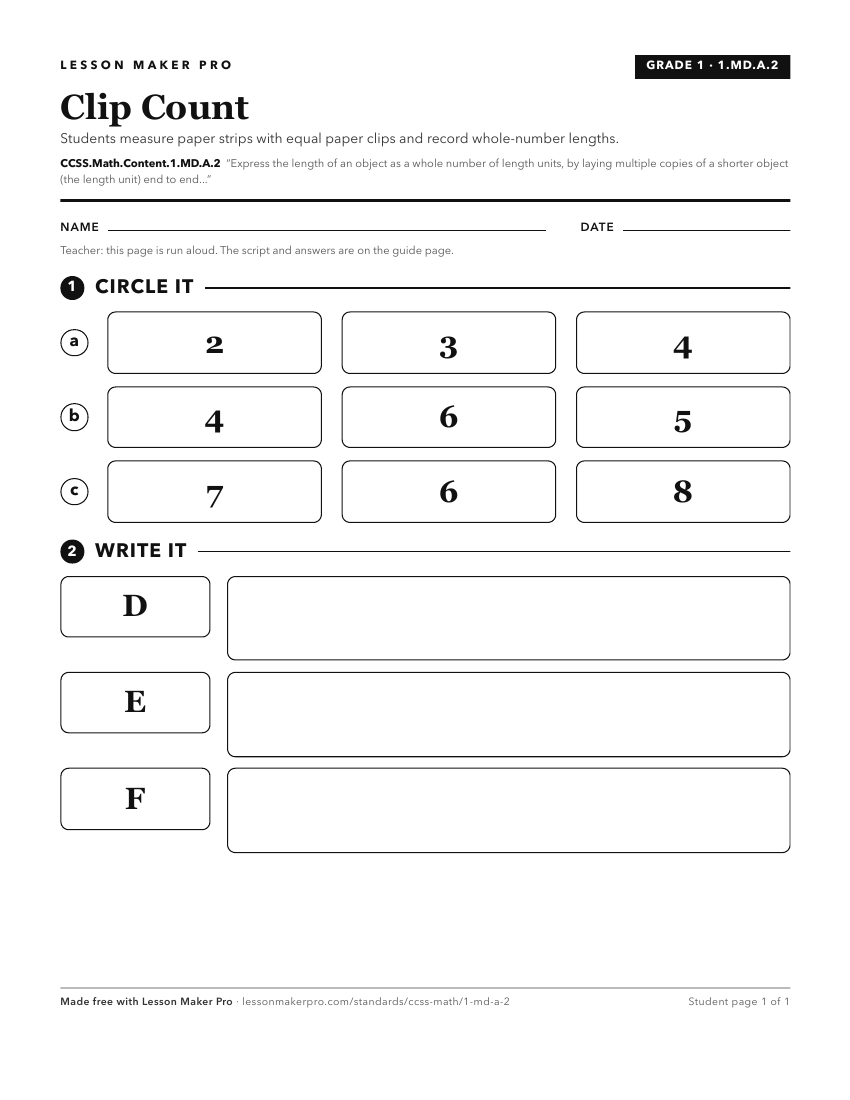
A ready-to-print activity worksheet aligned to CCSS.Math.Content.1.MD.A.2, with an answer key for the teacher on its own page. No account needed.
PDF, US Letter, prints cleanly in black and white.
Download the worksheetLearning progression
Where This Standard Sits
See the whole path on the Measurement & Data progression map.
Before This Standard
If students are struggling here, check these first.
- CCSS.Math.Content.K.MD.A.1
Recognizing length as a measurable attribute prepares students to use equal units to quantify how long an object is.
- CCSS.Math.Content.K.CC.B.4
Length measurement requires counting equal units and knowing the final count tells how many units span the object.
- CCSS.Math.Content.K.MD.A.2
Comparing objects by length prepares students to see length as an attribute before counting equal units along it.
What This Unlocks
Mastery here sets students up for these next.
- CCSS.Math.Content.2.MD.A.3
Estimating inches, feet, centimeters, and meters depends on knowing that length is counted by equal units spanning an object.
- CCSS.Math.Content.2.MD.A.1
Ruler measuring depends on seeing length as equal units laid end to end with no gaps or overlaps.
- CCSS.Math.Content.2.MD.B.5
Understanding length as equal units supports interpreting length word problems and drawings, though the target mainly uses addition and subtraction.
- CCSS.Math.Content.3.MD.C.5a
Length units laid end to end prepare students to see area as counting equal unit squares with no gaps or overlaps.
- CCSS.Math.Content.2.MD.A.2
Students use iteration of equal length units to understand why smaller units give larger counts and larger units give smaller counts.
- CCSS.Math.Content.2.MD.A.4
Comparing how much longer requires understanding length as equal units laid end to end, then subtracting or counting the extra units.
Keep exploring
Related Standards
Turn this exact standard into a lesson
Grade, subject, topic, and the complete standard are prefilled. Create one free, no account needed.
Also for this standard:Make a WorksheetMake a QuizMake a Sub Lesson