CCSS.
The Standard
A square with side length 1 unit, called "a unit square," is said to have "one square unit" of area, and can be used to measure area.
Common Core State Standards for Mathematics
Teacher's field guide
What This Standard Means
What Students Need to Do
- Students identify a 1-by-1 square as one square unit. They use copies of that square to measure how much surface a shape covers.
What Mastery Looks Like
- A student can label the area of a single unit square as one square unit. Given a tiled shape, the student counts each unit square once and reports the area in square units.
Common Misconceptions
- Students may call both the side length and the area 1 unit. They may count grid lines or corners instead of squares. Some leave gaps or overlap tiles and still treat the count as an area measure.
How to Assess It
- On an exit ticket, draw a rectangle covered by eight equal 1-by-1 squares. Ask students to give its area and explain what one small square represents.
Lesson moves
Ways to Teach It
Give pairs 1-inch paper squares to cover index cards without gaps or overlaps, then record each area in square inches.
Ask students to write why a square with sides of 1 centimeter measures one square centimeter, not one centimeter.
Play Grid Cover: students roll a number cube, cover that many grid squares, and state the total area after each turn.
Show a tiled classroom floor and ask how one floor tile could serve as a unit for measuring the floor’s area.
Free download
Printable 3.MD.C.5a Worksheet
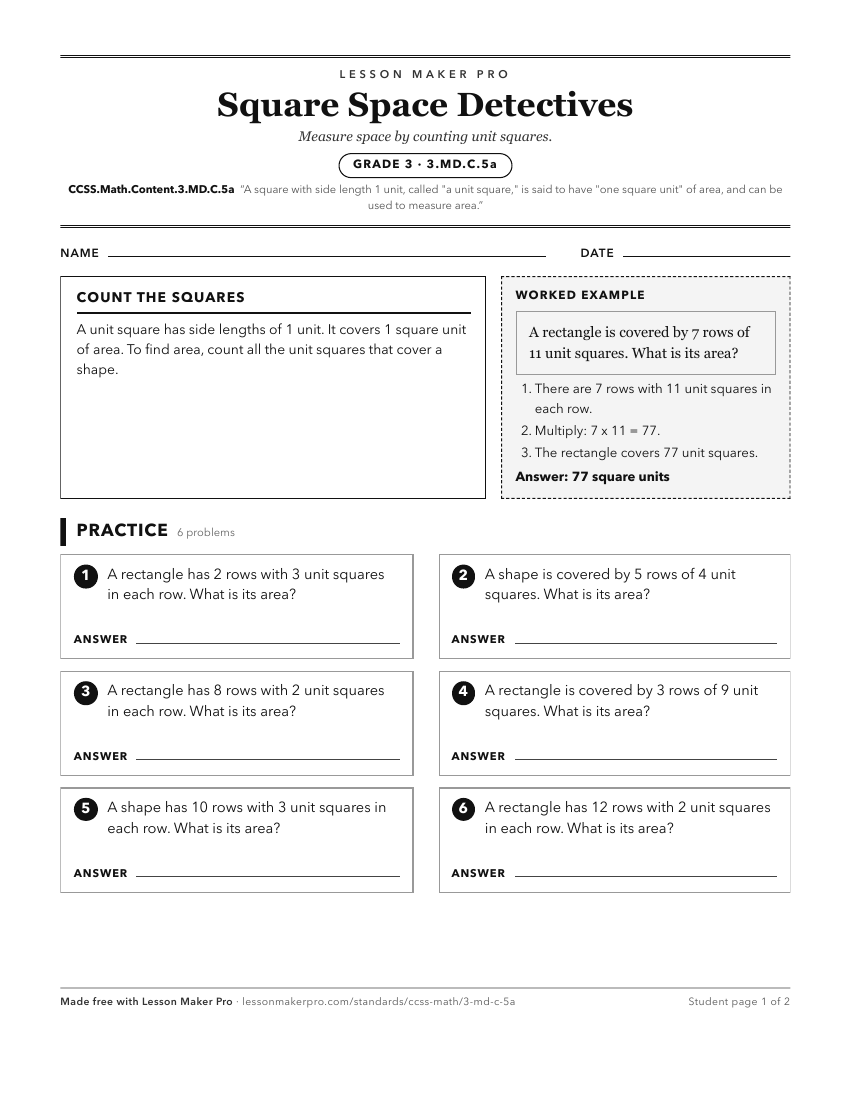
A ready-to-print activity worksheet aligned to CCSS.Math.Content.3.MD.C.5a, with an answer key for the teacher on its own page. No account needed.
PDF, US Letter, prints cleanly in black and white.
Download the worksheetLearning progression
Where This Standard Sits
Before This Standard
If students are struggling here, check these first.
- CCSS.Math.Content.1.MD.A.2
Length units laid end to end prepare students to see area as counting equal unit squares with no gaps or overlaps.
- CCSS.Math.Content.1.G.A.1
Recognizing squares by their defining attributes supports understanding a unit square as a specific square used to measure area.
- CCSS.Math.Content.2.G.A.2
Counting equal squares in rectangles prepares students to see a unit square as one area unit for measuring area.
What This Unlocks
Mastery here sets students up for these next.
- CCSS.Math.Content.5.MD.C.3a
Students extend the idea of measuring with one-unit shapes from unit squares for area to unit cubes for volume.
- CCSS.Math.Content.3.MD.C.5b
Students must understand one unit square as one area unit before counting unit squares to name a figure’s area.
- CCSS.Math.Content.3.MD.C.6
Counting unit squares to measure area requires knowing each 1-by-1 square represents one square unit of area.
Keep exploring
Related Standards
Turn this exact standard into a lesson
Grade, subject, topic, and the complete standard are prefilled. Create one free, no account needed.
Also for this standard:Make a WorksheetMake a QuizMake a Sub Lesson