CCSS.
The Standard
Understand the relationship between numbers and quantities; connect counting to cardinality.
Common Core State Standards for Mathematics · Counting and Cardinality
Teacher's field guide
What This Standard Means
What Students Need to Do
- Students match one spoken number to each object as they count. They use the final number as the total and connect one added object to the next counting number.
What Mastery Looks Like
- A student touches or moves each object once while counting in order. After counting, the student gives the total and knows that adding one object makes the next counting number.
Common Misconceptions
- Students may skip objects, count an object twice, or say numbers without matching each number to one object. They may think rearranging objects changes the total or fail to connect adding one object with the next number.
How to Assess It
- Place 7 counters on a mat and ask the student to count them and state the total. Add one counter, then ask for the new total and how they knew.
Lesson moves
Ways to Teach It
Have students slide 8 counters into a cup one at a time, saying one number for each counter, then state the total.
Show two differently arranged sets of 6 dots and ask, "Do they have the same total? How do you know?"
Students roll a die, build that many cubes, add one cube, and say the next counting number to earn a point.
At snack time, assign one napkin to each child, count the napkins, then add one for the teacher and name the new total.
Free download
Printable K.CC.B.4 Worksheet
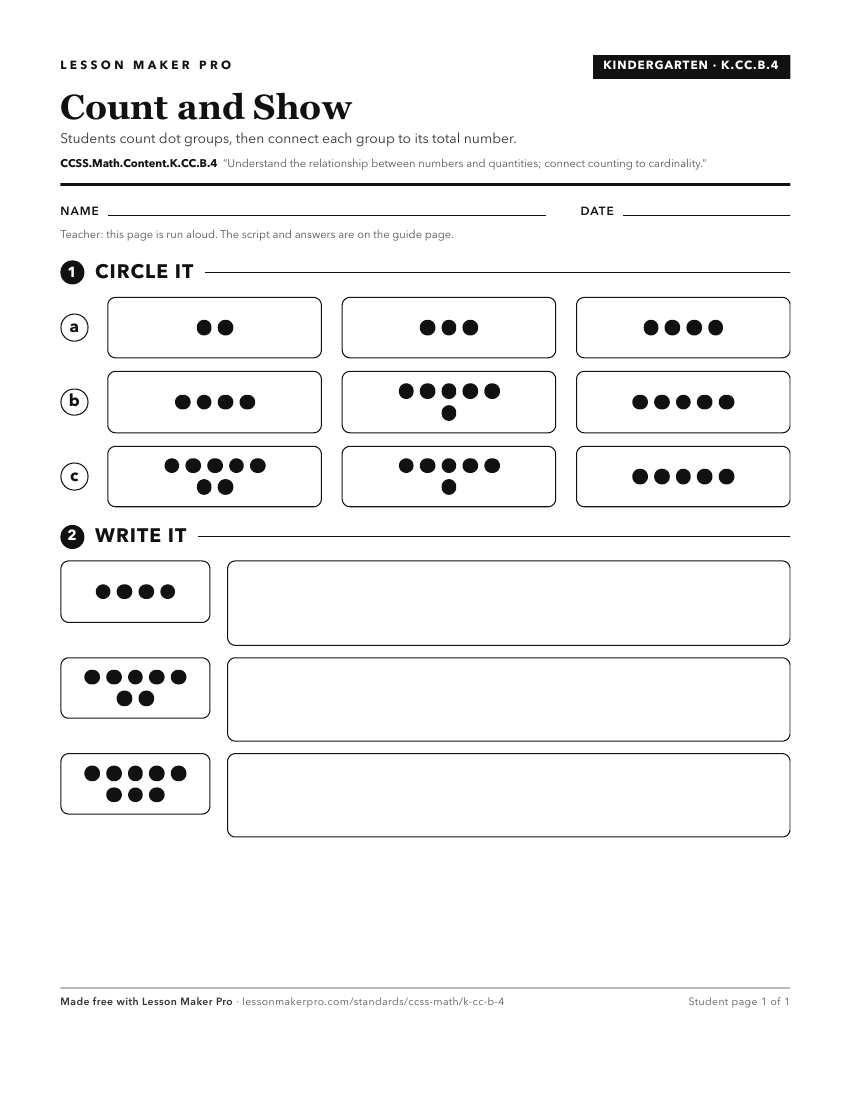
A ready-to-print activity worksheet aligned to CCSS.Math.Content.K.CC.B.4, with an answer key for the teacher on its own page. No account needed.
PDF, US Letter, prints cleanly in black and white.
Download the worksheetLearning progression
Where This Standard Sits
Before This Standard
If students are struggling here, check these first.
What This Unlocks
Mastery here sets students up for these next.
- CCSS.Math.Content.1.G.A.3
Counting and cardinality support seeing a whole as two or four shares and comparing the number of equal parts.
- CCSS.Math.Content.1.MD.A.2
Length measurement requires counting equal units and knowing the final count tells how many units span the object.
- CCSS.Math.Content.1.NBT.B.2a
Understanding that counting tells how many lets students see ten individual ones as the same quantity as one ten.
- CCSS.Math.Content.1.NBT.B.2
Place value depends on knowing that number words and written numbers name exact quantities that can be grouped into tens and ones.
- CCSS.Math.Content.K.OA.A.5
Fluently adding and subtracting within 5 depends on knowing that counted numbers represent quantities that can be combined or separated.
- CCSS.Math.Content.K.MD.B.3
Counting each category and comparing category sizes require knowing that the last count tells how many objects are in the set.
Keep exploring
Related Standards
Turn this exact standard into a lesson
Grade, subject, topic, and the complete standard are prefilled. Create one free, no account needed.
Also for this standard:Make a WorksheetMake a QuizMake a Sub Lesson