CCSS.
The Standard
When counting objects, say the number names in the standard order, pairing each object with one and only one number name and each number name with one and only one object.
Common Core State Standards for Mathematics
Teacher's field guide
What This Standard Means
What Students Need to Do
- Students touch, point to, or move each object as they count aloud in order. They keep track so no object is skipped or counted twice.
What Mastery Looks Like
- A student points to or moves items one at a time while saying number words in order. The count is accurate, even when objects are scattered.
Common Misconceptions
- Students may say number words faster than they touch or move objects. They may skip an object, count one twice, or use two number words for one object.
How to Assess It
- Place nine counters in a scattered group. Ask each student to count them aloud while you note whether every counter gets one count.
Lesson moves
Ways to Teach It
Give pairs 12 counters and an egg carton; students place one counter in each cup while counting aloud.
Show a messy group of buttons and ask, "How could you count these without missing any or counting one twice?"
Play Count and Cover: students draw a number card, move that many cubes onto a mat, and partner-check each move.
Have students count plates, cups, or napkins while setting a classroom snack table, touching each item once.
Free download
Printable K.CC.B.4a Worksheet
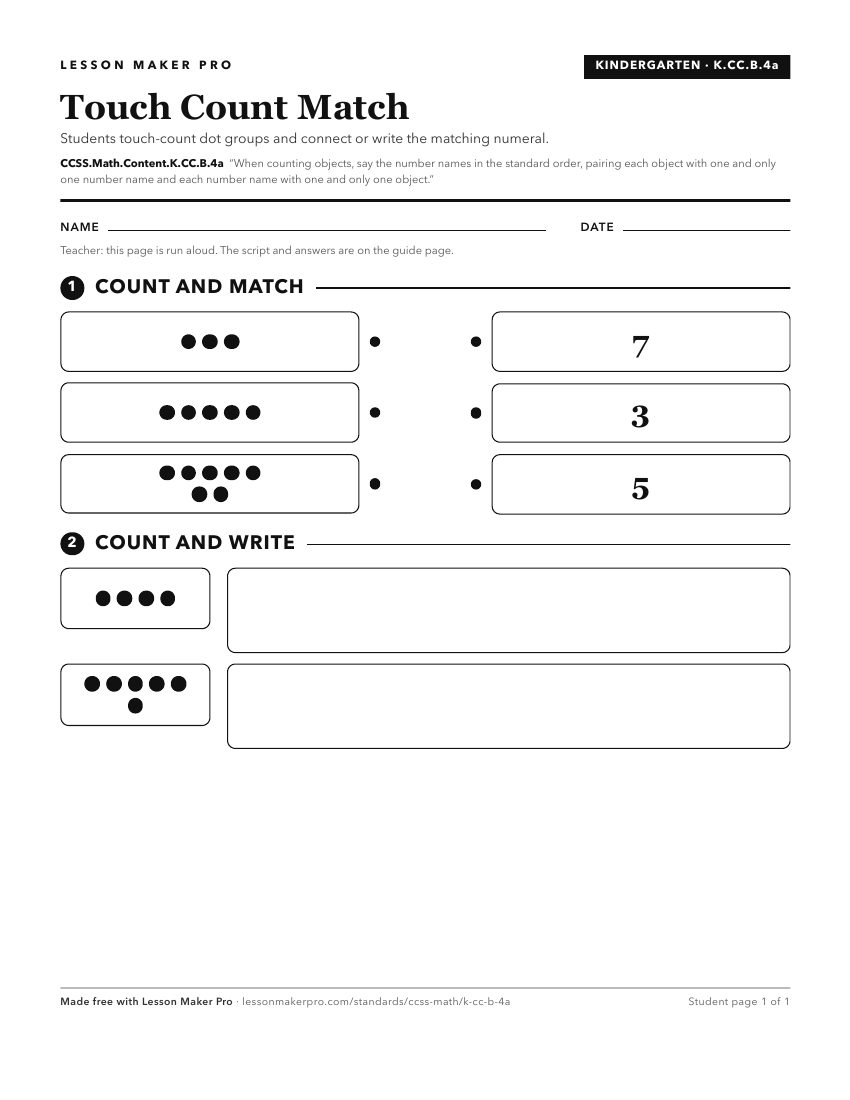
A ready-to-print activity worksheet aligned to CCSS.Math.Content.K.CC.B.4a, with an answer key for the teacher on its own page. No account needed.
PDF, US Letter, prints cleanly in black and white.
Download the worksheetLearning progression
Where This Standard Sits
Before This Standard
If students are struggling here, check these first.
What This Unlocks
Mastery here sets students up for these next.
- CCSS.Math.Content.K.CC.B.4c
One-to-one counting helps students see that adding one more object moves the count to the next number name.
- CCSS.Math.Content.K.CC.B.4b
Accurate one-to-one counting is needed before the last count word can reliably name the total set size.
- CCSS.Math.Content.K.CC.B.5
Answering “how many” and counting out sets require one-to-one pairing of number words with objects while counting.
- CCSS.Math.Content.K.CC.A.3
One-to-one counting helps students find how many objects a written numeral should represent, though numeral writing can begin separately.
- CCSS.Math.Content.K.CC.C.6
Accurate one-to-one counting supports finding each group’s amount before deciding which has more, less, or the same.
- CCSS.Math.Content.K.CC.B.4
One-to-one pairing of number words to objects is essential for connecting counting words to the quantity counted.
Keep exploring
Related Standards
Turn this exact standard into a lesson
Grade, subject, topic, and the complete standard are prefilled. Create one free, no account needed.
Also for this standard:Make a WorksheetMake a QuizMake a Sub Lesson