CCSS.
Standard Cluster
Classify objects and count the number of objects in each category.
Common Core State Standards for Mathematics
Cluster contents
Standards in This Cluster
CCSS.Math.Content.K.MD.B is a cluster heading. These are the individual standards under it.
Teacher's field guide
What This Cluster Means
What Students Need to Do
- Students sort objects into groups based on a shared feature, such as color, shape, size, or use. They name the groups and count the objects in each one.
What Mastery Looks Like
- Students sort objects consistently using one clear feature and explain why each object belongs. They count each group accurately and record or state the total.
Common Misconceptions
- Students may change the sorting rule halfway through or place objects by preference instead of a shared feature. They may skip objects, count one twice, or assume the largest group has the most items.
How to Assess It
- Give each student eight mixed buttons. Ask them to sort by color, name each group, and write or say how many are in each group.
Lesson moves
Ways to Teach It
Give pairs a tray of buttons to sort by color, label each group, and count the buttons in every group.
Show six shape cards and ask, “What sorting rule did you use, and where would this new card belong?”
Play Category Grab by having students draw object cards, place them in labeled groups, and count each group after ten turns.
Sort classroom recycling into paper, plastic, and metal bins, then count and record each total on a class chart.
Free download
Printable K.MD.B Worksheet
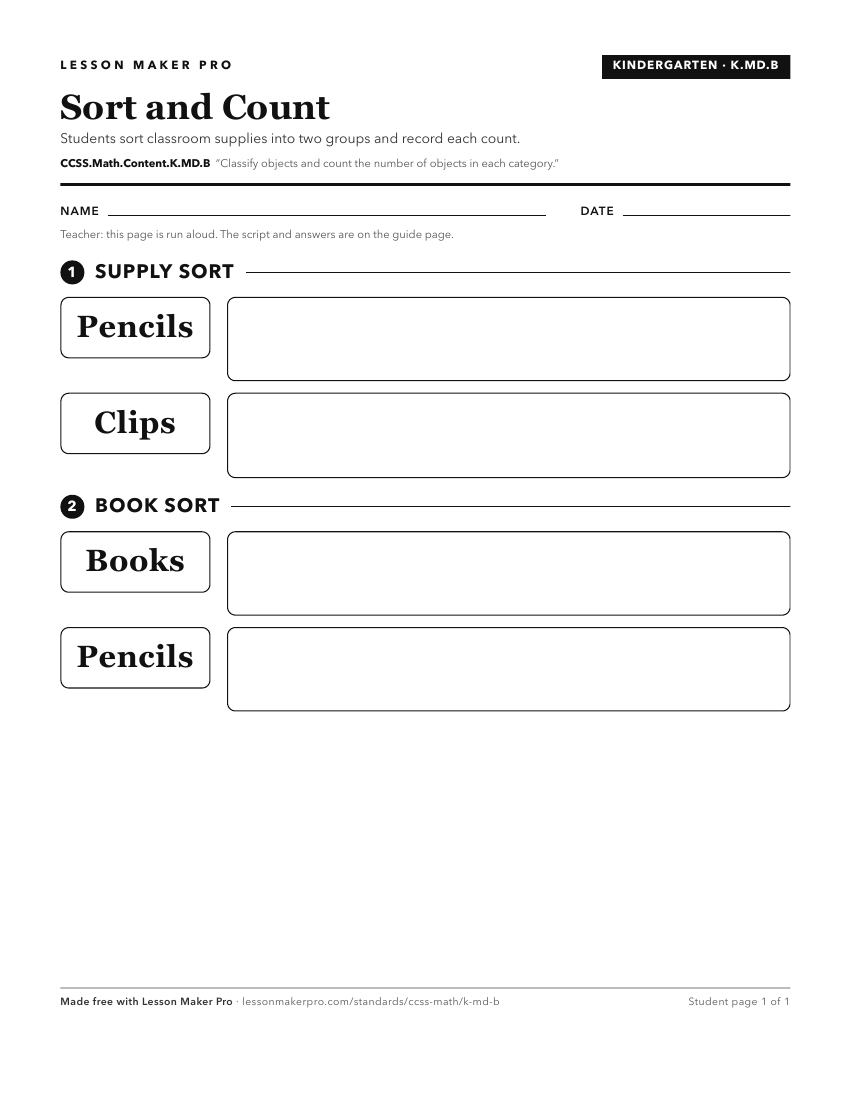
A ready-to-print activity worksheet aligned to CCSS.Math.Content.K.MD.B, with an answer key for the teacher on its own page. No account needed.
PDF, US Letter, prints cleanly in black and white.
Download the worksheetKeep exploring
Related Standards
- CCSS.Math.Content.K.CC.B
Count to tell the number of objects.
- CCSS.Math.Content.5.G.B
Classify two-dimensional figures into categories based on their properties.
- CCSS.Math.Content.K.CC.C.6
Identify whether the number of objects in one group is greater than, less than, or equal to the number of objects in another group, e.g., by using matching and ...
Turn this cluster into a lesson
Grade, subject, topic, and the complete cluster are prefilled. Create one free, no account needed.
Also for this cluster:Make a WorksheetMake a QuizMake a Sub Lesson