CCSS.
The Standard
Identify whether the number of objects in one group is greater than, less than, or equal to the number of objects in another group, e.g., by using matching and counting strategies.
Common Core State Standards for Mathematics · Counting and Cardinality
Teacher's field guide
What This Standard Means
What Students Need to Do
- Students compare two groups of up to 10 objects by pairing items or counting each group. They say which group has more, fewer, or the same amount.
What Mastery Looks Like
- A student correctly compares groups arranged in different ways, including close rows, spread-out rows, and mixed layouts. The student explains the answer by pairing objects or counting each group accurately.
Common Misconceptions
- Students may think the longer, more spread-out row always has more. They may compare object size instead of quantity or miscount by skipping and counting objects twice.
How to Assess It
- Show 7 counters beside 5 counters and ask, "Which group has more? Prove it by matching or counting."
Lesson moves
Ways to Teach It
Give pairs of students two plates and counters, then have them build, match, and compare groups of up to 10.
Show two differently spaced groups and ask, "Which has more, and how can you prove the spacing does not matter?"
Play Compare and Keep with dot cards, where partners reveal cards and the player with more dots keeps both.
Compare classroom supplies, such as pencils and glue sticks, to decide which group has more, fewer, or the same amount.
Free download
Printable K.CC.C.6 Worksheet
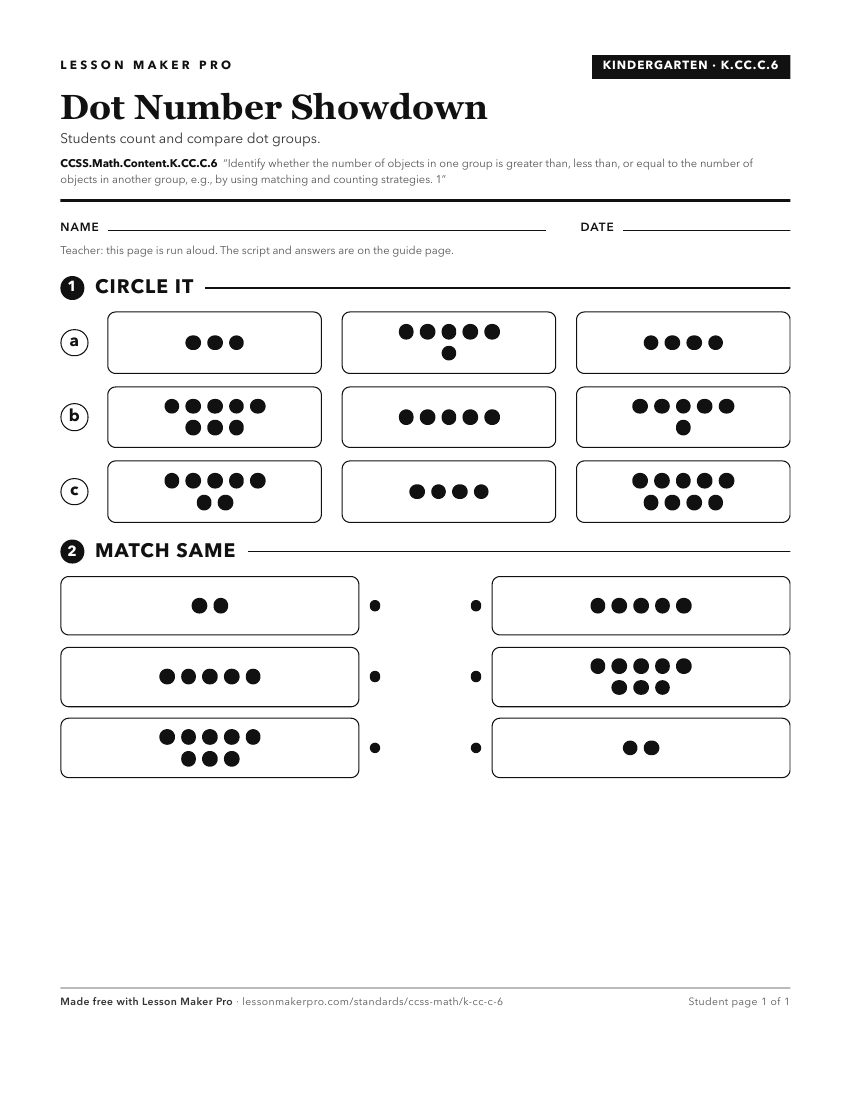
A ready-to-print activity worksheet aligned to CCSS.Math.Content.K.CC.C.6, with an answer key for the teacher on its own page. No account needed.
PDF, US Letter, prints cleanly in black and white.
Download the worksheetLearning progression
Where This Standard Sits
Before This Standard
If students are struggling here, check these first.
- CCSS.Math.Content.K.CC.B.4b
Comparing groups by counting requires knowing each count's last number tells the group's quantity, regardless of arrangement.
- CCSS.Math.Content.K.CC.B.4
Comparing groups by count depends on knowing that the last count word tells how many objects are in each group.
- CCSS.Math.Content.K.CC.B.4a
Accurate one-to-one counting supports finding each group’s amount before deciding which has more, less, or the same.
What This Unlocks
Mastery here sets students up for these next.
- CCSS.Math.Content.1.NBT.B.3
Comparing object groups develops greater than, less than, and equal ideas later applied to two-digit numbers using tens and ones.
- CCSS.Math.Content.1.MD.C.4
Comparing groups as greater, less, or equal supports interpreting category counts and answering which category has more or fewer.
- CCSS.Math.Content.1.OA.D.7
Comparing groups as equal or not supports seeing the equal sign as a relationship between two quantities in equations.
- CCSS.Math.Content.K.MD.B.3
Comparing groups as greater, less, or equal supports sorting categories by count after objects are classified and counted.
- CCSS.Math.Content.K.CC.C.7
Comparing object groups develops the greater than, less than, and equal ideas later applied to written numerals.
Keep exploring
Related Standards
- CCSS.Math.Content.K.MD.B
Classify objects and count the number of objects in each category.
- CCSS.Math.Content.2.OA.C.3
Determine whether a group of objects (up to 20) has an odd or even number of members, e.g., by pairing objects or counting them by 2s; write an equation to expr...
- CCSS.Math.Content.K.MD.A.2
Directly compare two objects with a measurable attribute in common, to see which object has "more of"/"less of" the attribute, and describe the difference.
Turn this exact standard into a lesson
Grade, subject, topic, and the complete standard are prefilled. Create one free, no account needed.
Also for this standard:Make a WorksheetMake a QuizMake a Sub Lesson