CCSS.
The Standard
Classify objects into given categories; count the numbers of objects in each category and sort the categories by count.
Common Core State Standards for Mathematics · Measurement and Data
Teacher's field guide
What This Standard Means
What Students Need to Do
- Students sort objects into categories named by the teacher. They count each group, then arrange or name the categories from fewest to most, using no more than 10 objects per category.
What Mastery Looks Like
- Students place each object in the correct given category. They accurately count up to 10 objects in each group and order the groups by count.
Common Misconceptions
- Students may sort by their own rule instead of using the named categories. They may count an object twice, skip objects, or compare object size instead of group count.
How to Assess It
- Give each student 10 picture cards: 4 dogs, 3 cats, 2 birds, and 1 fish. Ask them to sort, count, and order the groups from least to greatest.
Lesson moves
Ways to Teach It
Give pairs ten mixed buttons to sort into color bowls, count each group, and line up the bowls from least to greatest.
Ask, “How can you prove which group has more?” and have students explain using counts or matched pairs.
Play a card sort race where partners group picture cards, record each count, and check the category order together.
Use ten items from an art tray, sort them as crayons, markers, or pencils, then identify which supply has the fewest.Нап
Free download
Printable K.MD.B.3 Worksheet
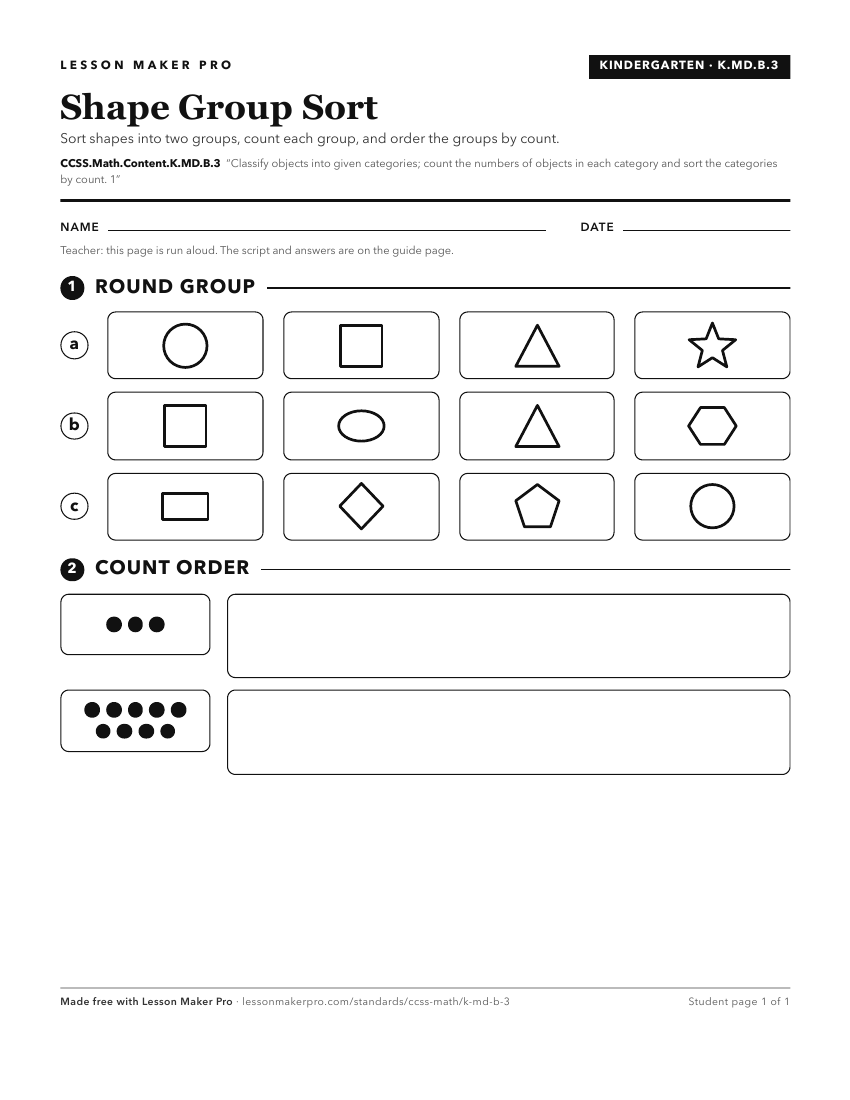
A ready-to-print activity worksheet aligned to CCSS.Math.Content.K.MD.B.3, with an answer key for the teacher on its own page. No account needed.
PDF, US Letter, prints cleanly in black and white.
Download the worksheetLearning progression
Where This Standard Sits
See the whole path on the Measurement & Data progression map.
Before This Standard
If students are struggling here, check these first.
- CCSS.Math.Content.K.CC.B.4
Counting each category and comparing category sizes require knowing that the last count tells how many objects are in the set.
- CCSS.Math.Content.K.CC.B.5
Counting objects to answer “how many” carries directly into counting each category before comparing category sizes.
- CCSS.Math.Content.K.CC.C.6
Comparing groups as greater, less, or equal supports sorting categories by count after objects are classified and counted.
What This Unlocks
Mastery here sets students up for these next.
- CCSS.Math.Content.1.MD.C.4
Students must sort items into categories and count each category before representing data and comparing category counts.
- CCSS.Math.Content.2.MD.D.10
Classifying objects, counting categories, and comparing counts support representing categorical data in picture and bar graphs.
Keep exploring
Related Standards
Turn this exact standard into a lesson
Grade, subject, topic, and the complete standard are prefilled. Create one free, no account needed.
Also for this standard:Make a WorksheetMake a QuizMake a Sub Lesson