CCSS.
The Standard
Determine whether a group of objects (up to 20) has an odd or even number of members, e.g., by pairing objects or counting them by 2s; write an equation to express an even number as a sum of two equal addends.
Common Core State Standards for Mathematics · Operations and Algebraic Thinking
Teacher's field guide
What This Standard Means
What Students Need to Do
- Students decide whether a collection of up to 20 objects is odd or even. They make pairs or count by twos and notice whether one object remains. They show an even total as two equal addends.
What Mastery Looks Like
- A student pairs 17 counters and identifies the total as odd because one counter remains. For 16 counters, the student makes two equal groups and writes 8 + 8 = 16.
Common Misconceptions
- Students may think odd means unusual or that even means objects look balanced. They may miss a leftover object when pairing or write unequal addends, such as 6 + 4 = 10.
How to Assess It
- Give students pictures of 13 dots and 18 dots. Ask them to circle pairs, label each total odd or even, and write an equal addends equation for 18.
Lesson moves
Ways to Teach It
Give students 15 counters to pair and record any leftovers, then have them repeat with 12 counters.
Ask, "How does pairing prove whether 14 and 15 are odd or even?" Students draw and explain.
Play Odd or Even Draw: students choose a number card to 20, build pairs, then record the correct label and equation.
Count markers in classroom bins, decide whether each total is odd or even, then split even totals equally between two tables.
Free download
Printable 2.OA.C.3 Worksheet
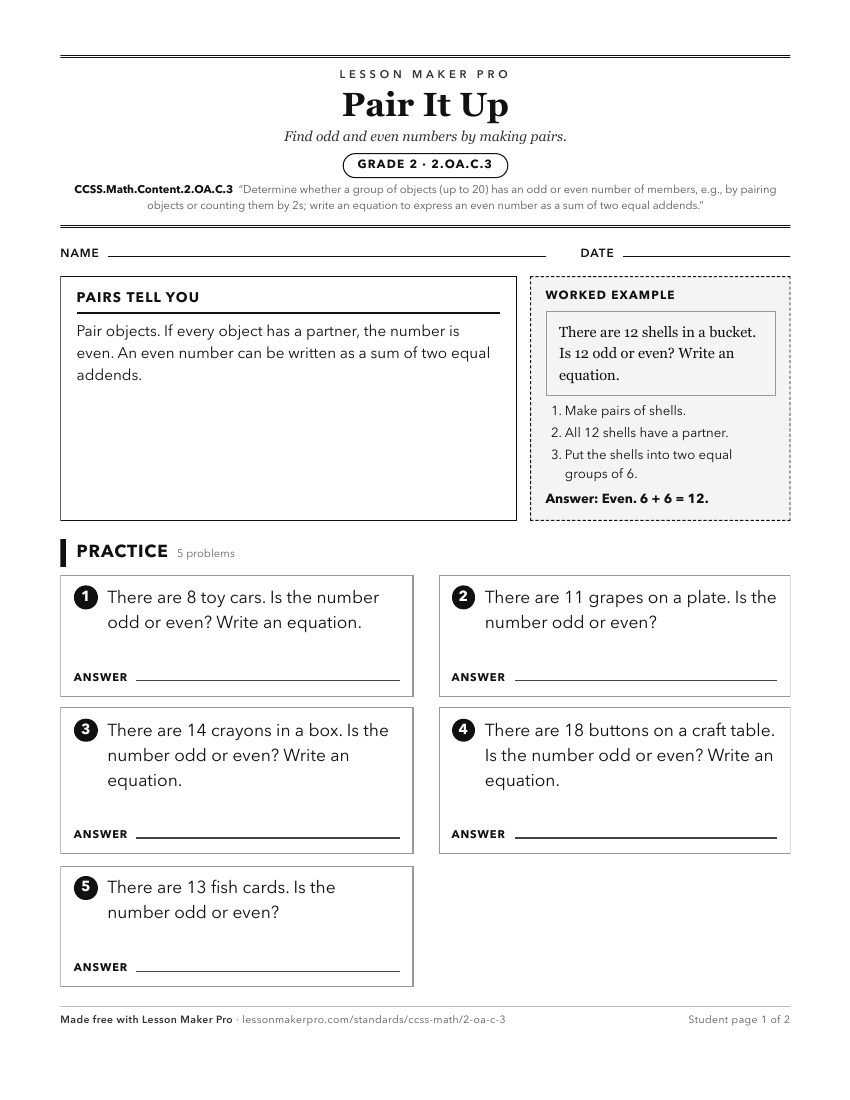
A ready-to-print activity worksheet aligned to CCSS.Math.Content.2.OA.C.3, with an answer key for the teacher on its own page. No account needed.
PDF, US Letter, prints cleanly in black and white.
Download the worksheetLearning progression
Where This Standard Sits
See the whole path on the Operations & Algebraic Thinking progression map.
Before This Standard
If students are struggling here, check these first.
- CCSS.Math.Content.K.CC.A.3
Writing numerals to 20 supports recording group sizes and equal-addend equations after students pair objects or count by twos.
- CCSS.Math.Content.K.CC.B.5
Counting objects to 20 supports finding group size before checking pairs, counting by twos, or splitting into equal addends.
- CCSS.Math.Content.1.OA.D.7
Understanding the equal sign supports writing an even number as two equal addends, but odd-even pairing can begin without it.
Keep exploring
Related Standards
- CCSS.Math.Content.2.OA.C.4
Use addition to find the total number of objects arranged in rectangular arrays with up to 5 rows and up to 5 columns; write an equation to express the total as...
- CCSS.Math.Content.K.CC.C.6
Identify whether the number of objects in one group is greater than, less than, or equal to the number of objects in another group, e.g., by using matching and ...
- CCSS.Math.Content.K.OA.A.4
For any number from 1 to 9, find the number that makes 10 when added to the given number, e.g., by using objects or drawings, and record the answer with a drawi...
- CCSS.Math.Content.K.OA.A.3
Decompose numbers less than or equal to 10 into pairs in more than one way, e.g., by using objects or drawings, and record each decomposition by a drawing or eq...
Turn this exact standard into a lesson
Grade, subject, topic, and the complete standard are prefilled. Create one free, no account needed.
Also for this standard:Make a WorksheetMake a QuizMake a Sub Lesson