CCSS.
The Standard
For any number from 1 to 9, find the number that makes 10 when added to the given number, e.g., by using objects or drawings, and record the answer with a drawing or equation.
Common Core State Standards for Mathematics · Operations and Algebraic Thinking
Teacher's field guide
What This Standard Means
What Students Need to Do
- Students find the missing amount needed to make a group of 10. They use objects or drawings, then record their thinking with a picture or equation.
What Mastery Looks Like
- Given any number from 1 through 9, a student finds its partner to make 10 without guessing. The student shows the answer with counters, a ten-frame, a drawing, or a correct equation.
Common Misconceptions
- Students may write the starting number again instead of the missing amount. They may count filled spaces rather than empty spaces on a ten-frame, or reverse the two quantities in their drawing.
How to Assess It
- Exit ticket: “You have 7 counters. Draw how many more you need to make 10, then complete 7 + __ = 10.”
Lesson moves
Ways to Teach It
Give students ten-frames and counters, name a starting number, and have them fill the empty spaces and record the matching equation.
Ask, “Mia has 6 apples and needs 10; how many more does she need?” Students draw, write an equation, and explain.
Play Make Ten Match by pairing numeral cards whose values total 10, such as 3 and 7 or 8 and 2.
Set up a ten-seat bus picture, place some passenger counters aboard, and have students find how many seats remain.
Free download
Printable K.OA.A.4 Worksheet
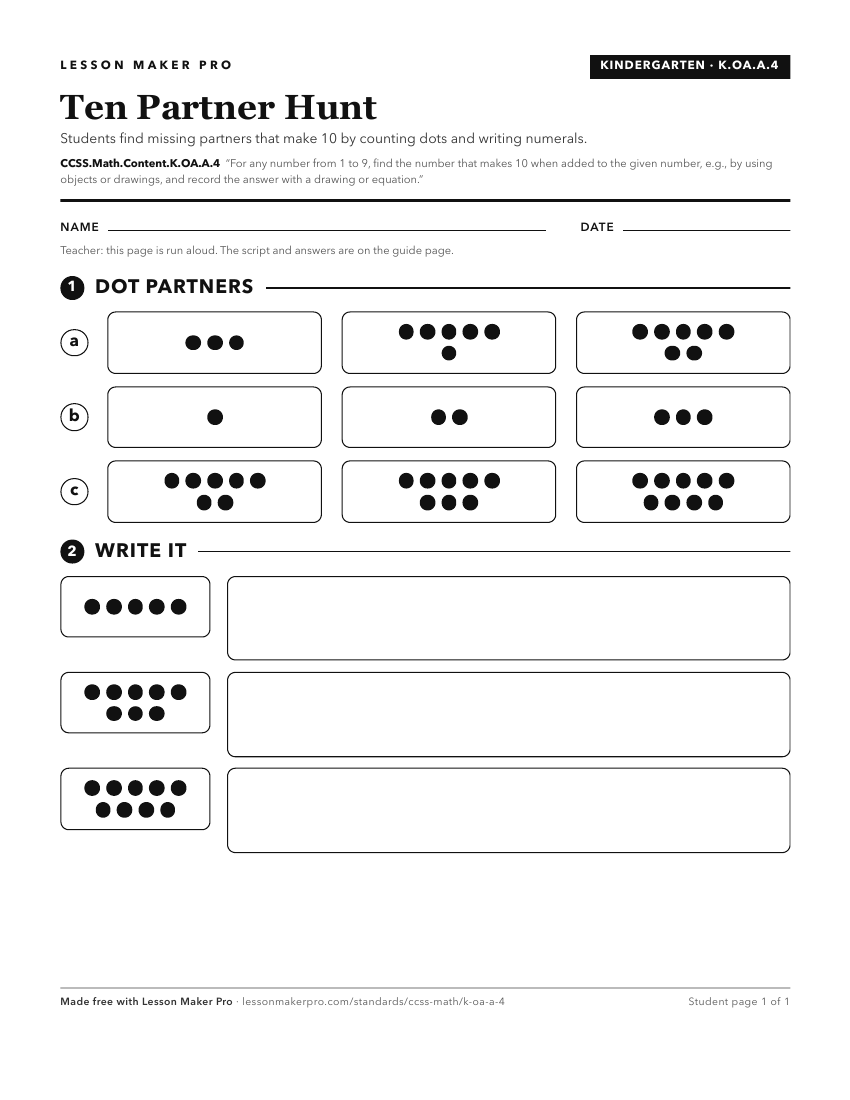
A ready-to-print activity worksheet aligned to CCSS.Math.Content.K.OA.A.4, with an answer key for the teacher on its own page. No account needed.
PDF, US Letter, prints cleanly in black and white.
Download the worksheetLearning progression
Where This Standard Sits
See the whole path on the Operations & Algebraic Thinking progression map.
Before This Standard
If students are struggling here, check these first.
- CCSS.Math.Content.K.OA.A.1
Making 10 requires representing an addition situation with objects, drawings, or equations, but students can practice it directly.
- CCSS.Math.Content.K.CC.B.4
Making 10 with objects requires knowing that counted numbers name quantities and that the last count gives the total.
- CCSS.Math.Content.K.OA.A.3
Making 10 with a given addend is a special case of decomposing 10 into addend pairs.
What This Unlocks
Mastery here sets students up for these next.
Keep exploring
Related Standards
- CCSS.Math.Content.K.NBT.A.1
Compose and decompose numbers from 11 to 19 into ten ones and some further ones, e.g., by using objects or drawings, and record each composition or decompositio...
- CCSS.Math.Content.1.NBT.C.5
Given a two-digit number, mentally find 10 more or 10 less than the number, without having to count; explain the reasoning used.
- CCSS.Math.Content.K.OA.A.2
Solve addition and subtraction word problems, and add and subtract within 10, e.g., by using objects or drawings to represent the problem.
Turn this exact standard into a lesson
Grade, subject, topic, and the complete standard are prefilled. Create one free, no account needed.
Also for this standard:Make a WorksheetMake a QuizMake a Sub Lesson