CCSS.
The Standard
Count to 100 by ones and by tens.
Common Core State Standards for Mathematics · Counting and Cardinality
Teacher's field guide
What This Standard Means
What Students Need to Do
- Students say number names in order through 100 without skipping or rearranging them. They also say the decade numbers from 10 through 100 in order.
What Mastery Looks Like
- A student recites the full sequence through 100 without skips or repeats. They move correctly from 29 to 30 and 99 to 100, and name each decade in order.
Common Misconceptions
- Students may skip decade numbers, especially 40, 70, or 90. They may reverse teen numbers or say 20 after 29 instead of 30.
How to Assess It
- Ask each student to count from 1 to 100, then from 10 to 100 by tens. Note any skipped numbers or incorrect decade changes.
Lesson moves
Ways to Teach It
Build a train of 100 linking cubes, add one cube per count, and place a color break after every ten cubes.
Display a hundred chart with 39 covered, then have partners explain which number belongs there and how they know.
Play Number Echo: say a short sequence by ones or tens, pause, and have students call out the next three numbers.
Add one straw for each school day, bundle every ten straws, and count the collection by ones, then by tens.
Free download
Printable K.CC.A.1 Worksheet
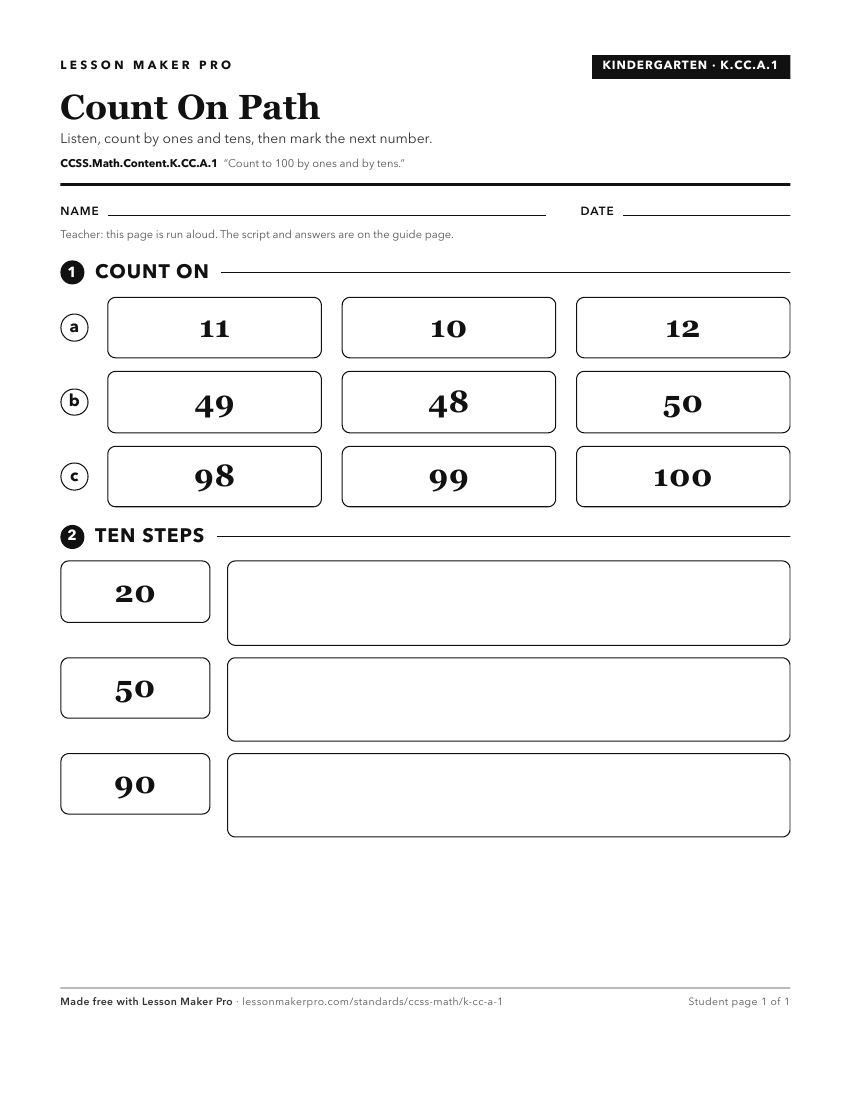
A ready-to-print activity worksheet aligned to CCSS.Math.Content.K.CC.A.1, with an answer key for the teacher on its own page. No account needed.
PDF, US Letter, prints cleanly in black and white.
Download the worksheetLearning progression
Where This Standard Sits
What This Unlocks
Mastery here sets students up for these next.
- CCSS.Math.Content.2.NBT.A.2
Counting to 100 by ones and tens gives the number sequence and ten-count patterns needed to extend counting within 1000.
- CCSS.Math.Content.1.NBT.A.1
Counting to 120 and starting anywhere depends on knowing the count sequence through 100 and decade transitions.
- CCSS.Math.Content.K.CC.B.4a
Knowing the number-name order supports assigning one count word to each object when counting a set.
- CCSS.Math.Content.K.CC.A.2
Knowing the counting sequence by ones lets students continue from a number without restarting at 1.
- CCSS.Math.Content.K.CC.B.4
Knowing the number-word sequence supports matching one word to each object and using the last word as the amount.
- CCSS.Math.Content.2.NBT.A.1a
Counting by tens to 100 supports seeing ten groups of ten as one hundred.
Keep exploring
Related Standards
- CCSS.Math.Content.2.NBT.A.1b
The numbers 100, 200, 300, 400, 500, 600, 700, 800, 900 refer to one, two, three, four, five, six, seven, eight, or nine hundreds (and 0 tens and 0 ones).
- CCSS.Math.Content.3.NBT.A.3
Multiply one-digit whole numbers by multiples of 10 in the range 10—90 (e.g., 9 × 80, 5 × 60) using strategies based on place value and properties of operations...
Turn this exact standard into a lesson
Grade, subject, topic, and the complete standard are prefilled. Create one free, no account needed.
Also for this standard:Make a WorksheetMake a QuizMake a Sub Lesson