CCSS.
The Standard
Count within 1000; skip-count by 5s, 10s, and 100s.
Common Core State Standards for Mathematics · Number and Operations in Base Ten
Teacher's field guide
What This Standard Means
What Students Need to Do
- Students continue number sequences to 1,000 and identify the amount added at each step. They count forward in equal jumps of 5, 10, or 100 from different starting numbers.
What Mastery Looks Like
- A student can continue and create equal-step number sequences without using a chart. They keep the pattern accurate when crossing tens and hundreds and can explain what changes in each place.
Common Misconceptions
- Students may change the tens digit when adding 100, or change only the ones digit when adding 10. They may also lose the pattern when crossing a hundred, such as moving from 195 to 200.
How to Assess It
- Give this exit ticket: Complete 385, 390, __, __ and 640, 740, __, __. Write the amount added in each sequence.
Lesson moves
Ways to Teach It
Give pairs base-ten blocks and number cards, then have them build a starting number and add groups of 5, 10, or 100.
Ask students to explain in writing what changes and what stays the same when moving from 245 to 345.
Play Sequence Relay: teams draw a start card and step card, then take turns writing the next five numbers correctly.
Use a store price list with items costing 5, 10, or 100 cents, and have students track repeated purchases up to 1,000 cents.
Free download
Printable 2.NBT.A.2 Worksheet
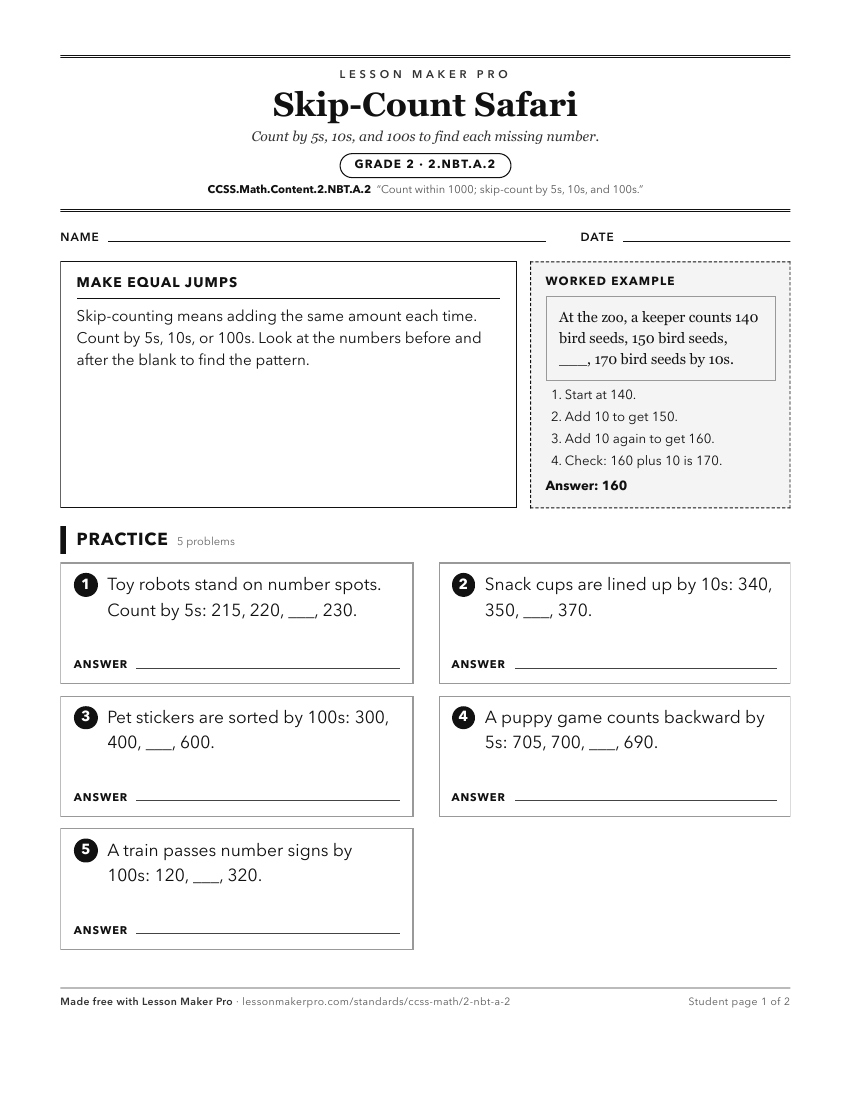
A ready-to-print activity worksheet aligned to CCSS.Math.Content.2.NBT.A.2, with an answer key for the teacher on its own page. No account needed.
PDF, US Letter, prints cleanly in black and white.
Download the worksheetLearning progression
Where This Standard Sits
See the whole path on the Number & Operations in Base Ten progression map.
Before This Standard
If students are struggling here, check these first.
- CCSS.Math.Content.K.CC.A.2
Counting on from any starting number supports extending the number sequence and recognizing skip-count patterns within 1000.
- CCSS.Math.Content.K.CC.A.1
Counting to 100 by ones and tens gives the number sequence and ten-count patterns needed to extend counting within 1000.
- CCSS.Math.Content.1.NBT.A.1
Counting and reading numbers to 120 supports extending the counting sequence and recognizing patterns used in skip-counting within 1000.
What This Unlocks
Mastery here sets students up for these next.
- CCSS.Math.Content.2.MD.C.8
Skip-counting by 5s, 10s, and 100s supports totaling nickels, dimes, and dollars in money word problems.
- CCSS.Math.Content.2.MD.C.7
Skip-counting by fives helps students convert clock numbers to minute values when reading analog clocks to five minutes.
- CCSS.Math.Content.2.NBT.A.3
Counting within 1000 supports knowing number sequences and names, which helps students read and write three-digit numbers.
- CCSS.Math.Content.4.OA.C.5
Skip-counting gives practice generating regular number sequences, which supports using rules and noticing features in later patterns.
- CCSS.Math.Content.4.NBT.A.1
Skip-counting by 10s and 100s supports seeing place values as repeated groups, preparing for ten-times place relationships.
- CCSS.Math.Content.3.MD.B.3
Skip-counting helps students read and label scaled graph intervals, especially when bar graph scales use 5s, 10s, or 100s.
Keep exploring
Related Standards
Turn this exact standard into a lesson
Grade, subject, topic, and the complete standard are prefilled. Create one free, no account needed.
Also for this standard:Make a WorksheetMake a QuizMake a Sub Lesson