CCSS.
The Standard
Read and write numbers to 1000 using base-ten numerals, number names, and expanded form.
Common Core State Standards for Mathematics · Number and Operations in Base Ten
Teacher's field guide
What This Standard Means
What Students Need to Do
- Students represent the same number in digit form, word form, and as a sum of hundreds, tens, and ones. They use place value to match forms and explain what each digit means.
What Mastery Looks Like
- Given 604, a student writes six hundred four and 600 + 4, then identifies six hundreds, zero tens, and four ones. The student also converts word and expanded forms back to 604.
Common Misconceptions
- Students may read 507 as five zero seven or write it as 57 because they ignore the zero placeholder. They may swap hundreds and tens, or expand 462 as 40 + 600 + 2.
How to Assess It
- Exit ticket: Write 708 in words and as a sum of place values. Then write the numeral for 900 + 20 + 5.
Lesson moves
Ways to Teach It
Give pairs base ten blocks and numeral cards; students build a card, then record its word form and place value sum.
Ask, “How are 406 and 460 different?” Students write two sentences using hundreds, tens, and ones.
Play a matching game with cards showing numerals, number names, and expanded sums; students collect complete sets of three.
Use a store flyer with three digit prices; students rewrite each price in words and as hundreds, tens, and ones.
Free download
Printable 2.NBT.A.3 Worksheet
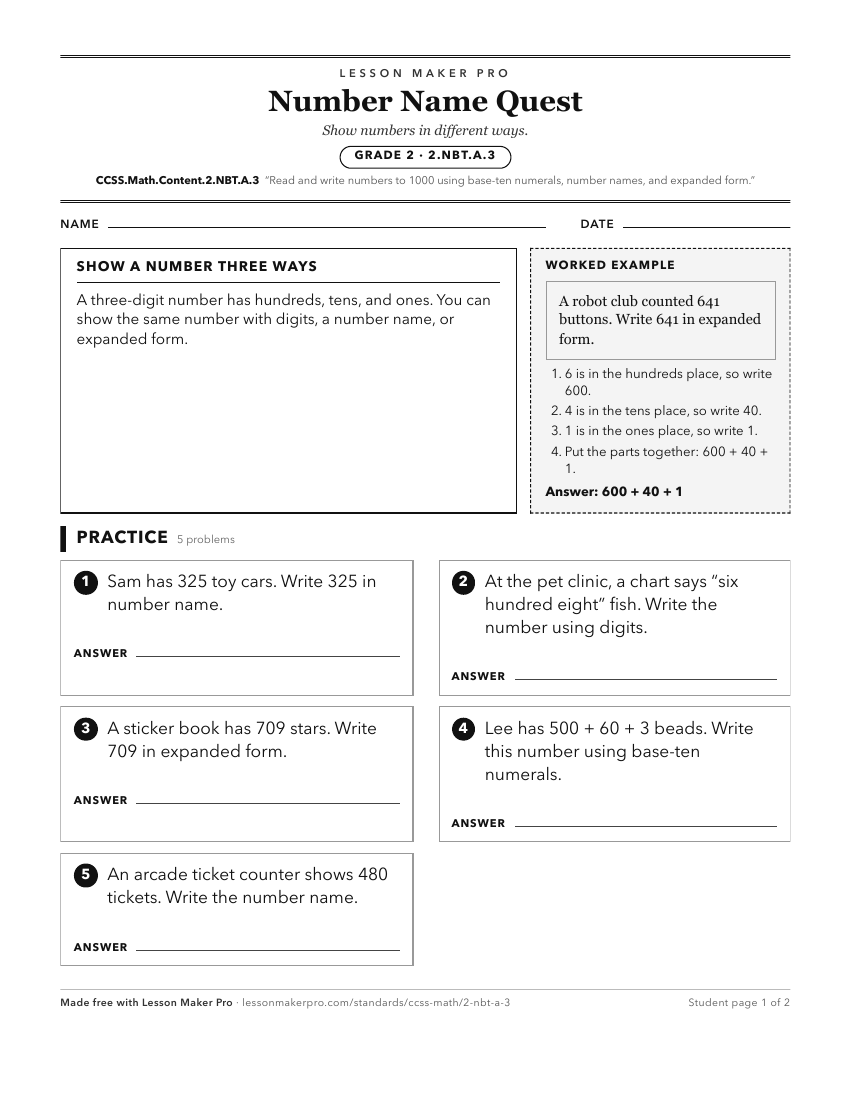
A ready-to-print activity worksheet aligned to CCSS.Math.Content.2.NBT.A.3, with an answer key for the teacher on its own page. No account needed.
PDF, US Letter, prints cleanly in black and white.
Download the worksheetLearning progression
Where This Standard Sits
See the whole path on the Number & Operations in Base Ten progression map.
Before This Standard
If students are struggling here, check these first.
- CCSS.Math.Content.2.NBT.A.1
Knowing what each digit means as hundreds, tens, and ones is necessary for expanded form and accurate three-digit number writing.
- CCSS.Math.Content.1.NBT.A.1
Reading and writing numbers to 120 establishes the numeral sequence and notation needed to read, write, and expand numbers to 1000.
- CCSS.Math.Content.2.NBT.A.2
Counting within 1000 supports knowing number sequences and names, which helps students read and write three-digit numbers.
What This Unlocks
Mastery here sets students up for these next.
- CCSS.Math.Content.3.NBT.A.1
Reading numbers and expanded form to 1000 supports identifying tens and hundreds needed for rounding decisions.
- CCSS.Math.Content.2.NBT.A.4
Comparing three-digit numerals requires reading the numbers and understanding hundreds, tens, and ones values often shown in expanded form.
- CCSS.Math.Content.4.NBT.A.2
Reading, naming, and expanding numbers to 1000 provides the place-value language needed for larger numbers and comparisons.
- CCSS.Math.Content.2.NBT.B.7
Reading and writing three-digit numbers in expanded form supports matching hundreds, tens, and ones in place-value addition and subtraction.
Keep exploring
Related Standards
Turn this exact standard into a lesson
Grade, subject, topic, and the complete standard are prefilled. Create one free, no account needed.
Also for this standard:Make a WorksheetMake a QuizMake a Sub Lesson