CCSS.
The Standard
Understand that the three digits of a three-digit number represent amounts of hundreds, tens, and ones; e.g., 706 equals 7 hundreds, 0 tens, and 6 ones. Understand the following as special cases:
Common Core State Standards for Mathematics
Teacher's field guide
What This Standard Means
What Students Need to Do
- Students identify how many hundreds, tens, and ones are shown by each digit in a three-digit number. They compose and decompose numbers with blocks, drawings, numbers, and words, including places containing zero. They also explain that ten tens make one hundred.
What Mastery Looks Like
- Given 408, a student shows 4 hundreds, 0 tens, and 8 ones. The student can build the number, write 400 + 8, and explain why the zero keeps the tens place empty. The student also recognizes 10 tens as 1 hundred.
Common Misconceptions
- Students may name each digit rather than its value, saying the 4 in 438 means 4 instead of 400. They may ignore a zero and read 405 as 45, or shift the 5 into the tens place. Some may count 10 tens without exchanging them for 1 hundred.
How to Assess It
- Exit ticket: For 504, draw a base-ten model, label each place, explain the zero, and show how 10 tens can be renamed.
Lesson moves
Ways to Teach It
Build 326 with base-ten blocks, then trade ten rods for one flat and record the value of each place.
Post the prompt Compare 352 and 305, then have students write two sentences using hundreds, tens, and ones.
Play Place Value Draw: teams draw three digit cards and score a point for naming each digit's value correctly.
Use an inventory of 407 pencils, then describe the quantity as boxes of 100, packs of 10, and single pencils.
Free download
Printable 2.NBT.A.1 Worksheet
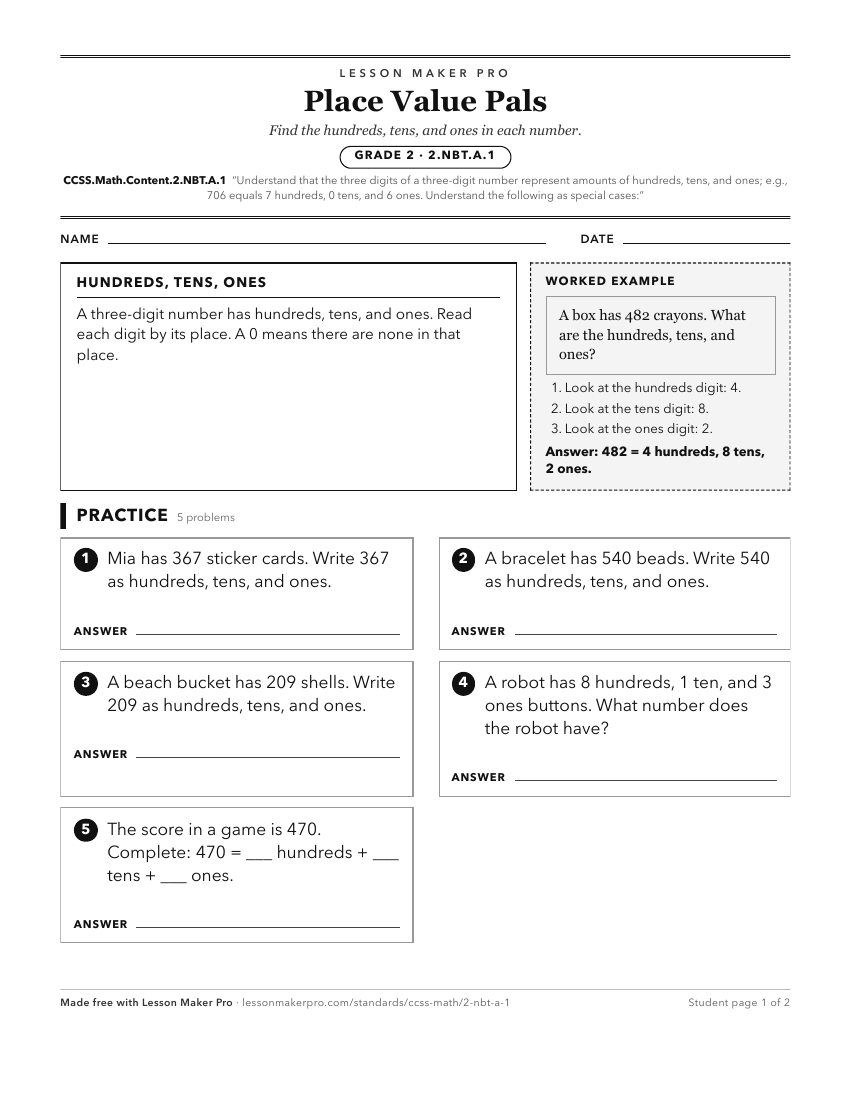
A ready-to-print activity worksheet aligned to CCSS.Math.Content.2.NBT.A.1, with an answer key for the teacher on its own page. No account needed.
PDF, US Letter, prints cleanly in black and white.
Download the worksheetLearning progression
Where This Standard Sits
See the whole path on the Number & Operations in Base Ten progression map.
Before This Standard
If students are struggling here, check these first.
- CCSS.Math.Content.2.NBT.A.1a
Understanding a hundred as ten tens is needed to interpret the hundreds digit in three-digit numbers.
- CCSS.Math.Content.1.NBT.B.2
Students must understand tens and ones before adding hundreds to interpret each digit in a three-digit number.
- CCSS.Math.Content.1.NBT.B.2a
Understanding a ten as one bundled unit is necessary to interpret the tens digit within three-digit place value.
What This Unlocks
Mastery here sets students up for these next.
- CCSS.Math.Content.2.NBT.A.3
Knowing what each digit means as hundreds, tens, and ones is necessary for expanded form and accurate three-digit number writing.
- CCSS.Math.Content.3.NBT.A.1
Rounding to tens or hundreds requires knowing which digit represents hundreds, tens, and ones in a three-digit number.
- CCSS.Math.Content.4.NBT.A.1
Understanding digits as hundreds, tens, and ones is necessary before seeing each place as ten times the place to its right.
- CCSS.Math.Content.2.NBT.A.4
Comparing three-digit numbers depends on knowing what the hundreds, tens, and ones digits mean in each number.
- CCSS.Math.Content.3.NBT.A.2
Fluent addition and subtraction within 1000 require understanding hundreds, tens, and ones for composing, decomposing, and regrouping numbers.
- CCSS.Math.Content.2.NBT.B.7
Three-digit addition and subtraction require knowing digits as hundreds, tens, and ones to combine like units and regroup correctly.
Keep exploring
Related Standards
- CCSS.Math.Content.2.NBT.A.1b
The numbers 100, 200, 300, 400, 500, 600, 700, 800, 900 refer to one, two, three, four, five, six, seven, eight, or nine hundreds (and 0 tens and 0 ones).
- CCSS.Math.Content.5.NBT.A.1
Recognize that in a multi-digit number, a digit in one place represents 10 times as much as it represents in the place to its right and 1/10 of what it represen...
Turn this exact standard into a lesson
Grade, subject, topic, and the complete standard are prefilled. Create one free, no account needed.
Also for this standard:Make a WorksheetMake a QuizMake a Sub Lesson