CCSS.
The Standard
Understand that the two digits of a two-digit number represent amounts of tens and ones. Understand the following as special cases:
Common Core State Standards for Mathematics
Teacher's field guide
What This Standard Means
What Students Need to Do
- Students group ten single objects into one larger unit. They use the left digit to count groups of ten and the right digit to count leftovers. They also recognize teen numbers and numbers ending in zero.
What Mastery Looks Like
- Students build, draw, and label any two-digit number as groups of ten and leftover ones. They explain that 10 is one full group, 16 has one group and six singles, and 60 has six groups with none left.
Common Misconceptions
- Students may treat each digit as a separate number, so they read 34 as 3 and 4. They may reverse the places or say 40 has four ones. Some do not see ten single objects as one group of ten.
How to Assess It
- Exit ticket: Draw 17 and 40 with tens sticks and ones dots. Complete: 17 = __ tens + __ ones; 40 = __ tens + __ ones.
Lesson moves
Ways to Teach It
Give students linking cubes to build 24, snap cubes into groups of ten, and label the groups and leftover cubes.
Ask, “How are 16 and 60 alike and different?” Students draw both numbers and write one comparison sentence.
Students draw two digit cards, build that number with base-ten blocks, and earn a point for a correct model.
Pack classroom counters into cups of ten, then record the full cups, leftover counters, and total amount.
Free download
Printable 1.NBT.B.2 Worksheet
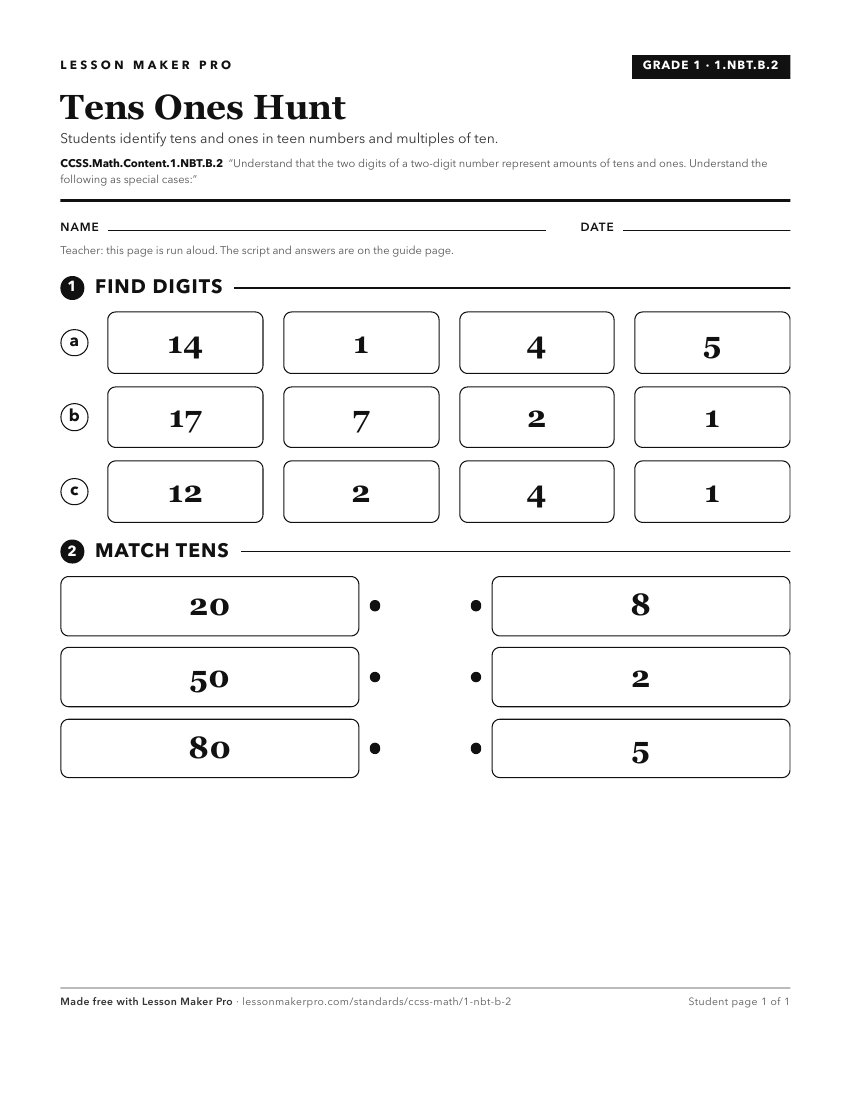
A ready-to-print activity worksheet aligned to CCSS.Math.Content.1.NBT.B.2, with an answer key for the teacher on its own page. No account needed.
PDF, US Letter, prints cleanly in black and white.
Download the worksheetLearning progression
Where This Standard Sits
See the whole path on the Number & Operations in Base Ten progression map.
Before This Standard
If students are struggling here, check these first.
- CCSS.Math.Content.K.NBT.A.1
Teen numbers as one ten and extra ones prepares students to read any two digit number as tens and ones.
- CCSS.Math.Content.K.CC.B.4
Place value depends on knowing that number words and written numbers name exact quantities that can be grouped into tens and ones.
- CCSS.Math.Content.K.CC.A.1
Counting by ones and tens supports seeing two-digit numbers as some tens plus leftover ones.
What This Unlocks
Mastery here sets students up for these next.
- CCSS.Math.Content.2.NBT.A.1
Students must understand tens and ones before adding hundreds to interpret each digit in a three-digit number.
- CCSS.Math.Content.2.NBT.B.9
Explaining two-digit addition and subtraction strategies requires seeing numbers as tens and ones and tracking how those units combine or separate.
- CCSS.Math.Content.2.NBT.B.5
Students need tens and ones meanings to decompose two-digit numbers for efficient addition and subtraction within 100.
- CCSS.Math.Content.2.NBT.B.6
Adding several two-digit numbers by tens and ones requires knowing each digit’s tens or ones value.
- CCSS.Math.Content.1.NBT.C.5
Understanding tens and ones lets students change the tens digit by one while keeping the ones digit the same.
- CCSS.Math.Content.1.NBT.C.4
Students need two-digit tens-and-ones place value to add tens with tens, ones with ones, and compose a ten.
Keep exploring
Related Standards
- CCSS.Math.Content.1.NBT.B.3
Compare two two-digit numbers based on meanings of the tens and ones digits, recording the results of comparisons with the symbols >, =, and <.
- CCSS.Math.Content.4.NBT.A.1
Recognize that in a multi-digit whole number, a digit in one place represents ten times what it represents in the place to its right.
- CCSS.Math.Content.5.NBT.A.1
Recognize that in a multi-digit number, a digit in one place represents 10 times as much as it represents in the place to its right and 1/10 of what it represen...
Turn this exact standard into a lesson
Grade, subject, topic, and the complete standard are prefilled. Create one free, no account needed.
Also for this standard:Make a WorksheetMake a QuizMake a Sub Lesson