CCSS.
The Standard
Recognize that in a multi-digit number, a digit in one place represents 10 times as much as it represents in the place to its right and 1/10 of what it represents in the place to its left.
Common Core State Standards for Mathematics · Number and Operations in Base Ten
Teacher's field guide
What This Standard Means
What Students Need to Do
- Students identify the value of a repeated digit in different places. They explain each value using multiplication or division by 10, including whole numbers and decimals.
What Mastery Looks Like
- Given a number such as 3,330, a student identifies each 3 as 3,000, 300, or 30. The student uses equations and words to explain the relationship between adjacent places.
Common Misconceptions
- Students may think moving left adds 10 rather than multiplies by 10. They may compare the written digits instead of their values, or reverse the left and right relationships.
How to Assess It
- Give students the number 4,440. Ask: “How is the value of each 4 related to the 4 immediately to its right?”
Lesson moves
Ways to Teach It
Build numbers with digit cards on a place value mat, then shift one card left or right and record its new value.
Ask, “How are the two 7s in 7,700 related?” Students write an equation and explain their reasoning to a partner.
Play Place Value Match: students pair cards such as 600 and 60, then state the multiplicative relationship.
Compare prices such as $0.50 and $5.00, then have students explain how the value of 5 changes by place.
Free download
Printable 5.NBT.A.1 Worksheet
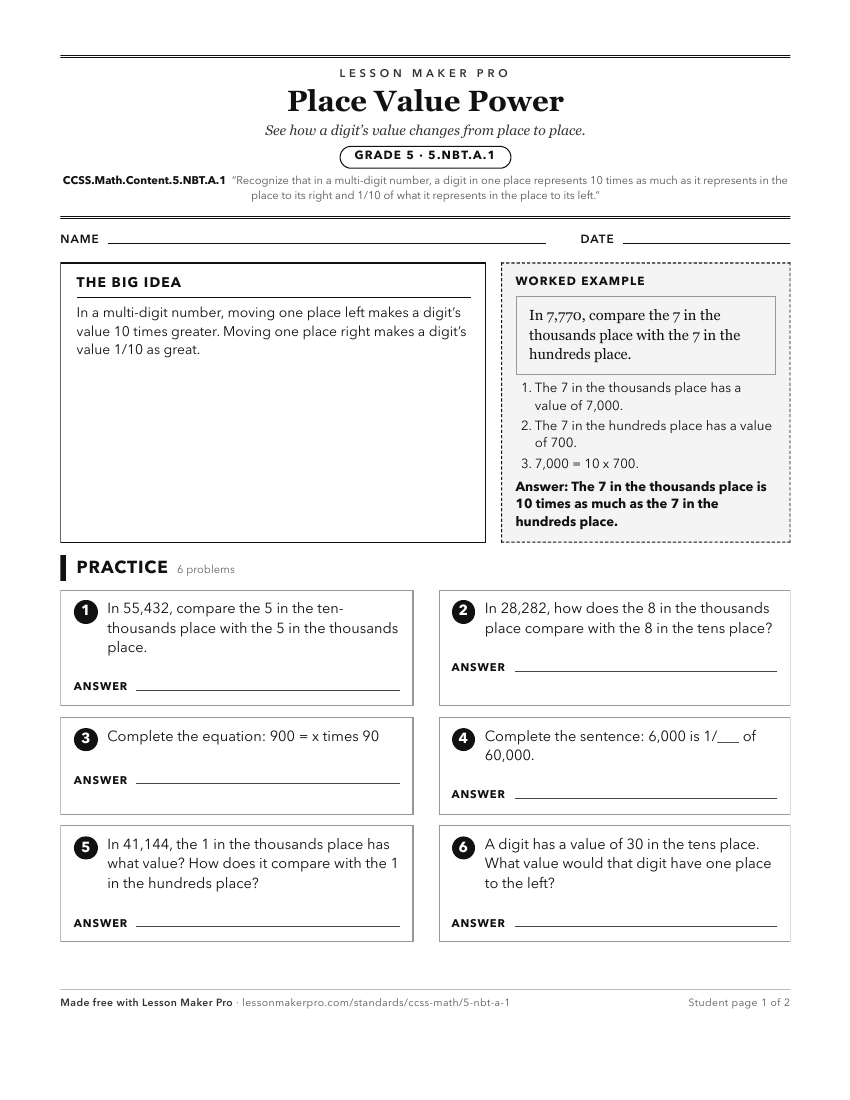
A ready-to-print activity worksheet aligned to CCSS.Math.Content.5.NBT.A.1, with an answer key for the teacher on its own page. No account needed.
PDF, US Letter, prints cleanly in black and white.
Download the worksheetLearning progression
Where This Standard Sits
See the whole path on the Number & Operations in Base Ten progression map.
Before This Standard
If students are struggling here, check these first.
- CCSS.Math.Content.4.NBT.A.1
Understanding each place as ten times the one to its right is the core idea extended to leftward tenths relationships.
- CCSS.Math.Content.4.NF.C.6
Writing tenths and hundredths as decimals supports seeing adjacent decimal places as 10 times or one tenth apart.
- CCSS.Math.Content.4.NBT.A.2
Reading, writing, and comparing whole numbers by digit values supports seeing adjacent places as ten times or one tenth.
What This Unlocks
Mastery here sets students up for these next.
- CCSS.Math.Content.5.NBT.A.3b
Comparing decimals to thousandths requires knowing each digit’s value and how adjacent decimal places change by factors of ten.
- CCSS.Math.Content.5.NBT.A.3
Decimal reading, writing, and comparison rely on knowing each place is ten times the next and one tenth of the previous.
- CCSS.Math.Content.5.NBT.A.3a
Reading and expanding decimals to thousandths requires knowing how each place’s value changes by a factor of ten.
- CCSS.Math.Content.5.NBT.A.2
Understanding each place is 10 times the next supports explaining zero patterns and decimal shifts with powers of 10.
- CCSS.Math.Content.5.NBT.A.4
Rounding decimals to any place requires knowing each digit’s value and how adjacent decimal places relate by factors of ten.
- CCSS.Math.Content.5.NBT.B.7
Decimal operations to hundredths rely on understanding each place is ten times or one tenth of adjacent places.
Keep exploring
Related Standards
- CCSS.Math.Content.1.NBT.B.2
Understand that the two digits of a two-digit number represent amounts of tens and ones. Understand the following as special cases:
- CCSS.Math.Content.4.NBT.A
Generalize place value understanding for multi-digit whole numbers.
- CCSS.Math.Content.2.NBT.A.1
Understand that the three digits of a three-digit number represent amounts of hundreds, tens, and ones; e.g., 706 equals 7 hundreds, 0 tens, and 6 ones. Underst...
Turn this exact standard into a lesson
Grade, subject, topic, and the complete standard are prefilled. Create one free, no account needed.
Also for this standard:Make a WorksheetMake a QuizMake a Sub Lesson