CCSS.
The Standard
Read and write decimals to thousandths using base-ten numerals, number names, and expanded form, e.g., 347.392 = 3 × 100 + 4 × 10 + 7 × 1 + 3 × (1/10) + 9 × (1/100) + 2 × (1/1000).
Common Core State Standards for Mathematics
Teacher's field guide
What This Standard Means
What Students Need to Do
- Students read and write decimals through the thousandths place. They represent the same number with digits, number names, and expanded form using each digit’s place value.
What Mastery Looks Like
- Students correctly read a decimal such as 347.392 and write it in numerals, words, and expanded form. They use zero placeholders correctly and connect each digit to its place value.
Common Misconceptions
- Students may read 0.45 as “zero point forty-five” or confuse tenths, hundredths, and thousandths. They may omit zero placeholders or expand 3.07 as 3 + 7/10 instead of 3 + 7/100.
How to Assess It
- Give students 6.204 and ask them to write it in words and expanded form, then label the value of each nonzero digit.
Lesson moves
Ways to Teach It
Build decimals with a place-value mat and digit cards, then record each number in numerals, words, and expanded form.
Ask students to explain how the value of 7 differs in 7.25, 2.75, and 2.057.
Play a matching game using cards showing the same decimal in numeral, word, expanded, and place-value forms.
Use a race time such as 12.438 seconds and have students read it aloud and write it in expanded form.
Free download
Printable 5.NBT.A.3a Worksheet
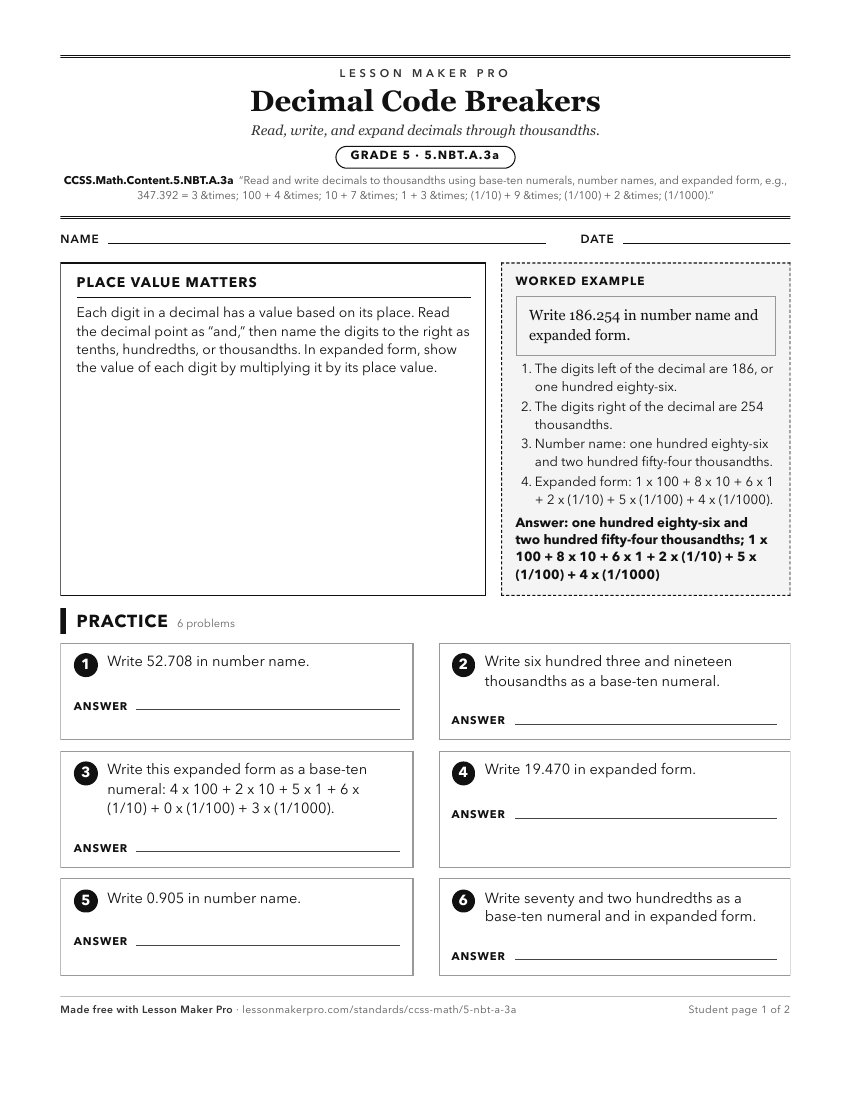
A ready-to-print activity worksheet aligned to CCSS.Math.Content.5.NBT.A.3a, with an answer key for the teacher on its own page. No account needed.
PDF, US Letter, prints cleanly in black and white.
Download the worksheetLearning progression
Where This Standard Sits
Before This Standard
If students are struggling here, check these first.
- CCSS.Math.Content.4.NBT.A.2
Reading, writing, and expanding whole numbers by place value directly extends to decimal places and fractional place values.
- CCSS.Math.Content.5.NBT.A.1
Reading and expanding decimals to thousandths requires knowing how each place’s value changes by a factor of ten.
- CCSS.Math.Content.4.NF.C.6
Writing tenths and hundredths as decimals is essential for reading and expanding decimals that extend to thousandths.
What This Unlocks
Mastery here sets students up for these next.
Keep exploring
Related Standards
Turn this exact standard into a lesson
Grade, subject, topic, and the complete standard are prefilled. Create one free, no account needed.
Also for this standard:Make a WorksheetMake a QuizMake a Sub Lesson