CCSS.
The Standard
Understand that each successive number name refers to a quantity that is one larger.
Common Core State Standards for Mathematics
Teacher's field guide
What This Standard Means
What Students Need to Do
- Students recognize that adding one object changes the count to the next number. They use the counting sequence to predict the new total.
What Mastery Looks Like
- A student can look at 6 counters, add one, and say there are 7. They can explain that 7 follows 6 because the set grew by one.
Common Misconceptions
- Students may recount the whole set without noticing the predictable change after one object is added. They may skip a number or think the new total could increase by more than one.
How to Assess It
- Show 8 counters, then add one. Ask, “How many are there now, and how did you know?”
Lesson moves
Ways to Teach It
Build a staircase with connecting cubes, using one cube for the first tower and adding one cube to each new tower.
Show five dots and six dots, then ask, “What changed, and why does the second set have the next counting number?”
Students roll a number cube, build that many counters, add one counter, and say the new total to a partner.
Set four plates for toy animals, add one more animal, and have students decide how many plates are now needed.
Free download
Printable K.CC.B.4c Worksheet
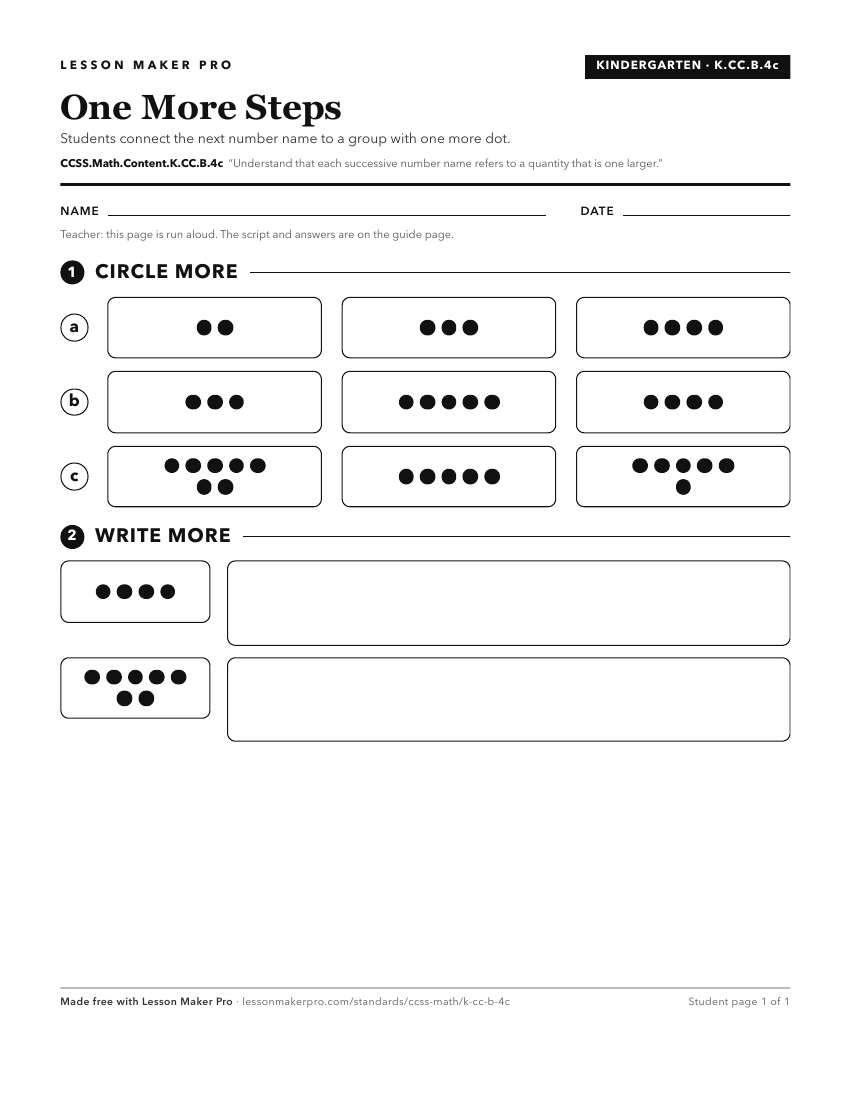
A ready-to-print activity worksheet aligned to CCSS.Math.Content.K.CC.B.4c, with an answer key for the teacher on its own page. No account needed.
PDF, US Letter, prints cleanly in black and white.
Download the worksheetLearning progression
Where This Standard Sits
Before This Standard
If students are struggling here, check these first.
What This Unlocks
Mastery here sets students up for these next.
- CCSS.Math.Content.1.OA.C.5
Counting on for addition depends on knowing each next number name increases the quantity by one.
- CCSS.Math.Content.K.CC.C.7
Knowing each next number means one more gives the size order needed to decide which written numeral is greater.
- CCSS.Math.Content.K.OA.A.1
Knowing the next number means one more supports modeling addition as joining and subtraction as taking away with countable quantities.
Keep exploring
Related Standards
- CCSS.Math.Content.4.NBT.A.1
Recognize that in a multi-digit whole number, a digit in one place represents ten times what it represents in the place to its right.
- CCSS.Math.Content.8.EE.A.3
Use numbers expressed in the form of a single digit times an integer power of 10 to estimate very large or very small quantities, and to express how many times ...
- CCSS.Math.Content.2.NBT.A.1b
The numbers 100, 200, 300, 400, 500, 600, 700, 800, 900 refer to one, two, three, four, five, six, seven, eight, or nine hundreds (and 0 tens and 0 ones).
Turn this exact standard into a lesson
Grade, subject, topic, and the complete standard are prefilled. Create one free, no account needed.
Also for this standard:Make a WorksheetMake a QuizMake a Sub Lesson