CCSS.
The Standard
Use numbers expressed in the form of a single digit times an integer power of 10 to estimate very large or very small quantities, and to express how many times as much one is than the other.
Common Core State Standards for Mathematics · Expressions and Equations
Teacher's field guide
What This Standard Means
What Students Need to Do
- Students represent estimates for very large and very small quantities using a one-digit number and a power of 10. They compare two estimates by finding how many times greater one quantity is than the other.
What Mastery Looks Like
- Students can choose a reasonable one-digit coefficient and power of 10 for a large or small quantity. They can divide two estimates and explain the resulting factor using coefficients and exponent rules.
Common Misconceptions
- Students may treat the exponent difference as the complete factor and ignore the coefficients. They may subtract exponents in the wrong order, treat negative exponents as negative values, or find an additive difference instead of a factor.
How to Assess It
- Exit ticket: A grain of sand is 0.0005 meter wide, and a bacterium is 0.000002 meter long. Write each as a one-digit number times a power of 10, then determine how many times wider the grain is.
Lesson moves
Ways to Teach It
Give students measurement cards and power-of-10 cards to match, order, and use for multiplicative comparisons.
Ask, “A city has 6 × 10^5 residents and a town has 2 × 10^4. How many times larger, and why?”
Play Ratio Relay: teams draw two number cards, divide the coefficients, subtract the exponents, and check the comparison with a calculator.
Compare sizes of a virus, bacterium, red blood cell, and grain of sand using measurements from a supplied data table.
Free download
Printable 8.EE.A.3 Worksheet
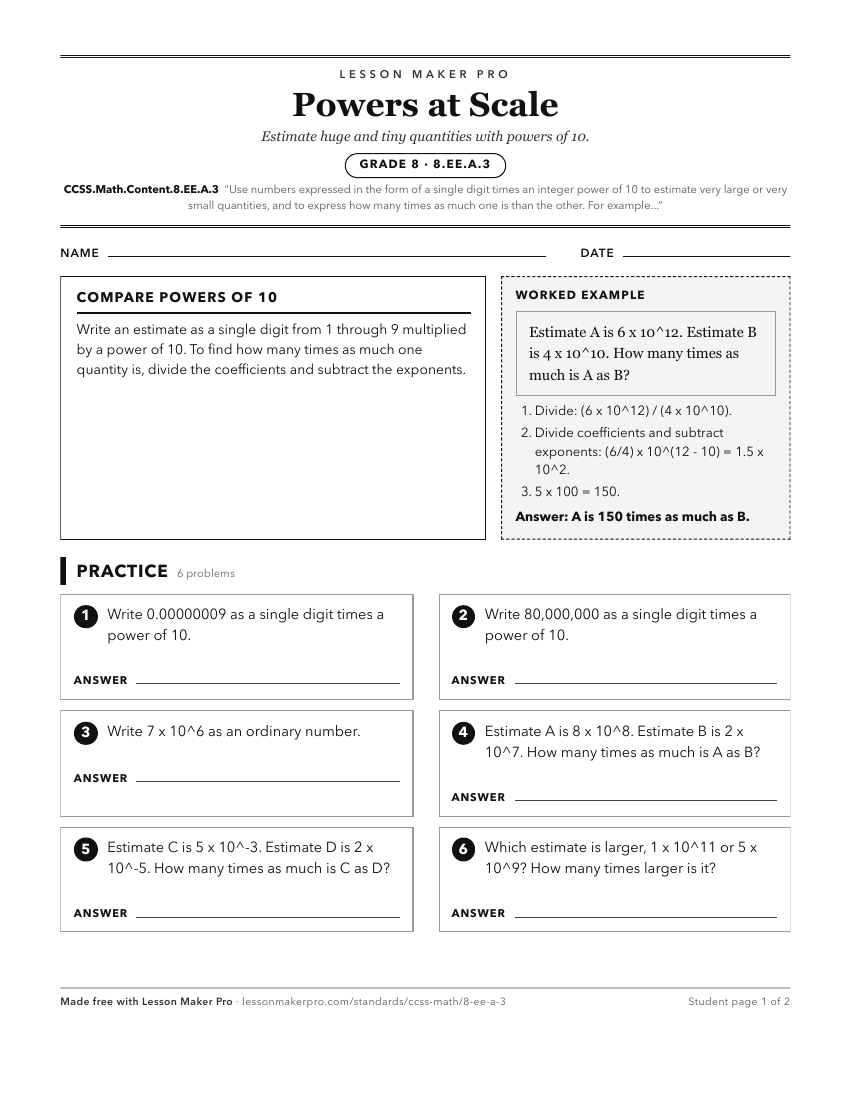
A ready-to-print activity worksheet aligned to CCSS.Math.Content.8.EE.A.3, with an answer key for the teacher on its own page. No account needed.
PDF, US Letter, prints cleanly in black and white.
Download the worksheetLearning progression
Where This Standard Sits
See the whole path on the Expressions & Equations progression map.
Before This Standard
If students are struggling here, check these first.
- CCSS.Math.Content.6.EE.A.1
Understanding exponent notation and evaluating powers carries over to interpreting powers of 10 in scientific notation.
- CCSS.Math.Content.8.EE.A.1
Properties of powers of 10 support writing scientific notation and comparing sizes by multiplying or dividing powers of ten.
- CCSS.Math.Content.6.RP.A.1
Ratio language supports interpreting “how many times as much” when comparing quantities written in scientific notation.
What This Unlocks
Mastery here sets students up for these next.
Keep exploring
Related Standards
- CCSS.Math.Content.4.NBT.A.1
Recognize that in a multi-digit whole number, a digit in one place represents ten times what it represents in the place to its right.
- CCSS.Math.Content.5.NBT.A.2
Explain patterns in the number of zeros of the product when multiplying a number by powers of 10, and explain patterns in the placement of the decimal point whe...
- CCSS.Math.Content.5.NBT.A.1
Recognize that in a multi-digit number, a digit in one place represents 10 times as much as it represents in the place to its right and 1/10 of what it represen...
- CCSS.Math.Content.3.NBT.A.3
Multiply one-digit whole numbers by multiples of 10 in the range 10—90 (e.g., 9 × 80, 5 × 60) using strategies based on place value and properties of operations...
Turn this exact standard into a lesson
Grade, subject, topic, and the complete standard are prefilled. Create one free, no account needed.
Also for this standard:Make a WorksheetMake a QuizMake a Sub Lesson