CCSS.
The Standard
Explain patterns in the number of zeros of the product when multiplying a number by powers of 10, and explain patterns in the placement of the decimal point when a decimal is multiplied or divided by a power of 10. Use whole-number exponents to denote powers of 10.
Common Core State Standards for Mathematics · Number and Operations in Base Ten
Teacher's field guide
What This Standard Means
What Students Need to Do
- Students use place value to predict results when multiplying or dividing by 10, 100, 1,000, and other powers of 10. They describe the pattern and write powers of 10 with whole-number exponents.
What Mastery Looks Like
- Students correctly calculate with powers of 10 and write powers using exponents. They explain that each digit changes place value by one place for every factor of 10.
Common Misconceptions
- Students may treat 10³ as 10 × 3 instead of 10 × 10 × 10. They may move digits in the wrong direction when dividing. They may add zeros to a decimal without considering place value.
How to Assess It
- Exit ticket: Find 4.27 × 10³ and 4.27 ÷ 10², then explain each result using place-value language. Write 100,000 as a power of 10.
Lesson moves
Ways to Teach It
Place digit cards on a place-value chart, then shift them for multiplication and division by 10, 100, and 1,000.
Ask students to explain why 3.6 × 100 equals 360 without saying, “move the decimal point.”
Play a matching game with decimal expressions, powers of 10, products or quotients, and place-value explanations.
Convert measurements such as 3.45 meters to centimeters and explain how multiplying by 100 changes each digit’s place value.
Free download
Printable 5.NBT.A.2 Worksheet
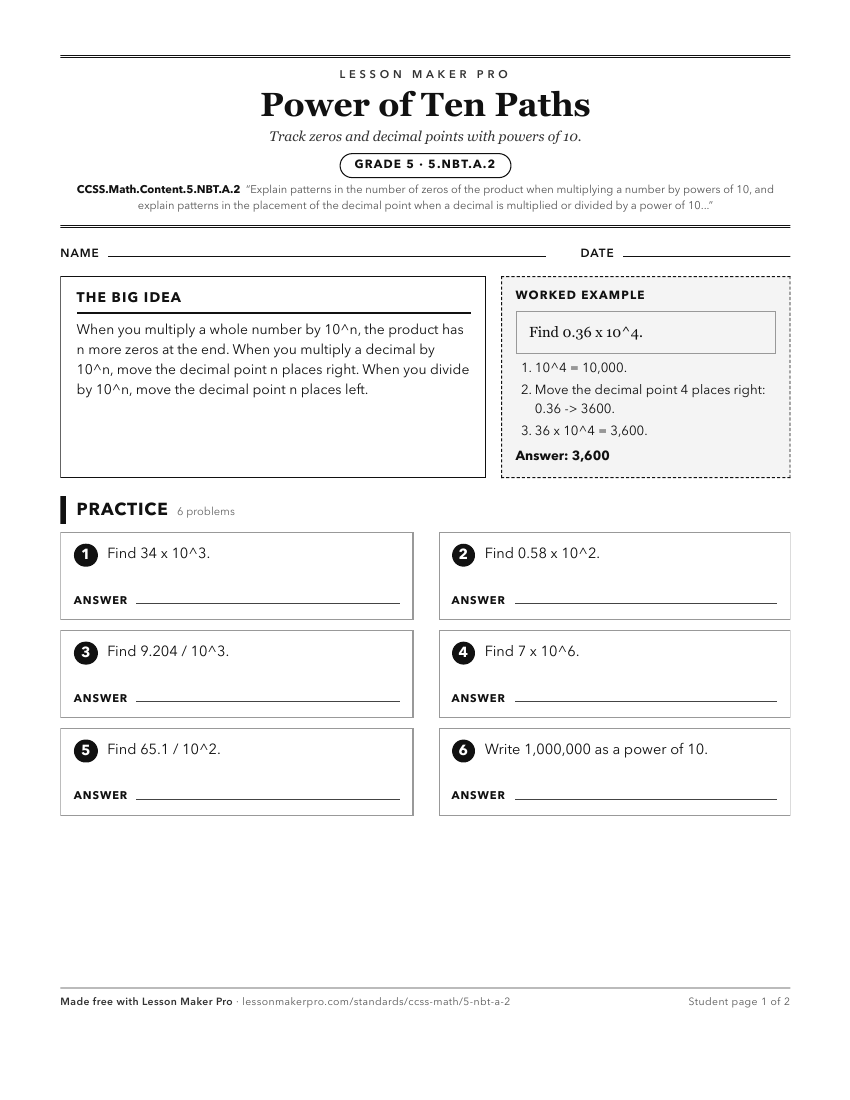
A ready-to-print activity worksheet aligned to CCSS.Math.Content.5.NBT.A.2, with an answer key for the teacher on its own page. No account needed.
PDF, US Letter, prints cleanly in black and white.
Download the worksheetLearning progression
Where This Standard Sits
See the whole path on the Number & Operations in Base Ten progression map.
Before This Standard
If students are struggling here, check these first.
- CCSS.Math.Content.5.NBT.A.1
Understanding each place is 10 times the next supports explaining zero patterns and decimal shifts with powers of 10.
- CCSS.Math.Content.4.NF.C.6
Writing tenths and hundredths as decimals supports understanding how multiplying or dividing by powers of 10 changes decimal place value.
- CCSS.Math.Content.4.NBT.A.1
Understanding that each place is ten times the next supports explaining digit shifts and zeros when multiplying by powers of 10.
What This Unlocks
Mastery here sets students up for these next.
Keep exploring
Related Standards
- CCSS.Math.Content.8.EE.A.3
Use numbers expressed in the form of a single digit times an integer power of 10 to estimate very large or very small quantities, and to express how many times ...
- CCSS.Math.Content.3.NBT.A.3
Multiply one-digit whole numbers by multiples of 10 in the range 10—90 (e.g., 9 × 80, 5 × 60) using strategies based on place value and properties of operations...
Turn this exact standard into a lesson
Grade, subject, topic, and the complete standard are prefilled. Create one free, no account needed.
Also for this standard:Make a WorksheetMake a QuizMake a Sub Lesson