CCSS.
The Standard
Measure the length of an object twice, using length units of different lengths for the two measurements; describe how the two measurements relate to the size of the unit chosen.
Common Core State Standards for Mathematics · Measurement and Data
Teacher's field guide
What This Standard Means
What Students Need to Do
- Students measure one object with two different-sized units, such as inch cubes and craft sticks. They explain how the unit size affects the measurement count.
What Mastery Looks Like
- A student measures the same object accurately with two unit sizes and labels each result. The student explains that smaller units give a larger count, while larger units give a smaller count.
Common Misconceptions
- Students may think a larger measurement number means the object became longer. They may also leave gaps, overlap units, or compare counts without naming the units used.
How to Assess It
- Give students a pencil, inch cubes, and paper clips. Ask them to measure with both units and explain why the two counts differ.
Lesson moves
Ways to Teach It
Give pairs paper clips and craft sticks to measure a desk, record both counts, and compare how unit size changes the number.
Ask students to write: Why does the same book measure more cubes than markers, even though its length has not changed?
Play Unit Match: students predict which of two units will give the larger count, then measure to check and earn a point.
Compare measuring a hallway in feet and yards, then discuss why builders choose units that fit the length being measured.
Free download
Printable 2.MD.A.2 Worksheet
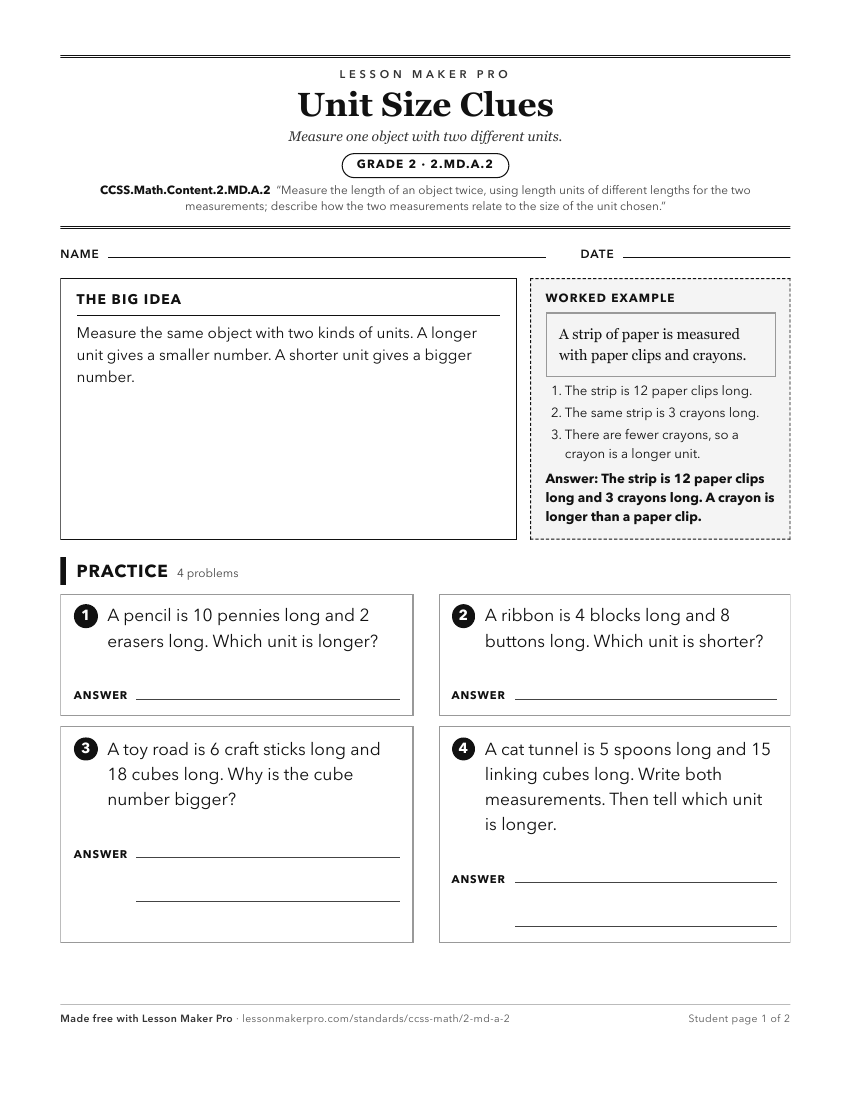
A ready-to-print activity worksheet aligned to CCSS.Math.Content.2.MD.A.2, with an answer key for the teacher on its own page. No account needed.
PDF, US Letter, prints cleanly in black and white.
Download the worksheetLearning progression
Where This Standard Sits
See the whole path on the Measurement & Data progression map.
Before This Standard
If students are struggling here, check these first.
- CCSS.Math.Content.2.MD.A.1
Students must use length-measuring tools correctly before comparing measurements made with different-sized units.
- CCSS.Math.Content.1.MD.A.2
Students use iteration of equal length units to understand why smaller units give larger counts and larger units give smaller counts.
- CCSS.Math.Content.K.CC.B.4
Students must connect counted units to a total quantity before comparing length measurements made with different-sized units.
Keep exploring
Related Standards
- CCSS.Math.Content.2.MD.A.4
Measure to determine how much longer one object is than another, expressing the length difference in terms of a standard length unit.
- CCSS.Math.Content.1.MD.A
Measure lengths indirectly and by iterating length units.
- CCSS.Math.Content.2.MD.A
Measure and estimate lengths in standard units.
Turn this exact standard into a lesson
Grade, subject, topic, and the complete standard are prefilled. Create one free, no account needed.
Also for this standard:Make a WorksheetMake a QuizMake a Sub Lesson