CCSS.
The Standard
Recognize situations in which one quantity changes at a constant rate per unit interval relative to another.
Common Core State Standards for Mathematics · Construct and compare linear, quadratic, and exponential models and solve problems
Teacher's field guide
What This Standard Means
What Students Need to Do
- Students decide whether equal changes in one quantity produce equal changes in another. They find the rate from tables, graphs, equations, or contexts and describe it using units.
What Mastery Looks Like
- Students can identify a linear relationship in a table, graph, equation, or situation. They calculate the rate using two points, check it across other intervals, and explain what the rate means with units.
Common Misconceptions
- Students may confuse a constant difference with a constant ratio, especially when comparing linear and exponential patterns. They may also compare output differences without accounting for unequal input intervals or assume only increasing relationships qualify.
How to Assess It
- Give this table: time in hours 0, 2, 5 and distance in miles 7, 13, 22. Ask whether the rate is constant, then have students show calculations and state the rate with units.
Lesson moves
Ways to Teach It
Have students add three linking cubes each round, record each total, graph the data, and describe the repeated change.
Ask students to compare a taxi fare that adds $2 per mile with bacteria that double hourly, then explain which has constant change.
Run a card sort with tables, graphs, equations, and stories labeled constant rate or not constant rate, requiring written evidence.
Compare two phone plans using cost tables, calculate each cost per gigabyte, and decide whether each plan changes at a constant rate.
Free download
Printable HSF-LE.A.1b Worksheet
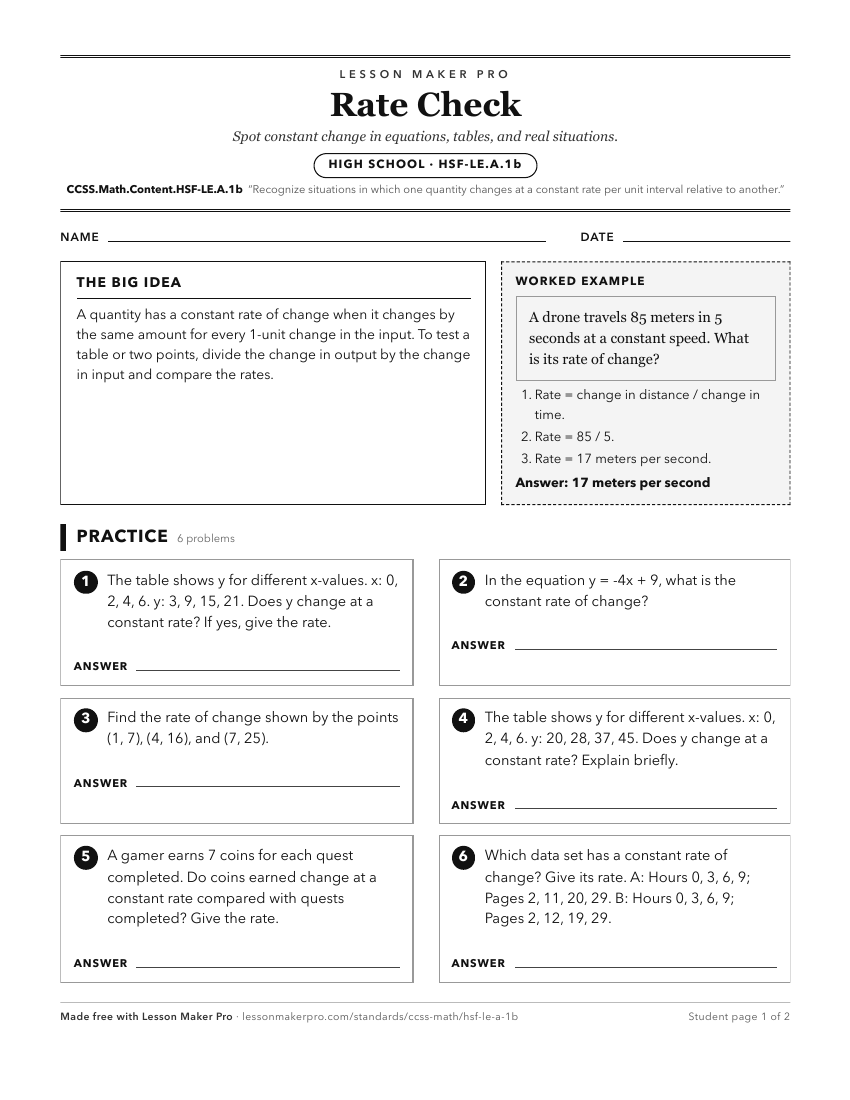
A ready-to-print activity worksheet aligned to CCSS.Math.Content.HSF-LE.A.1b, with an answer key for the teacher on its own page. No account needed.
PDF, US Letter, prints cleanly in black and white.
Download the worksheetLearning progression
Where This Standard Sits
Before This Standard
If students are struggling here, check these first.
- CCSS.Math.Content.8.EE.B.5
Unit rate as slope in proportional graphs supports recognizing a constant rate of change in broader linear situations.
- CCSS.Math.Content.7.RP.A.1
Unit rates help students identify the constant change per one unit that signals a linear situation.
- CCSS.Math.Content.8.F.B.4
Finding and interpreting a linear rate of change prepares students to identify situations with a constant rate per interval.
Keep exploring
Related Standards
- CCSS.Math.Content.7.RP.A.2
Recognize and represent proportional relationships between quantities.
- CCSS.Math.Content.HSF-LE.A.1c
Recognize situations in which a quantity grows or decays by a constant percent rate per unit interval relative to another.
- CCSS.Math.Content.6.RP.A.3b
Solve unit rate problems including those involving unit pricing and constant speed.
- CCSS.Math.Content.7.RP.A.2b
Identify the constant of proportionality (unit rate) in tables, graphs, equations, diagrams, and verbal descriptions of proportional relationships.
Turn this exact standard into a lesson
Grade, subject, topic, and the complete standard are prefilled. Create one free, no account needed.
Also for this standard:Make a WorksheetMake a QuizMake a Sub Lesson