CCSS.
The Standard
Verify experimentally the properties of dilations given by a center and a scale factor:
Common Core State Standards for Mathematics
Teacher's field guide
What This Standard Means
What Students Need to Do
- Students construct dilated figures from a given center and scale factor. They use measurements and diagrams to verify how lengths and lines change.
What Mastery Looks Like
- Students accurately construct a dilation from any given center and positive scale factor. They show that lengths are multiplied by the scale factor and identify which lines stay fixed or become parallel.
Common Misconceptions
- Students may multiply coordinates from the origin even when the center is elsewhere. They may also think every line moves, rather than recognizing that a line through the center maps onto itself.
How to Assess It
- Give a center, scale factor, segment, and line through the center. Ask students to draw both images and explain what changes and what stays the same.
Lesson moves
Ways to Teach It
Use patty paper, rulers, and a marked center to dilate a triangle, then compare side lengths, slopes, and alignment with the center.
Ask students to explain why a line through the center maps onto itself while another line maps to a parallel line.
Play a matching game with dilation diagrams, scale factors, length ratios, and statements about parallel or unchanged lines.
Resize a simple floor plan by a given scale factor, then calculate new wall lengths and identify parallel walls.
Free download
Printable HSG-SRT.A.1 Worksheet
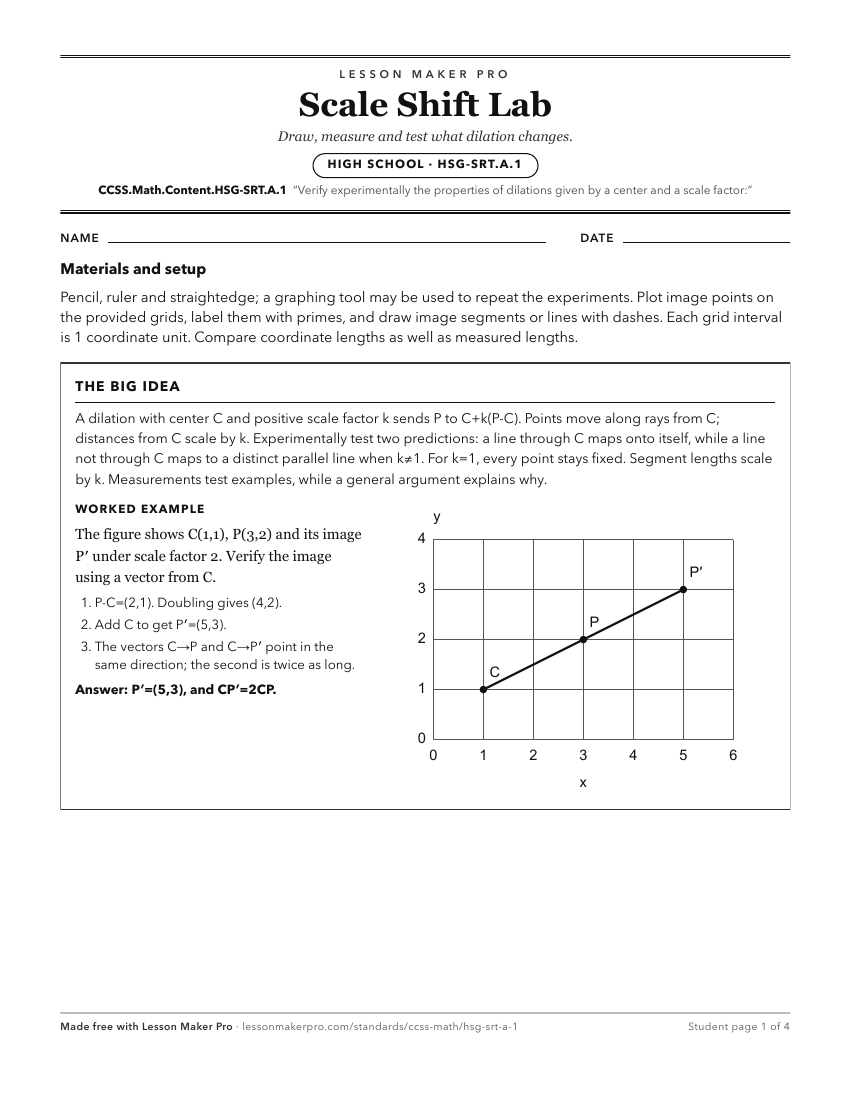
A ready-to-print activity worksheet aligned to CCSS.Math.Content.HSG-SRT.A.1, with an answer key for the teacher on its own page. No account needed.
PDF, US Letter, prints cleanly in black and white.
Download the worksheetLearning progression
Where This Standard Sits
Before This Standard
If students are struggling here, check these first.
- CCSS.Math.Content.8.G.A.3
Coordinate descriptions of dilations prepare students to test how centers and scale factors move points and change distances.
- CCSS.Math.Content.8.G.A.1
Experimenting with rigid transformations prepares students to track how transformations move points and affect lengths, angles, and lines.
- CCSS.Math.Content.7.G.A.1
Scale drawings give students experience with scale factors and proportional lengths before studying dilations from a center.
What This Unlocks
Mastery here sets students up for these next.
- CCSS.Math.Content.HSG-C.A.1
Proving circles similar depends on using a dilation scale factor to map one radius, and all points, onto another circle.
- CCSS.Math.Content.HSG-SRT.A.3
AA similarity proof relies on knowing dilations preserve angles and scale lengths from a center by a fixed factor.
- CCSS.Math.Content.HSG-SRT.A.2
Similarity transformations depend on dilations preserving angles, making parallel images, and scaling lengths, which explains proportional sides.
- CCSS.Math.Content.HSG-SRT.A.1b
Understanding dilations by center and scale factor supports seeing every segment length multiply by that scale factor.
Keep exploring
Related Standards
Turn this exact standard into a lesson
Grade, subject, topic, and the complete standard are prefilled. Create one free, no account needed.
Also for this standard:Make a WorksheetMake a QuizMake a Sub Lesson