CCSS.
Standard Cluster
Understand similarity in terms of similarity transformations
Common Core State Standards for Mathematics · High School — Geometry
Cluster contents
Standards in This Cluster
CCSS.Math.Content.HSG-SRT.A is a cluster heading. These are the individual standards under it.
- CCSS.Math.Content.HSG-SRT.A.1
Verify experimentally the properties of dilations given by a center and a scale factor:
- CCSS.Math.Content.HSG-SRT.A.1a
A dilation takes a line not passing through the center of the dilation to a parallel line, and leaves a line passing through the center unchanged.
- CCSS.Math.Content.HSG-SRT.A.1b
The dilation of a line segment is longer or shorter in the ratio given by the scale factor.
- CCSS.Math.Content.HSG-SRT.A.2
Given two figures, use the definition of similarity in terms of similarity transformations to decide if they are similar; explain using similarity transformatio...
- CCSS.Math.Content.HSG-SRT.A.3
Use the properties of similarity transformations to establish the AA criterion for two triangles to be similar.
Teacher's field guide
What This Cluster Means
What Students Need to Do
- Students describe how dilations change lengths, preserve angle measures, and map lines to parallel lines or the same line. They use dilations and rigid motions to decide whether figures are similar and justify the AA criterion.
What Mastery Looks Like
- Given two figures on a coordinate grid, students can identify a dilation center and scale factor, then describe any needed translation, rotation, or reflection. They justify similarity using equal corresponding angles and proportional corresponding sides.
Common Misconceptions
- Students often confuse similarity with congruence, reverse the scale factor, or add the same amount to each side instead of multiplying. They may match the wrong vertices or assume figures are similar because they look alike.
How to Assess It
- Exit ticket: Triangle ABC has vertices A(0,0), B(2,0), C(0,3), and triangle DEF has D(1,1), E(5,1), F(1,7). Describe a transformation sequence mapping ABC to DEF, then justify that the triangles are similar.
Lesson moves
Ways to Teach It
Give students grid triangles and tracing paper; they dilate from a marked center, then slide, turn, or flip each image onto its match.
Ask, "Why does a dilation preserve angle measures but change lengths?" Students write three sentences, then compare explanations with a partner.
Run a card sort matching figure pairs, transformation sequences, scale factors, and similarity statements; teams verify matches with coordinate calculations.
Provide maps with two scales and matching road triangles; students calculate corresponding distances and explain why the map shapes are similar.
Free download
Printable HSG-SRT.A Worksheet
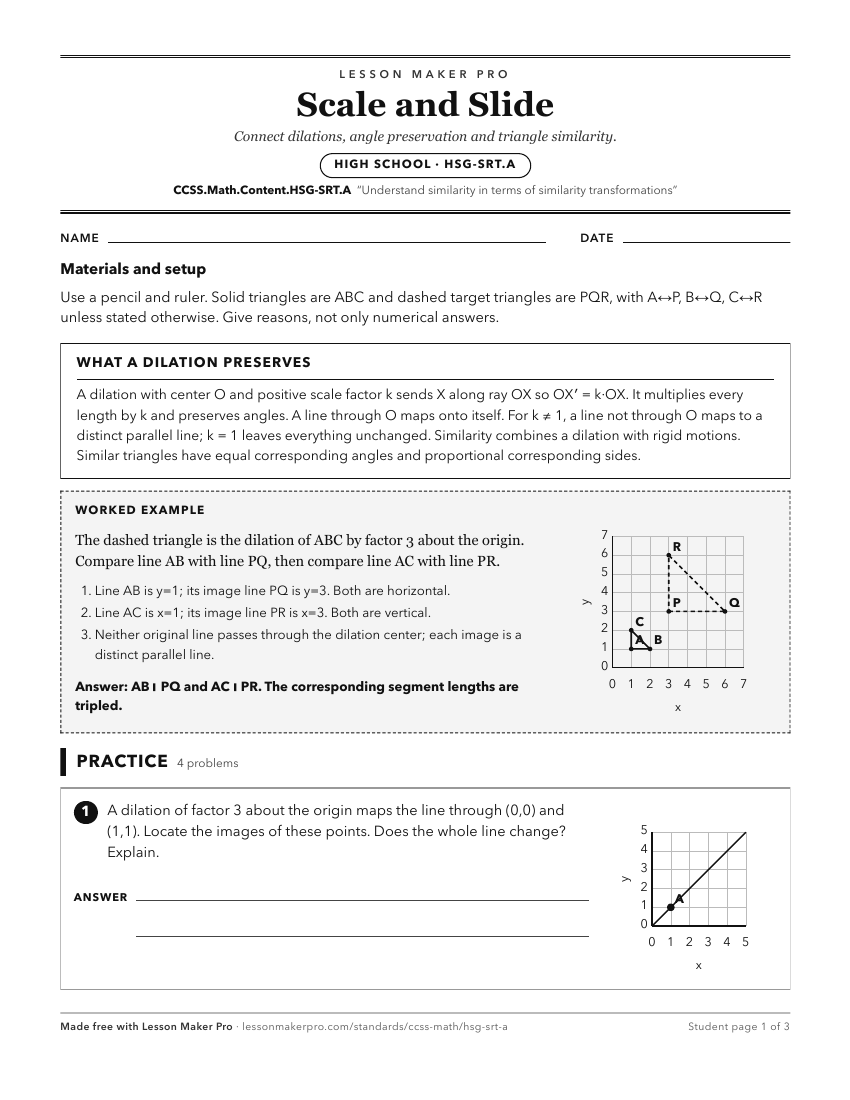
A ready-to-print activity worksheet aligned to CCSS.Math.Content.HSG-SRT.A, with an answer key for the teacher on its own page. No account needed.
PDF, US Letter, prints cleanly in black and white.
Download the worksheetKeep exploring
Related Standards
Turn this cluster into a lesson
Grade, subject, topic, and the complete cluster are prefilled. Create one free, no account needed.
Also for this cluster:Make a WorksheetMake a QuizMake a Sub Lesson