CCSS.
The Standard
An angle that turns through n one-degree angles is said to have an angle measure of n degrees.
Common Core State Standards for Mathematics
Teacher's field guide
What This Standard Means
What Students Need to Do
- Students treat one degree as a unit for measuring a turn. They determine an angle’s measure by counting how many one-degree turns fit between its rays.
What Mastery Looks Like
- Students connect the number of equal one-degree turns to the angle’s measure. They can explain that ray length and rotation direction do not change that measure.
Common Misconceptions
- Students may think longer rays create a larger angle. They may count marks instead of spaces, or confuse the direction of a turn with its measure.
How to Assess It
- Exit ticket: Draw a ray that turns 73 one-degree steps from its starting position. State the angle measure and explain what 73 counts.
Lesson moves
Ways to Teach It
Give students a paper circle divided into 360 sectors and two hinged strips; they open an angle, count sectors, and label its measure.
Maya says longer rays make a larger angle; draw a counterexample and explain what actually determines angle measure.
Play Angle Match: students pair an angle card with a card stating how many one-degree turns it contains.
Use clock hands to compare quarter, half, and smaller turns, then describe each angle as a count of one-degree turns.
Free download
Printable 4.MD.C.5b Worksheet
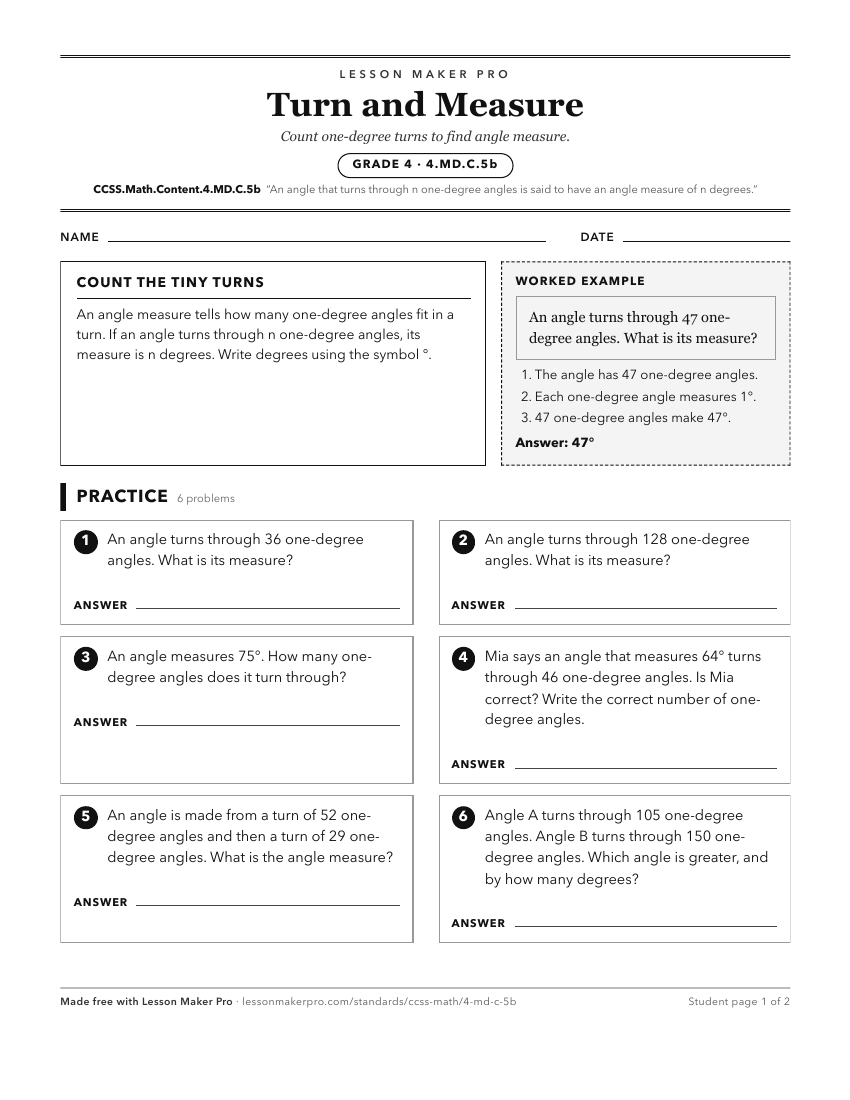
A ready-to-print activity worksheet aligned to CCSS.Math.Content.4.MD.C.5b, with an answer key for the teacher on its own page. No account needed.
PDF, US Letter, prints cleanly in black and white.
Download the worksheetLearning progression
Where This Standard Sits
Before This Standard
If students are struggling here, check these first.
What This Unlocks
Mastery here sets students up for these next.
Keep exploring
Related Standards
Turn this exact standard into a lesson
Grade, subject, topic, and the complete standard are prefilled. Create one free, no account needed.
Also for this standard:Make a WorksheetMake a QuizMake a Sub Lesson