CCSS.
The Standard
- CCSS.Math.Content.K.G.A
- Identify and describe shapes (squares, circles, triangles, rectangles, hexagons, cubes, cones, cylinders, and spheres).
Describe objects in the environment using names of shapes, and describe the relative positions of these objects using terms such as above, below, beside, in front of, behind, and next to.
Common Core State Standards for Mathematics · Geometry
Teacher's field guide
What This Standard Means
What Students Need to Do
- Students name flat and solid shapes they see in familiar objects. They tell where one object is compared with another using words such as above, below, beside, behind, and in front of.
What Mastery Looks Like
- Students correctly match familiar objects to shape names, including solid shapes. They describe one object's location compared with another object using clear position words.
Common Misconceptions
- Students may name objects instead of their shapes, such as saying "ball" instead of "sphere." They may also reverse above and below, or confuse in front of and behind.
How to Assess It
- Show a picture of a clock above a door and a ball beside a box. Ask, "What shapes do you see, and where is each object?"
Adopted as
This framework is adopted as written in Connecticut, Delaware, District of Columbia, Illinois, Michigan, Nevada, New Hampshire, New Mexico, Vermont.
- Alabama: K_G_A_18
- California: K_G_1
- Connecticut: CCSS.Math.Content.K.G.A.1
- Delaware: CCSS.Math.Content.K.G.A.1
- District of Columbia: CCSS.Math.Content.K.G.A.1
- Michigan: CCSS.Math.Content.K.G.A.1
- Mississippi: K_G_1
- Nevada: CCSS.Math.Content.K.G.A.1
- New Hampshire: CCSS.Math.Content.K.G.A.1
- New Mexico: CCSS.Math.Content.K.G.A.1
- Vermont: CCSS.Math.Content.K.G.A.1
- Washington: CCSS.Math.Content.K.G.A.1
- Washington: K_G_A_1
Lesson moves
Ways to Teach It
Give pairs foam shapes and toy objects, then call out directions such as, "Place the cone behind the cube."
Show a classroom photo and ask, "What shapes can you find, and where is each one compared with another object?"
Play Shape and Position Bingo using cards with pictures such as a circle above a square or a cylinder beside a cube.
Take a school shape walk, then record examples such as a rectangular door below a circular clock.
Free download
Printable K.G.A.1 Worksheet
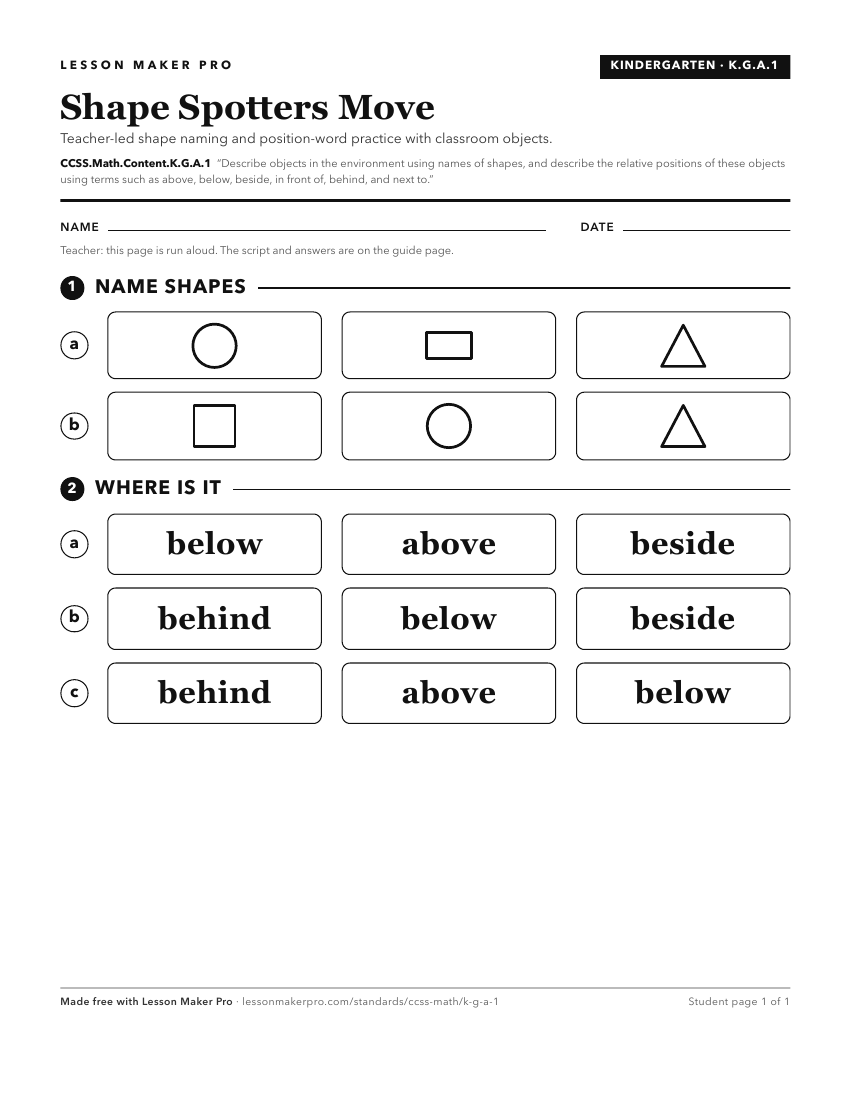
A ready-to-print activity worksheet aligned to CCSS.Math.Content.K.G.A.1, with an answer key for the teacher on its own page. No account needed.
PDF, US Letter, prints cleanly in black and white.
Download the worksheetWhat This Unlocks
Mastery here sets students up for these next.
Keep exploring
Related Standards
- CCSS.Math.Content.K.G.A
Identify and describe shapes (squares, circles, triangles, rectangles, hexagons, cubes, cones, cylinders, and spheres).
- CCSS.Math.Content.K.G.B.4
Analyze and compare two- and three-dimensional shapes, in different sizes and orientations, using informal language to describe their similarities, differences,...
- CCSS.Math.Content.HSG-MG.A.1
Use geometric shapes, their measures, and their properties to describe objects (e.g., modeling a tree trunk or a human torso as a cylinder).
- CCSS.Math.Content.K.CC.B.4a
When counting objects, say the number names in the standard order, pairing each object with one and only one number name and each number name with one and only ...
Turn this exact standard into a lesson
Grade, subject, topic, and the complete standard are prefilled. Create one free, no account needed.
Also for this standard:Make a WorksheetMake a QuizMake a Sub Lesson