CCSS.
The Standard
Tell and write time to the nearest minute and measure time intervals in minutes. Solve word problems involving addition and subtraction of time intervals in minutes, e.g., by representing the problem on a number line diagram.
Common Core State Standards for Mathematics · Measurement and Data
Teacher's field guide
What This Standard Means
What Students Need to Do
- Students read analog and digital clocks to the nearest minute and record times correctly. They find elapsed time and solve start-time, end-time, and duration problems using addition, subtraction, or a number line.
What Mastery Looks Like
- A student reads and writes times such as 8:06 and 4:53 accurately. They find elapsed time across an hour and explain their minute jumps on a number line.
Common Misconceptions
- Students may confuse the hour and minute hands or read each number as one minute. They may write 3:07 as 3:7. When an interval crosses an hour, they may subtract the minute values without accounting for 60 minutes.
How to Assess It
- Exit ticket: Draw clock hands for 2:47, then show on an open number line how many minutes pass from 2:47 to 3:18.
Lesson moves
Ways to Teach It
Give pairs movable clocks and time cards, then have one student set each time while the other checks it.
Ask students to explain in writing how they would find the minutes from 10:48 to 11:15.
Play Time Interval Match by pairing cards showing start times, end times, and matching elapsed minutes.
Use a class schedule to calculate how many minutes remain before lunch, recess, dismissal, or another daily event.
Free download
Printable 3.MD.A.1 Worksheet
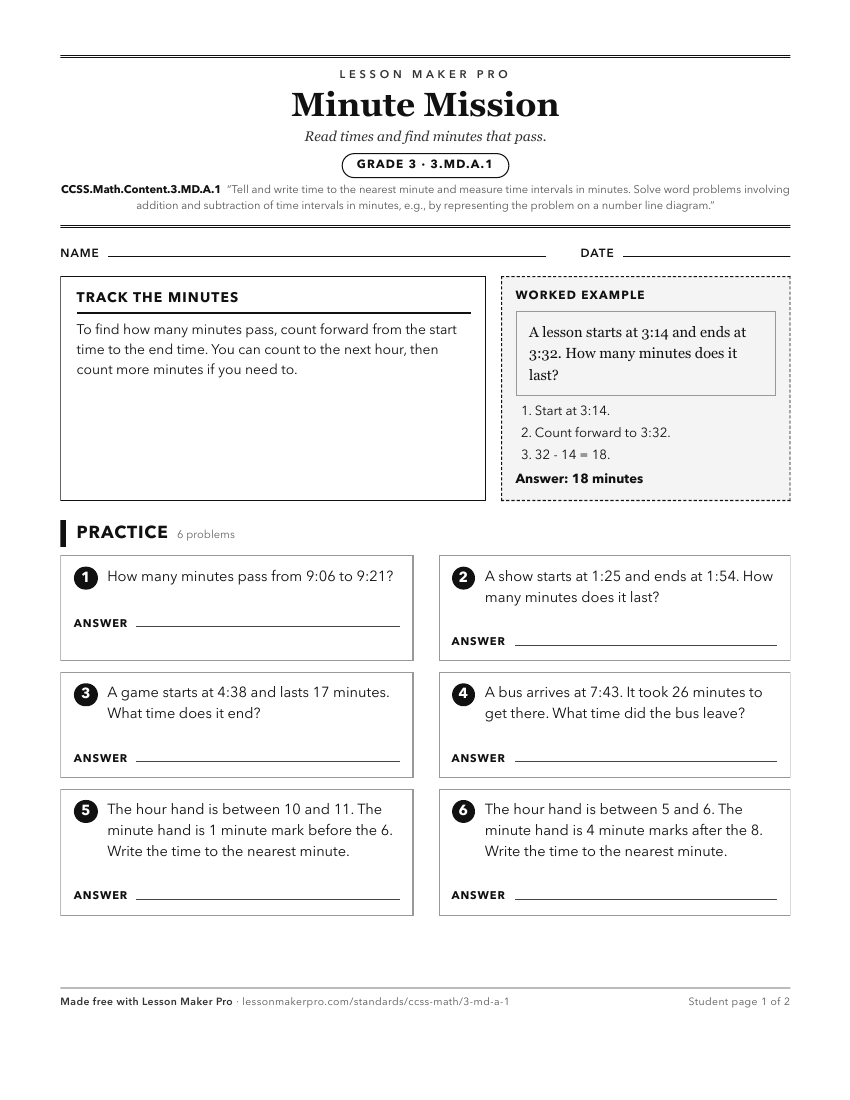
A ready-to-print activity worksheet aligned to CCSS.Math.Content.3.MD.A.1, with an answer key for the teacher on its own page. No account needed.
PDF, US Letter, prints cleanly in black and white.
Download the worksheetLearning progression
Where This Standard Sits
See the whole path on the Measurement & Data progression map.
Before This Standard
If students are struggling here, check these first.
- CCSS.Math.Content.2.MD.C.7
Reading clocks to five minutes and using a.m./p.m. are needed for nearest-minute time and elapsed-time problems.
- CCSS.Math.Content.2.NBT.B.5
Fluent two-digit addition and subtraction supports finding elapsed minutes and solving time interval word problems on number lines.
- CCSS.Math.Content.2.MD.B.6
Number line jumps for sums and differences support representing elapsed minutes and solving time-interval problems on a timeline.
What This Unlocks
Mastery here sets students up for these next.
- CCSS.Math.Content.4.MD.A.1
Elapsed-time work gives students concrete experience with hours and minutes before converting among hr, min, and sec.
- CCSS.Math.Content.4.MD.A.2
Solving elapsed-time problems in minutes carries into multi-operation measurement word problems with time and scaled number line diagrams.
Keep exploring
Related Standards
- CCSS.Math.Content.2.MD.B.5
Use addition and subtraction within 100 to solve word problems involving lengths that are given in the same units, e.g., by using drawings (such as drawings of ...
- CCSS.Math.Content.1.MD.B
Tell and write time.
- CCSS.Math.Content.K.OA.A.2
Solve addition and subtraction word problems, and add and subtract within 10, e.g., by using objects or drawings to represent the problem.
Turn this exact standard into a lesson
Grade, subject, topic, and the complete standard are prefilled. Create one free, no account needed.
Also for this standard:Make a WorksheetMake a QuizMake a Sub Lesson