CCSS.
The Standard
Fluently add and subtract within 100 using strategies based on place value, properties of operations, and/or the relationship between addition and subtraction.
Common Core State Standards for Mathematics · Number and Operations in Base Ten
Teacher's field guide
What This Standard Means
What Students Need to Do
- Students add and subtract numbers within 100 without relying on slow counting by ones. They choose and explain strategies using tens and ones, number properties, or related addition and subtraction facts.
What Mastery Looks Like
- Students solve addition and subtraction problems within 100 accurately and efficiently. They break numbers into tens and ones, make a ten, or use the inverse operation, and can explain their steps.
Common Misconceptions
- Students may add or subtract each digit separately without regrouping, such as solving 52 minus 28 as 34. Some count by ones for every problem or confuse when to compose or decompose a ten.
How to Assess It
- Give the exit ticket: “Solve 46 + 27 and 72 minus 38. Show a place value strategy for each, then check one answer using the inverse operation.”
Lesson moves
Ways to Teach It
Give pairs base-ten blocks to build 47 and 26, combine or regroup the pieces, and record the matching equation.
Ask students to solve 63 minus 28, then write two sentences explaining why they decomposed a ten.
Play Strategy Match by pairing equation cards with cards showing make-a-ten, tens-and-ones, or inverse-operation solutions.
Set up a class store with prices under $100, then have students find totals and change for two-item purchases.
Free download
Printable 2.NBT.B.5 Worksheet
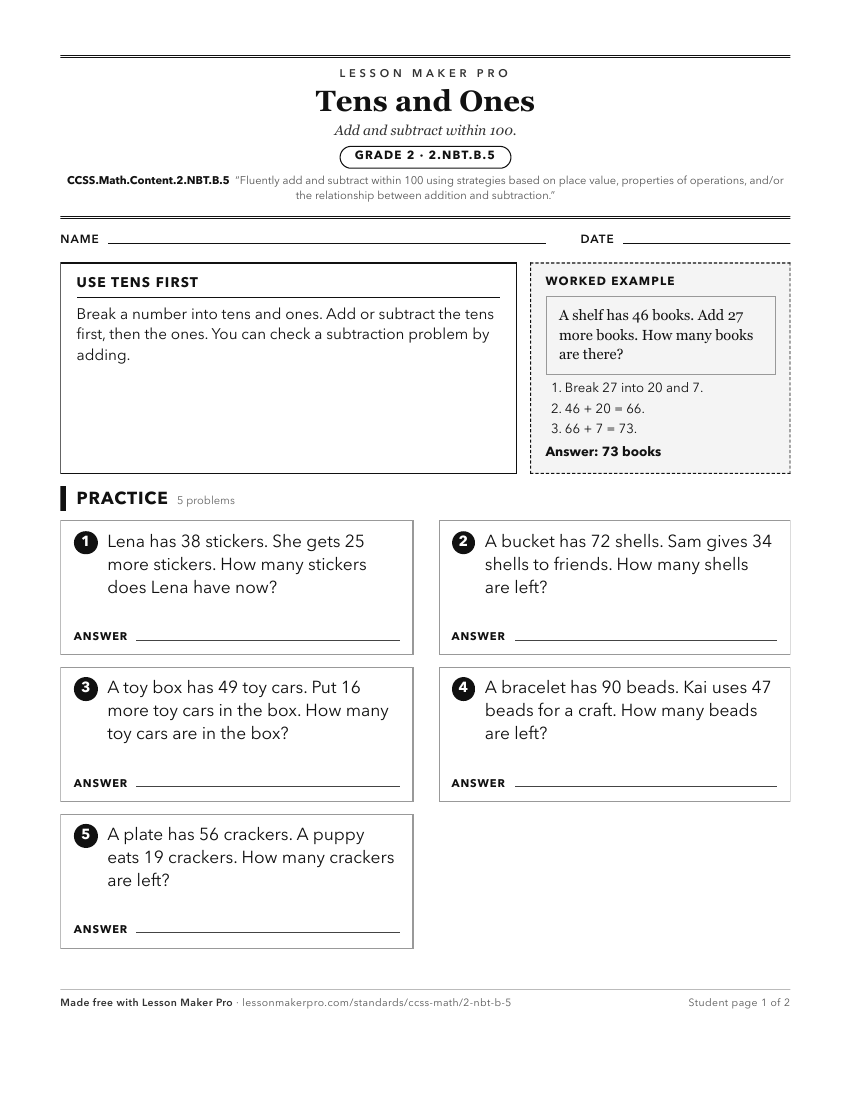
A ready-to-print activity worksheet aligned to CCSS.Math.Content.2.NBT.B.5, with an answer key for the teacher on its own page. No account needed.
PDF, US Letter, prints cleanly in black and white.
Download the worksheetLearning progression
Where This Standard Sits
See the whole path on the Number & Operations in Base Ten progression map.
Before This Standard
If students are struggling here, check these first.
- CCSS.Math.Content.1.OA.C.6
Within-20 facts, making tens, and addition-subtraction relationships support efficient two-digit strategies within 100.
- CCSS.Math.Content.1.NBT.B.2
Students need tens and ones meanings to decompose two-digit numbers for efficient addition and subtraction within 100.
- CCSS.Math.Content.1.NBT.C.4
Place value addition within 100, including composing tens, is necessary before students can fluently add within 100.
What This Unlocks
Mastery here sets students up for these next.
- CCSS.Math.Content.3.MD.A.1
Fluent two-digit addition and subtraction supports finding elapsed minutes and solving time interval word problems on number lines.
- CCSS.Math.Content.2.NBT.B.7
Two-digit place-value addition and subtraction with composing tens extends directly to hundreds, tens, and ones in three-digit calculations.
- CCSS.Math.Content.3.NBT.A.2
Fluent two-digit addition and subtraction with place value and regrouping are needed for extending the same methods to three-digit numbers.
- CCSS.Math.Content.2.MD.C.8
Fluent adding and subtracting within 100 helps students combine and compare coin values in money word problems.
- CCSS.Math.Content.2.OA.A.1
Efficient adding and subtracting within 100 supports solving and checking the computations in one- and two-step word problems.
- CCSS.Math.Content.2.NBT.B.9
Using place-value and operation strategies gives students concrete methods to justify when explaining why addition and subtraction work.
Keep exploring
Related Standards
Turn this exact standard into a lesson
Grade, subject, topic, and the complete standard are prefilled. Create one free, no account needed.
Also for this standard:Make a WorksheetMake a QuizMake a Sub Lesson