CCSS.
The Standard
Add within 100, including adding a two-digit number and a one-digit number, and adding a two-digit number and a multiple of 10, using concrete models or drawings and strategies based on place value, properties of operations, and/or the relationship between addition and subtraction; relate the strategy to a written method and explain the reasoning used. Understand that in adding two-digit numbers, one adds tens and tens, ones and ones; and sometimes it is necessary to compose a ten.
Common Core State Standards for Mathematics · Number and Operations in Base Ten
Teacher's field guide
What This Standard Means
What Students Need to Do
- Students add to a two-digit number by combining tens with tens and ones with ones. They use blocks or drawings, connect the model to equations, and explain how they made a new ten when needed.
What Mastery Looks Like
- A student correctly solves problems such as 36 + 7 and 36 + 40. They show how tens and ones are combined and explain when 10 ones become a new ten.
Common Misconceptions
- Students may treat 40 as 4 ones or combine tens with ones. When the ones total 10 or more, they may forget to trade 10 ones for 1 ten.
How to Assess It
- Give an exit ticket: Solve 27 + 8 and 27 + 30. Draw a tens-and-ones model for each and explain one strategy in a sentence.
Lesson moves
Ways to Teach It
Build 28 and 7 with base-ten blocks, trade 10 ones for a tens rod, and record each step with equations.
Ask, "How are 34 + 5 and 34 + 50 alike and different?" Students sketch and explain to a partner.
Students draw a two-digit card and an addend card marked 1 through 9 or whole tens, then solve to keep the pair.
Present 32 library books plus 20 new books, then have students model the total and explain why the ones stay the same.
Free download
Printable 1.NBT.C.4 Worksheet
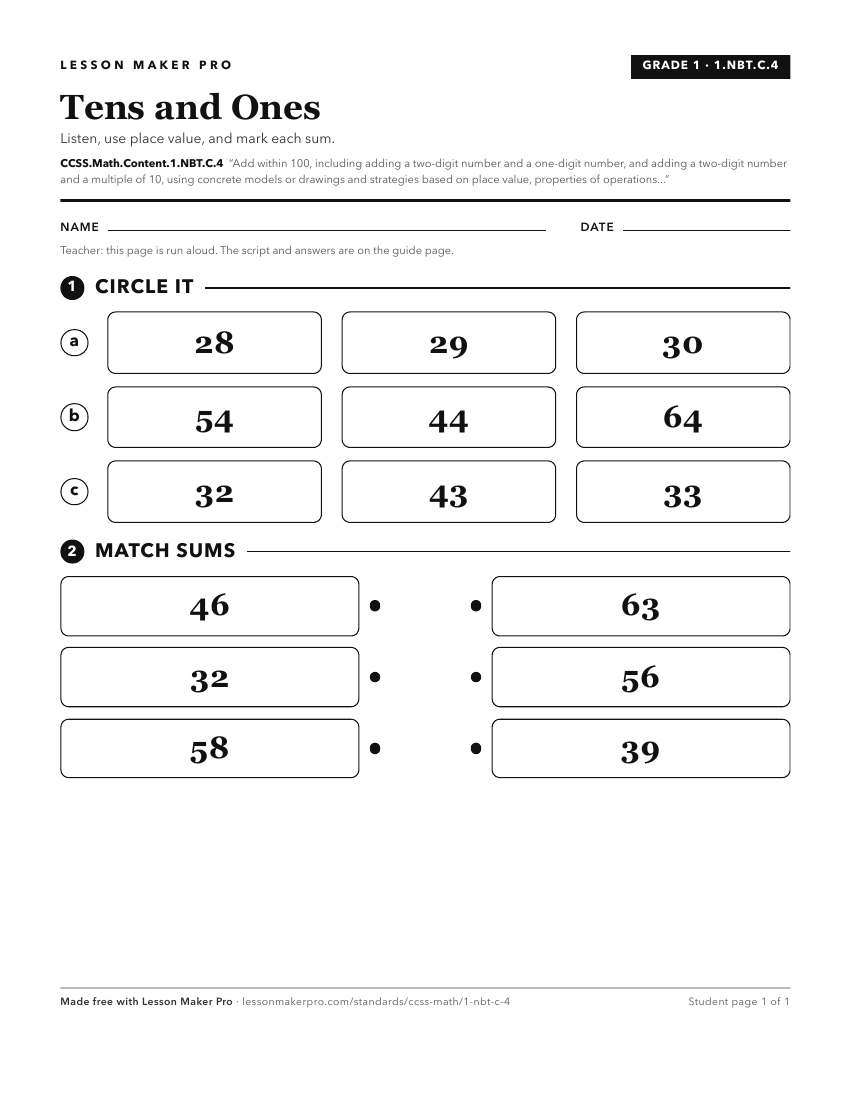
A ready-to-print activity worksheet aligned to CCSS.Math.Content.1.NBT.C.4, with an answer key for the teacher on its own page. No account needed.
PDF, US Letter, prints cleanly in black and white.
Download the worksheetLearning progression
Where This Standard Sits
See the whole path on the Number & Operations in Base Ten progression map.
Before This Standard
If students are struggling here, check these first.
- CCSS.Math.Content.1.NBT.B.2
Students need two-digit tens-and-ones place value to add tens with tens, ones with ones, and compose a ten.
- CCSS.Math.Content.1.OA.C.6
Within-20 facts, making ten, and decomposition support composing a ten and explaining two-digit addition strategies within 100.
- CCSS.Math.Content.1.NBT.C.5
Mentally changing a number by ten supports adding multiples of ten and tracking tens while ones stay the same.
What This Unlocks
Mastery here sets students up for these next.
- CCSS.Math.Content.2.NBT.B.5
Place value addition within 100, including composing tens, is necessary before students can fluently add within 100.
- CCSS.Math.Content.2.NBT.B.6
Adding four two-digit numbers requires combining tens and ones across addends and composing tens, first learned with two two-digit sums.
Keep exploring
Related Standards
- CCSS.Math.Content.5.NBT.B.7
Add, subtract, multiply, and divide decimals to hundredths, using concrete models or drawings and strategies based on place value, properties of operations, and...
- CCSS.Math.Content.2.NBT.B.7
Add and subtract within 1000, using concrete models or drawings and strategies based on place value, properties of operations, and/or the relationship between a...
- CCSS.Math.Content.1.NBT.C.6
Subtract multiples of 10 in the range 10-90 from multiples of 10 in the range 10-90 (positive or zero differences), using concrete models or drawings and strate...
Turn this exact standard into a lesson
Grade, subject, topic, and the complete standard are prefilled. Create one free, no account needed.
Also for this standard:Make a WorksheetMake a QuizMake a Sub Lesson