CCSS.
The Standard
Subtract multiples of 10 in the range 10-90 from multiples of 10 in the range 10-90 (positive or zero differences), using concrete models or drawings and strategies based on place value, properties of operations, and/or the relationship between addition and subtraction; relate the strategy to a written method and explain the reasoning used.
Common Core State Standards for Mathematics · Number and Operations in Base Ten
Teacher's field guide
What This Standard Means
What Students Need to Do
- Students subtract one multiple of ten from another and find a difference of zero or more. They use objects, drawings, place value, or addition facts, then connect their strategy to an equation.
What Mastery Looks Like
- Students correctly solve problems such as 80 minus 30 using tens rods, drawings, or known addition facts. They connect 8 tens minus 3 tens to 5 tens and explain why the answer is 50.
Common Misconceptions
- Students may subtract the ones digits and ignore the tens, or treat 60 minus 20 as 6 minus 2 without naming tens. Some count backward by ones, reverse the numbers, or think a zero answer is not allowed.
How to Assess It
- Give the exit ticket: “Solve 70 minus 30. Draw tens, write an equation, and explain how your drawing matches your equation.”
Lesson moves
Ways to Teach It
Give pairs base-ten rods to build 70, remove 40, and record the remaining tens with a drawing and equation.
Ask students to explain why 60 minus 20 can be solved like 6 minus 2, while keeping track of tens.
Play Tens Takeaway: students draw two multiple-of-ten cards, subtract the smaller number, and earn a point for a correct explanation.
Set up a classroom store where items cost multiples of ten cents, then have students find how much remains from 90 cents.
Free download
Printable 1.NBT.C.6 Worksheet
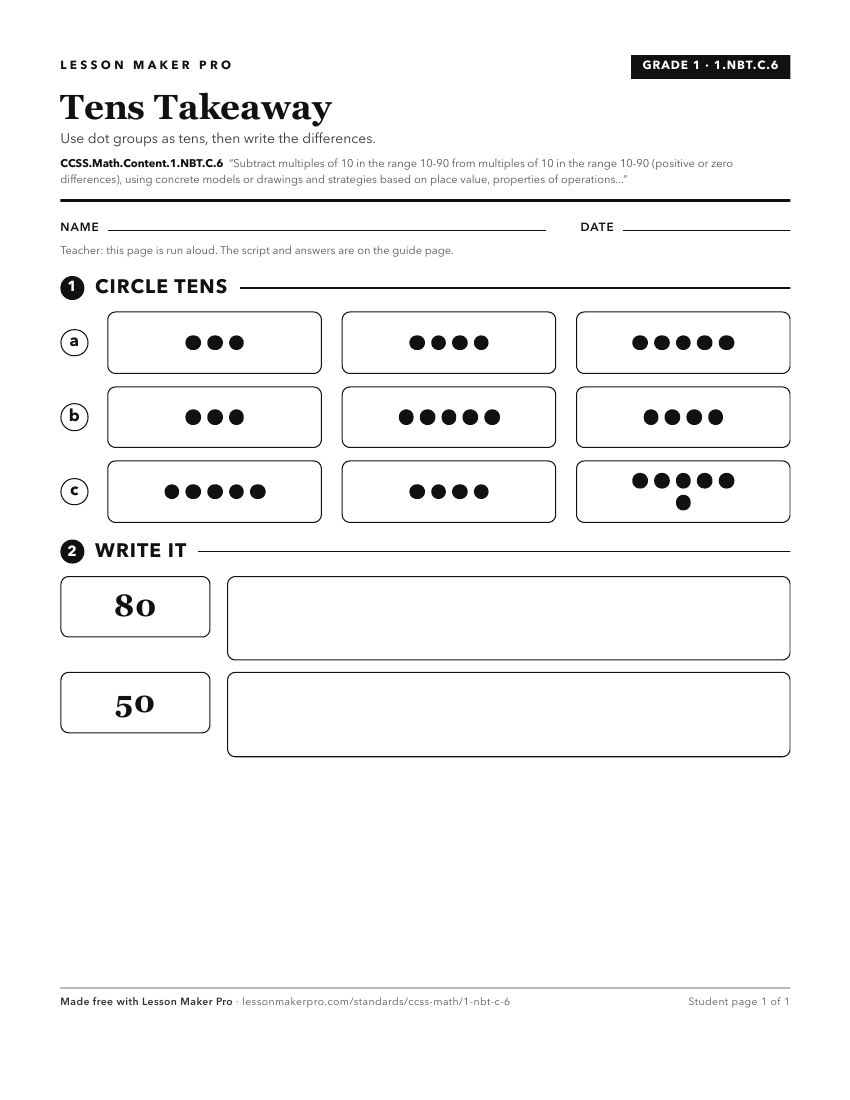
A ready-to-print activity worksheet aligned to CCSS.Math.Content.1.NBT.C.6, with an answer key for the teacher on its own page. No account needed.
PDF, US Letter, prints cleanly in black and white.
Download the worksheetLearning progression
Where This Standard Sits
See the whole path on the Number & Operations in Base Ten progression map.
Before This Standard
If students are struggling here, check these first.
- CCSS.Math.Content.1.NBT.B.2c
Subtracting 70 minus 30 as 7 tens minus 3 tens requires knowing decade numbers represent groups of tens.
- CCSS.Math.Content.K.OA.A.1
Representing subtraction with objects, drawings, equations, and explanations supports modeling tens subtraction and connecting strategies to written methods.
- CCSS.Math.Content.1.NBT.C.5
Finding 10 less mentally supports seeing each ten subtracted as one fewer ten, but full multiple-of-10 subtraction can use models.
Keep exploring
Related Standards
- CCSS.Math.Content.1.NBT.C.4
Add within 100, including adding a two-digit number and a one-digit number, and adding a two-digit number and a multiple of 10, using concrete models or drawing...
- CCSS.Math.Content.5.NBT.B.7
Add, subtract, multiply, and divide decimals to hundredths, using concrete models or drawings and strategies based on place value, properties of operations, and...
- CCSS.Math.Content.2.NBT.B.7
Add and subtract within 1000, using concrete models or drawings and strategies based on place value, properties of operations, and/or the relationship between a...
- CCSS.Math.Content.3.NBT.A.3
Multiply one-digit whole numbers by multiples of 10 in the range 10—90 (e.g., 9 × 80, 5 × 60) using strategies based on place value and properties of operations...
Turn this exact standard into a lesson
Grade, subject, topic, and the complete standard are prefilled. Create one free, no account needed.
Also for this standard:Make a WorksheetMake a QuizMake a Sub Lesson