CCSS.
The Standard
Tell and write time from analog and digital clocks to the nearest five minutes, using a.m. and p.m.
Common Core State Standards for Mathematics · Measurement and Data
Teacher's field guide
What This Standard Means
What Students Need to Do
- Students read clock hands by finding the hour and counting minute marks in groups of five. They write matching digital times and use context to label a.m. or p.m.
What Mastery Looks Like
- Given either clock format, a student states and writes the correct time in five-minute intervals. The student reads the hour hand correctly between numbers and uses a daily event to choose a.m. or p.m.
Common Misconceptions
- Students often count minute marks by ones instead of fives. They may name the next hour when the hour hand is between numbers. They may choose a.m. or p.m. from the clock face without using context.
How to Assess It
- Show an analog clock with the minute hand on 7 and the hour hand between 8 and 9. Ask, “Write the time for arriving at school, including a.m. or p.m.”
Lesson moves
Ways to Teach It
Give pairs movable clocks and time cards; one student sets each time, and the other writes the matching digital time.
Ask, “What extra information would help you decide whether 3:45 is a.m. or p.m.?”
Play Time Match with analog clock cards, digital time cards, and daily-event cards that students pair and label a.m. or p.m.
Use a class schedule to identify lunch, recess, and dismissal times, then write each time in digital form.
Free download
Printable 2.MD.C.7 Worksheet
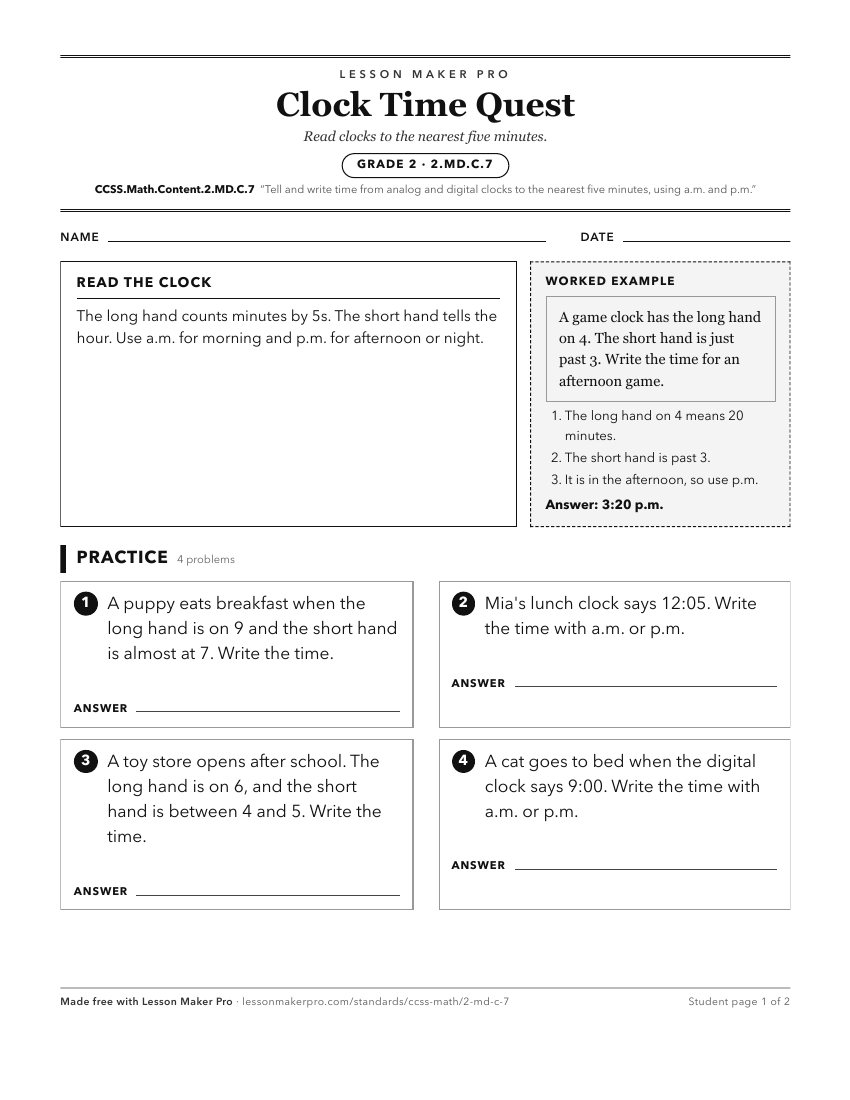
A ready-to-print activity worksheet aligned to CCSS.Math.Content.2.MD.C.7, with an answer key for the teacher on its own page. No account needed.
PDF, US Letter, prints cleanly in black and white.
Download the worksheetLearning progression
Where This Standard Sits
See the whole path on the Measurement & Data progression map.
Before This Standard
If students are struggling here, check these first.
- CCSS.Math.Content.1.MD.B.3
Reading clock faces and matching digital hour times carry over when adding five-minute intervals and a.m./p.m.
- CCSS.Math.Content.2.NBT.A.2
Skip-counting by fives helps students convert clock numbers to minute values when reading analog clocks to five minutes.
- CCSS.Math.Content.1.NBT.A.1
Reading and writing numerals to 60 supports recording digital times and interpreting minute numbers on clocks.
What This Unlocks
Mastery here sets students up for these next.
Keep exploring
Related Standards
Turn this exact standard into a lesson
Grade, subject, topic, and the complete standard are prefilled. Create one free, no account needed.
Also for this standard:Make a WorksheetMake a QuizMake a Sub Lesson