CCSS.
The Standard
Tell and write time in hours and half-hours using analog and digital clocks.
Common Core State Standards for Mathematics · Measurement and Data
Teacher's field guide
What This Standard Means
What Students Need to Do
- Students identify the hour hand and minute hand and use their positions to read a clock. They connect clock faces with written times ending in :00 or :30.
What Mastery Looks Like
- Students correctly read and write times such as 3:00 and 3:30. They place both clock hands correctly when given a digital time.
Common Misconceptions
- Students may switch the hour and minute hands or write 6:30 as 6:06. They may also point the hour hand directly at a number during a half-hour time.
How to Assess It
- Give an exit ticket with an analog clock showing 4:30 and a digital time of 7:00. Ask students to write the first time and draw the second.
Lesson moves
Ways to Teach It
Give pairs paper clocks with movable hands, then call out times for students to build and check together.
Ask students to write how the hands look different at 5:00 and 5:30, then share their descriptions.
Play Clock Match by having students pair analog clock cards with matching digital time cards.
Make a picture schedule for lunch, recess, and bedtime using analog clock drawings and matching digital times.
Free download
Printable 1.MD.B.3 Worksheet
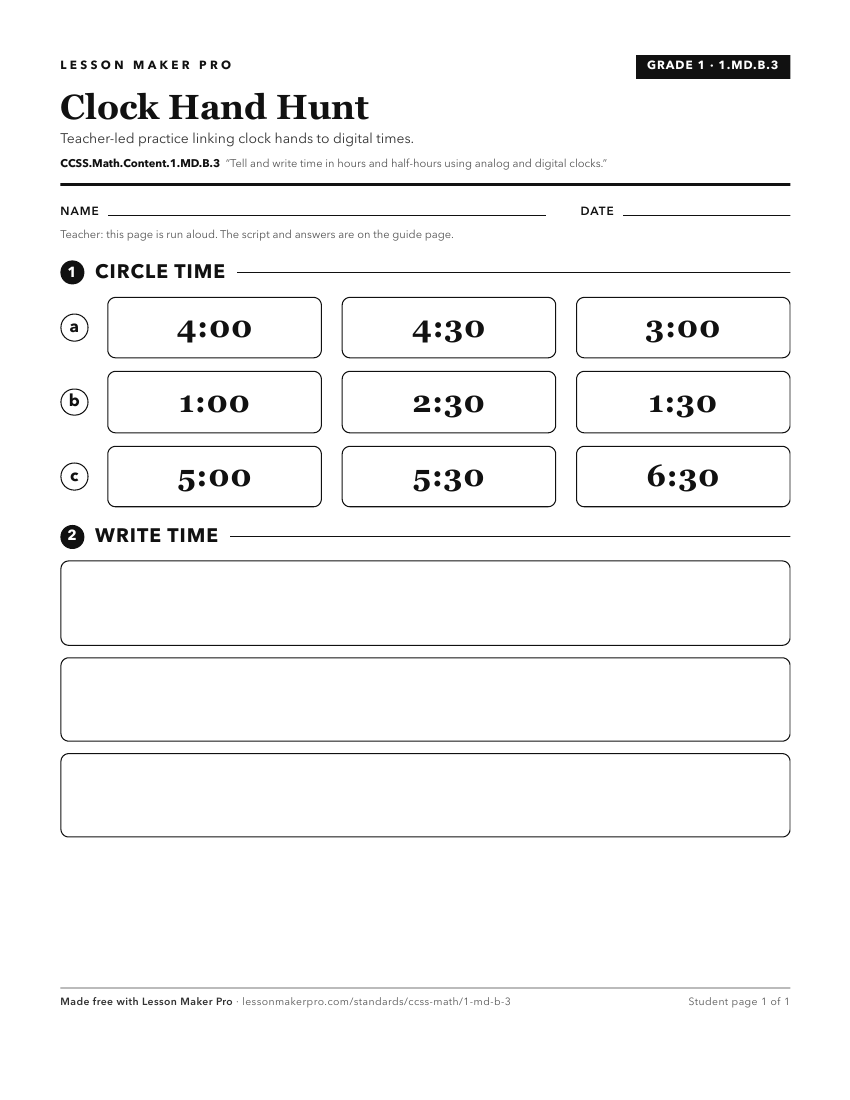
A ready-to-print activity worksheet aligned to CCSS.Math.Content.1.MD.B.3, with an answer key for the teacher on its own page. No account needed.
PDF, US Letter, prints cleanly in black and white.
Download the worksheetLearning progression
Where This Standard Sits
See the whole path on the Measurement & Data progression map.
Before This Standard
If students are struggling here, check these first.
What This Unlocks
Mastery here sets students up for these next.
Keep exploring
Related Standards
Turn this exact standard into a lesson
Grade, subject, topic, and the complete standard are prefilled. Create one free, no account needed.
Also for this standard:Make a WorksheetMake a QuizMake a Sub Lesson