CCSS.
The Standard
Count forward beginning from a given number within the known sequence (instead of having to begin at 1).
Common Core State Standards for Mathematics · Counting and Cardinality
Teacher's field guide
What This Standard Means
What Students Need to Do
- Start with a number named by the teacher and say the numbers that follow. Keep the sequence in order without going back to 1.
What Mastery Looks Like
- A student can begin at different numbers within the practiced range and continue in order. The student does not need to count from 1 first.
Common Misconceptions
- Students may restart at 1 when given another starting number. They may repeat the starting number, skip a number, or mix up teen numbers.
How to Assess It
- Give this oral exit prompt: “Start at 8 and say the next six numbers.” Note whether the student continues without returning to 1.
Lesson moves
Ways to Teach It
Give students number cards and have them build a six-card counting chain that begins with a card you choose.
Ask partners, “If we start at 12, what comes next, and how do you know without counting from 1?”
Play a circle game where students pass a beanbag and say the next number, beginning with a teacher-chosen number.
Number pretend bus seats, then have students call the seat numbers in order starting from any occupied seat.
Free download
Printable K.CC.A.2 Worksheet
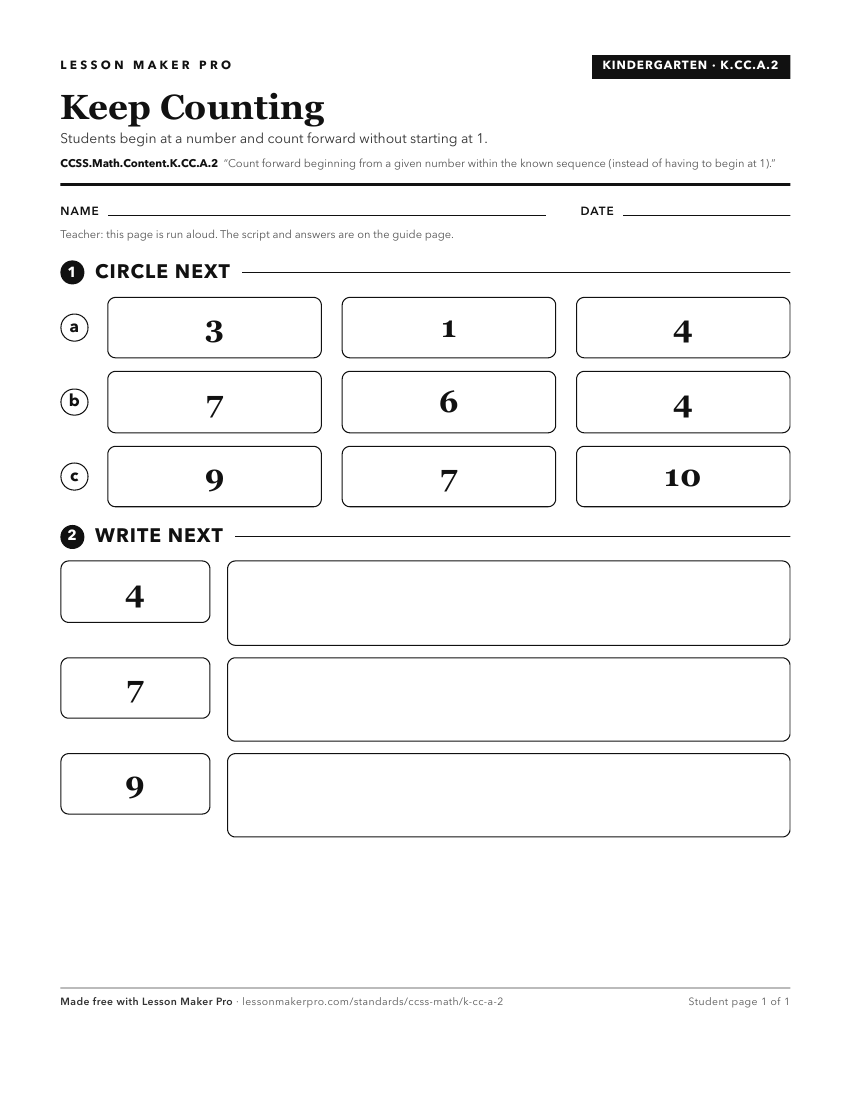
A ready-to-print activity worksheet aligned to CCSS.Math.Content.K.CC.A.2, with an answer key for the teacher on its own page. No account needed.
PDF, US Letter, prints cleanly in black and white.
Download the worksheetLearning progression
Where This Standard Sits
Before This Standard
If students are struggling here, check these first.
What This Unlocks
Mastery here sets students up for these next.
- CCSS.Math.Content.2.NBT.A.2
Counting on from any starting number supports extending the number sequence and recognizing skip-count patterns within 1000.
- CCSS.Math.Content.1.OA.C.5
Counting on for addition requires starting the count at an addend and continuing the number sequence accurately.
- CCSS.Math.Content.1.NBT.A.1
Counting on from a given number is required to count to 120 starting from any number less than 120.
Keep exploring
Related Standards
Turn this exact standard into a lesson
Grade, subject, topic, and the complete standard are prefilled. Create one free, no account needed.
Also for this standard:Make a WorksheetMake a QuizMake a Sub Lesson