CCSS.
Standard Cluster
Extend the counting sequence.
Common Core State Standards for Mathematics
Cluster contents
Standards in This Cluster
CCSS.Math.Content.1.NBT.A is a cluster heading. These are the individual standards under it.
Teacher's field guide
What This Cluster Means
What Students Need to Do
- Students count forward to 120 from any starting number below 120. They read and write numerals and match each numeral to a counted set.
What Mastery Looks Like
- A student can start at 47 and count forward without returning to 1. They can complete missing-number sequences through 120 and match written numerals to counted sets.
Common Misconceptions
- Students often skip numbers when crossing a decade, such as moving from 39 to 50. They may reverse written numerals or think counting stops at 100.
How to Assess It
- Ask students to start at 96, write the next 12 numbers, and circle 100.
Lesson moves
Ways to Teach It
Give pairs mixed number cards from 65 to 85 and have them build the sequence on the floor.
Ask, “How do you know what comes after 79?” Have students explain the pattern in words or pictures.
Students roll a die, move that many spaces on a 120 chart, and say each number they pass.
Count a classroom collection, such as crayons or linking cubes, then write and attach a numeral label.
Free download
Printable 1.NBT.A Worksheet
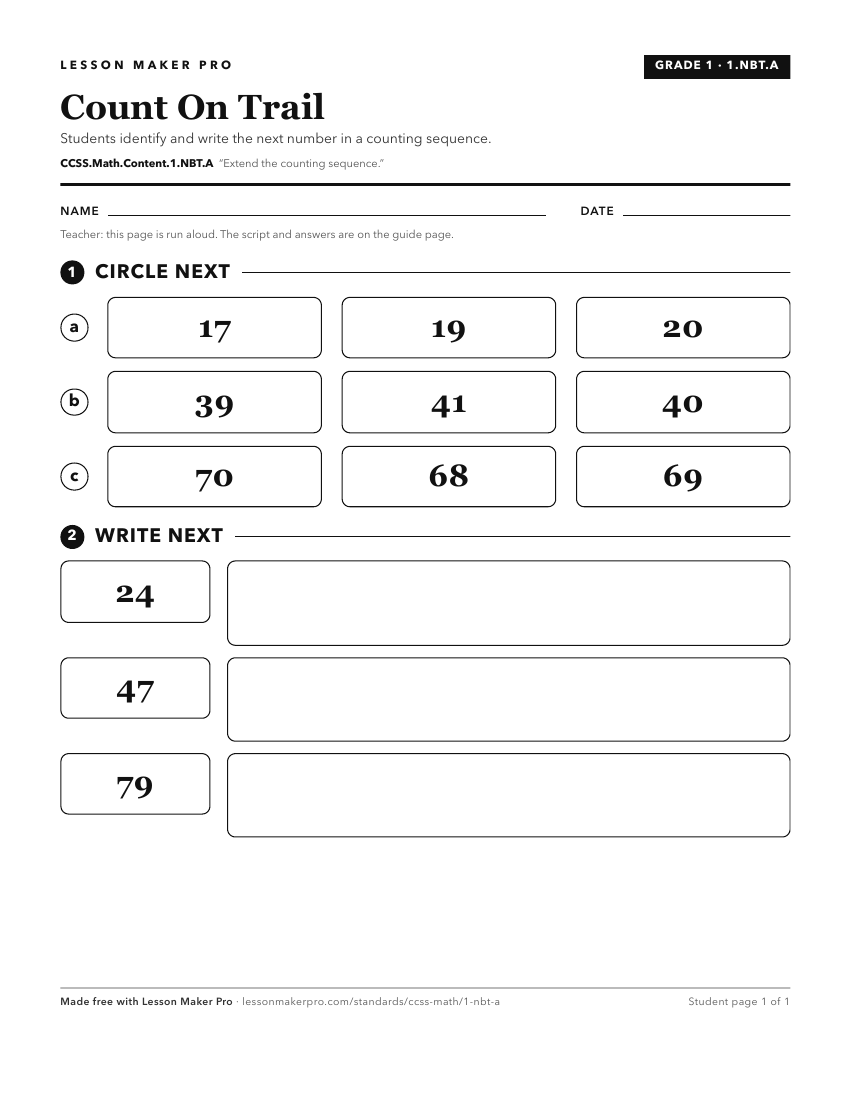
A ready-to-print activity worksheet aligned to CCSS.Math.Content.1.NBT.A, with an answer key for the teacher on its own page. No account needed.
PDF, US Letter, prints cleanly in black and white.
Download the worksheetKeep exploring
Related Standards
- CCSS.Math.Content.K.CC.A.1
Count to 100 by ones and by tens.
- CCSS.Math.Content.K.CC.A.2
Count forward beginning from a given number within the known sequence (instead of having to begin at 1).
- CCSS.Math.Content.K.CC.A
Know number names and the count sequence.
- CCSS.Math.Content.2.NBT.A.2
Count within 1000; skip-count by 5s, 10s, and 100s.
Turn this cluster into a lesson
Grade, subject, topic, and the complete cluster are prefilled. Create one free, no account needed.
Also for this cluster:Make a WorksheetMake a QuizMake a Sub Lesson