CCSS.
Standard Cluster
Relate addition and subtraction to length.
Common Core State Standards for Mathematics
Cluster contents
Standards in This Cluster
CCSS.Math.Content.2.MD.B is a cluster heading. These are the individual standards under it.
- CCSS.Math.Content.2.MD.B.5
Use addition and subtraction within 100 to solve word problems involving lengths that are given in the same units, e.g., by using drawings (such as drawings of ...
- CCSS.Math.Content.2.MD.B.6
Represent whole numbers as lengths from 0 on a number line diagram with equally spaced points corresponding to the numbers 0, 1, 2, …, and represent whole-numbe...
Teacher's field guide
What This Cluster Means
What Students Need to Do
- Students use addition and subtraction within 100 to solve problems about measured lengths in the same unit. They model sums and differences with equations and number lines.
What Mastery Looks Like
- Students choose the correct operation and solve length problems within 100. They draw accurate number-line jumps, label units, and explain what the answer means.
Common Misconceptions
- Students may choose an operation from a key word instead of the situation. They may count number-line marks instead of spaces, start at 1 instead of 0, or leave units off answers.
How to Assess It
- Give this exit ticket: “A ribbon is 63 centimeters long. You cut off 28 centimeters. How much remains?” Require an equation, labeled answer, and number-line model.
Lesson moves
Ways to Teach It
Give pairs two paper strips to measure, then have them find the combined length and the difference using equations.
Ask students to write and solve a story problem for 42 centimeters plus 19 centimeters, then explain their number-line jumps.
Play Number Line Race: students draw operation cards, make matching jumps on a floor number line, and record each equation.
Plan a bookshelf space by adding book widths or subtracting used space from the shelf’s total length.
Free download
Printable 2.MD.B Worksheet
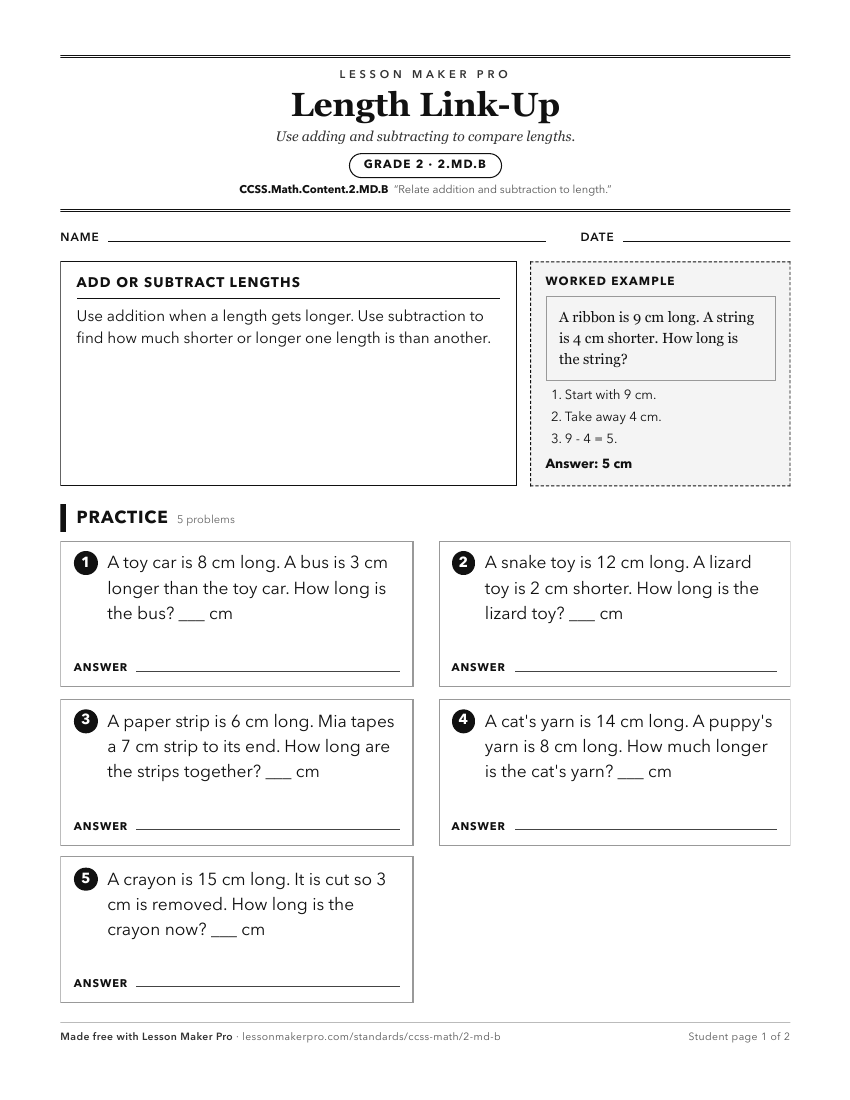
A ready-to-print activity worksheet aligned to CCSS.Math.Content.2.MD.B, with an answer key for the teacher on its own page. No account needed.
PDF, US Letter, prints cleanly in black and white.
Download the worksheetKeep exploring
Related Standards
- CCSS.Math.Content.1.OA.C.5
Relate counting to addition and subtraction (e.g., by counting on 2 to add 2).
- CCSS.Math.Content.1.OA.B
Understand and apply properties of operations and the relationship between addition and subtraction.
- CCSS.Math.Content.3.MD.C.7
Relate area to the operations of multiplication and addition.
Turn this cluster into a lesson
Grade, subject, topic, and the complete cluster are prefilled. Create one free, no account needed.
Also for this cluster:Make a WorksheetMake a QuizMake a Sub Lesson