CCSS.
Standard Cluster
- CCSS.Math.Content.5.MD.C
- Geometric measurement: understand concepts of volume and relate volume to multiplication and to addition.
Recognize volume as an attribute of solid figures and understand concepts of volume measurement.
Common Core State Standards for Mathematics · Measurement and Data
Cluster contents
Standards in This Cluster
CCSS.Math.Content.5.MD.C.3 is a cluster heading. These are the individual standards under it.
- CCSS.Math.Content.5.MD.C.3a
A cube with side length 1 unit, called a "unit cube," is said to have "one cubic unit" of volume, and can be used to measure volume.
- CCSS.Math.Content.5.MD.C.3b
A solid figure which can be packed without gaps or overlaps using n unit cubes is said to have a volume of n cubic units.
Teacher's field guide
What This Cluster Means
What Students Need to Do
- Students identify volume as the amount of space inside a solid figure. They measure it by counting unit cubes that fill the figure without gaps or overlaps.
What Mastery Looks Like
- A student can identify volume as the space inside a solid figure. They can count unit cubes in complete layers, include hidden cubes, and label the result in cubic units.
Common Misconceptions
- Students may confuse volume with surface area or count only the visible cubes. They may report square units instead of cubic units or allow gaps between cubes.
How to Assess It
- Show a solid made from two layers of six unit cubes. Ask, "What is its volume, and why is the unit cubic?"
Adopted as
This framework is adopted as written in Connecticut, Delaware, District of Columbia, Illinois, Michigan, Nevada, New Hampshire, New Mexico, Vermont.
- California: 5_MD_3
- Connecticut: CCSS.Math.Content.5.MD.C.3
- Delaware: CCSS.Math.Content.5.MD.C.3
- District of Columbia: CCSS.Math.Content.5.MD.C.3
- Michigan: CCSS.Math.Content.5.MD.C.3
- Mississippi: 5_MD_3
- Nevada: CCSS.Math.Content.5.MD.C.3
- New Hampshire: CCSS.Math.Content.5.MD.C.3
- New Mexico: CCSS.Math.Content.5.MD.C.3
- Vermont: CCSS.Math.Content.5.MD.C.3
- Washington: 5_MD_C_3
- Washington: CCSS.Math.Content.5.MD.C.3
Lesson moves
Ways to Teach It
Build two solids with 12 linking cubes, then count the cubes and label each volume in cubic units.
Write a response to: Why is volume measured in cubic units instead of square units?
Play Volume Match by pairing solid drawings with cube counts and cubic unit labels, then justify one match.
Estimate how many unit cubes would fill a small storage box, then build one layer to check the estimate.
Free download
Printable 5.MD.C.3 Worksheet
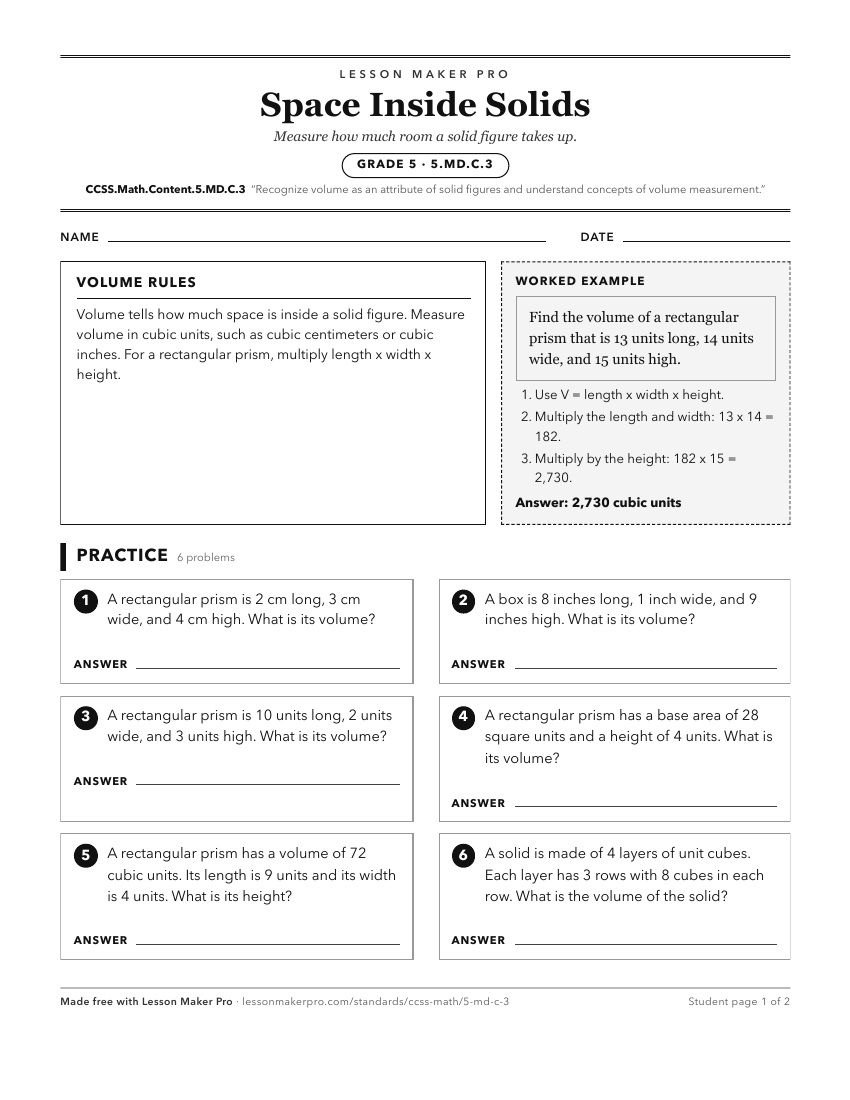
A ready-to-print activity worksheet aligned to CCSS.Math.Content.5.MD.C.3, with an answer key for the teacher on its own page. No account needed.
PDF, US Letter, prints cleanly in black and white.
Download the worksheetLearning progression
Where This Standard Sits
See the whole path on the Measurement & Data progression map.
Before This Standard
If students are struggling here, check these first.
What This Unlocks
Mastery here sets students up for these next.
- CCSS.Math.Content.5.MD.C.5c
Students must understand volume as measurable cubic space before adding volumes of rectangular-prism parts in a composite solid.
- CCSS.Math.Content.5.MD.C.5
Students need unit-cube volume concepts before using multiplication and addition to find and combine volumes of solids.
- CCSS.Math.Content.5.MD.C.5a
Understanding volume as counted unit cubes is necessary before packing prisms and connecting cube counts to length by width by height.
Keep exploring
Related Standards
Turn this cluster into a lesson
Grade, subject, topic, and the complete cluster are prefilled. Create one free, no account needed.
Also for this cluster:Make a WorksheetMake a QuizMake a Sub Lesson