Virginia SOL 9.C
SOL Standard (Knowledge and Skills Cluster)
The student will develop effective oral communication and collaboration skills to build a community of learners that process, understand, and interpret content together.
Virginia Standards of Learning for English
Cluster contents
Knowledge and Skills in This Standard
9.C is a Standards of Learning standard. These are the knowledge and skills expectations under it.
- 9.C.1
Communication, Listening, and Collaboration
- 9.C.1.A.i
Applying a variety of strategies to listen actively and speak purposefully and respectfully.
- 9.C.1.A.ii
Setting guidelines for group presentations and discussions.
- 9.C.1.A.iii
Incorporating all group members in the development of new understandings, making decisions, and solving problems.
- 9.C.1.A.iv
Setting clear goals and deadlines and defining individual roles as needed.
- 9.C.1.A.v
Responding thoughtfully and tactfully with evidence to diverse perspectives, including challenging, clarifying, or verifying ideas and conclusions.
- 9.C.1.A.vi
Summarizing points of agreement and disagreement.
- 9.C.1.A.vii
Using reflection to evaluate one’s own role and the process in paired or small-group activities.
- 9.C.2
Speaking and Presentation of Ideas
- 9.C.2.A.i
Choosing vocabulary, language and tone appropriate to the topic, audience, and purpose.
- 9.C.2.A.ii
Using listening and speaking strategies effectively with awareness of verbal and nonverbal cues (e.g., using body language to indicate attentiveness, and giving...
- 9.C.2.A.iii
Analyzing the effectiveness of one’s presentation, including introduction, central idea, organization, and conclusion.
- 9.C.2.B
Memorize and accurately recite a short selection from a longer text demonstrating inflection and meaningful expression that is appropriate to the tone and voice...
- 9.C.3
Integrating Multimodal Literacies
- 9.C.3.A
Make strategic use of multimodal tools.
- 9.C.3.B
Monitor, analyze, and use multiple streams of simultaneous information.
- 9.C.3.C
Create media messages for diverse audiences and purposes.
- 9.C.4
Examining Media Messages
- 9.C.4.A
Determine the purpose of the media message and its effect on the audience.
- 9.C.4.B
Analyze the persuasive techniques used in diverse media formats (e.g., name calling, innuendo, glittering generalities, card stacking, bandwagon, testimonials, ...
- 9.C.4.C
Evaluate the credibility, word choice, viewpoints, and bias in media presentations.
- 9.C.4.D
Examine how values and viewpoints are included or excluded and how the media can influence beliefs, behaviors, and interpretations.
- 9.C.4.E
Evaluate sources including advertisements, editorials, political cartoons, and feature stories for relationships between intent and factual content.
- 9.C.4.F
Identify the possible cause and effect relationships between mass media coverage and public opinion trends in media messages.
Teacher's field guide
What This Cluster Means
What Students Need to Do
- Students plan and sustain group discussions by listening closely, sharing roles, using evidence, inviting others, and responding respectfully. They present ideas clearly through speech, recitation, and well-chosen visual or digital tools. They also analyze media for purpose, audience, credibility, bias, persuasive techniques, and influence.
What Mastery Looks Like
- Students help set roles and deadlines, include every member, cite evidence, and summarize agreements and disagreements. They deliver an organized oral report or expressive recitation using suitable tone, vocabulary, body language, and media. They can explain how a media message uses evidence, bias, omitted viewpoints, and persuasive techniques to influence an audience.
Common Misconceptions
- Students may think strong participation means talking the most rather than listening, inviting others, and building on ideas. They may challenge a claim without evidence or summarize only their own view. They may also mistake polished media, confident speakers, or popular opinions for credible information.
How to Assess It
- Show a short advertisement and ask students to identify its audience, purpose, persuasive technique, bias, and one supporting detail. Then have them write one respectful question that challenges or clarifies its claim.
Lesson moves
Ways to Teach It
Give groups printed advertisements to sort by persuasive technique, then have them build an evidence board explaining each choice.
Discuss this prompt: When should a group challenge a member's idea, and what words keep the challenge respectful and useful?
Play Discussion Role Relay, rotating facilitator, evidence checker, summarizer, and inclusion monitor every four minutes during a text-based conversation.
Compare two news posts about the same local issue, noting audience, omitted viewpoints, loaded words, evidence, and likely effects on public opinion.
Free download
Printable 9.C Worksheet
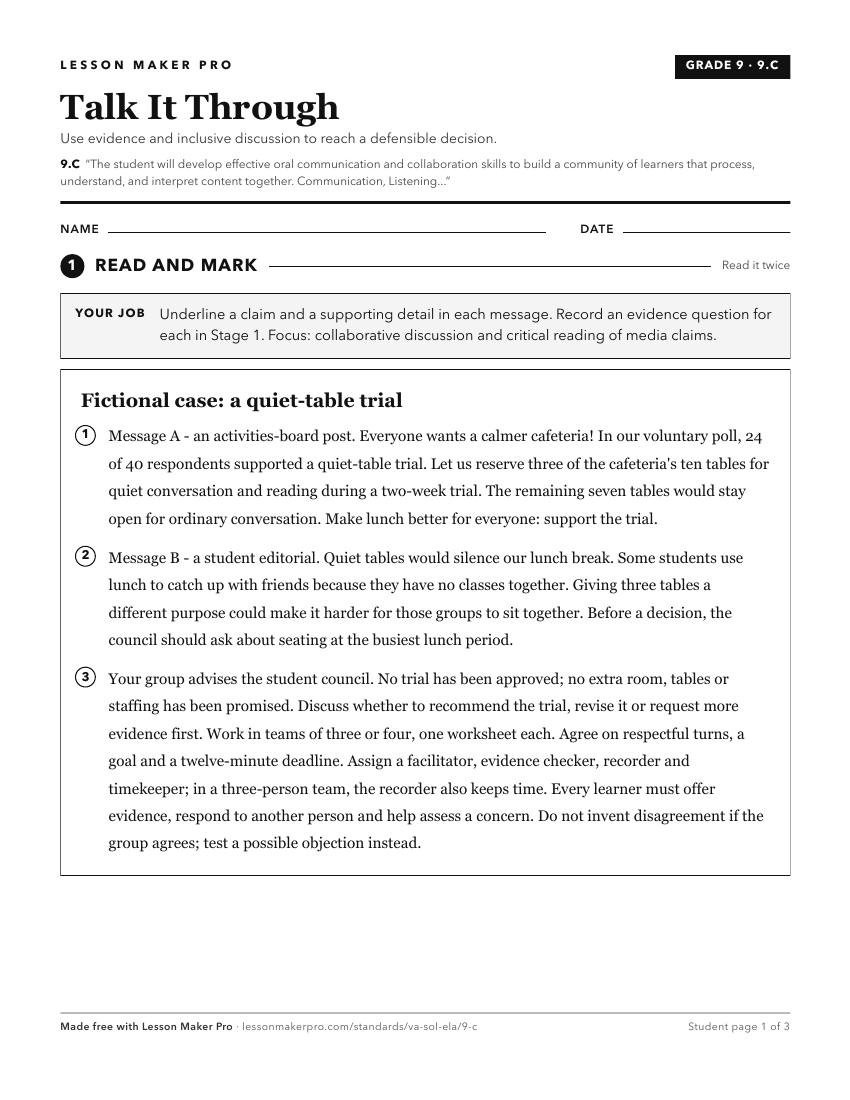
A ready-to-print activity worksheet aligned to 9.C, with an answer key for the teacher on its own page. No account needed.
PDF, US Letter, prints cleanly in black and white.
Download the worksheetKeep exploring
Related Standards
Turn this cluster into a lesson
Grade, subject, topic, and the complete cluster are prefilled. Create one free, no account needed.
Also for this cluster:Make a WorksheetMake a QuizMake a Sub Lesson