Virginia SOL 7.C
SOL Standard (Knowledge and Skills Cluster)
The student will develop effective oral communication and collaboration skills to build a community of learners that process, understand, and interpret content together.
Virginia Standards of Learning for English
Cluster contents
Knowledge and Skills in This Standard
7.C is a Standards of Learning standard. These are the knowledge and skills expectations under it.
- 7.C.1
Communication, Listening, and Collaboration
- 7.C.1.A.i
Listening actively through verbal and nonverbal communication and using agreedupon discussion rules.
- 7.C.1.A.ii
Working effectively and respectfully by building on others’ ideas, actively contributing relevant and well-supported ideas and opinions, and sharing responsibil...
- 7.C.1.A.iii
Asking and responding to probing questions and providing appropriate feedback within structured discussions.
- 7.C.1.A.iv
Communicating agreement or tactful disagreement with others’ ideas using carefully constructed statements.
- 7.C.1.A.v
Paraphrasing, summarizing, and writing reflectively in response to the ideas being discussed.
- 7.C.1.A.vi
Evaluating the effectiveness of participant interactions and one’s own contributions to small group activities.
- 7.C.2
Speaking and Presentation of Ideas
- 7.C.2.A.i
Clearly communicating information in an organized and succinct manner.
- 7.C.2.A.ii
Providing evidence to support the main ideas, including pertinent descriptions, facts, details, and examples.
- 7.C.2.A.iii
Adjusting verbal and nonverbal communication skills appropriate to audience, topic, and purpose to enhance the overall message.
- 7.C.2.A.iv
Responding to audience questions and comments with relevant evidence, observations, and ideas.
- 7.C.2.A.v
Referencing source material as appropriate during the presentation.
- 7.C.2.B
Memorize and recite a poem demonstrating inflection and meaningful expression that is appropriate to the tone and voice of the selection.
- 7.C.3
Integrating Multimodal Literacies
- 7.C.3.A
Use medial and visual literacy skills to select, organize, and create multimodal content that articulates and enhances the purpose of the presentation using two...
- 7.C.3.B
Craft and publish audience-specific media messages that present claims and findings with relevant evidence in a logical sequence.
- 7.C.4
Examining Media Messages
- 7.C.4.A
Explain persuasive/informative techniques used in media to sway the audience (e.g., innuendo, card stacking, bandwagon, and appeal to emotions).
- 7.C.4.B
Analyze media messages for facts, opinions, persuasive messages, word choice, and viewpoint.
- 7.C.4.C
Compare and contrast the effectiveness of techniques in auditory, visual, and written media messages (e.g., authorship, format, content, purpose) on the intende...
Teacher's field guide
What This Cluster Means
What Students Need to Do
- Students speak and listen in sustained group discussions. They build on ideas, support claims with evidence, ask useful questions, disagree tactfully, and reflect on their contribution. They give organized presentations, expressive poem recitations, and multimodal messages, then analyze how media choices influence an audience.
What Mastery Looks Like
- A student can summarize a peer’s point accurately before adding a relevant, supported idea. They present a clear claim in logical order, cite sources, use fitting voice, gestures, and visuals, and answer questions with evidence. They can separate fact from opinion and explain why a persuasive technique works for a specific audience.
Common Misconceptions
- Students often treat discussion as taking turns rather than building on earlier comments. They may confuse opinions with facts or name a persuasive technique without explaining its effect. During presentations, they may read crowded slides, use unrelated images, or cite a source without connecting it to evidence.
How to Assess It
- Show pairs a school lunch advertisement. Each pair gives a 60 second analysis naming the claim, one persuasive technique, and supporting evidence, then answers one peer question using the ad.
Lesson moves
Ways to Teach It
Give groups an advertisement, sticky notes, and chart paper to label its claim, evidence, emotional appeal, facts, opinions, and viewpoint.
After reading a short article, students answer: Which idea changed your thinking, and which classmate’s comment helped?
Run a discussion relay where each student must paraphrase the previous speaker, add evidence, and ask one probing question before passing.
Students compare a print ad and video ad for the same product, then explain which would persuade seventh graders more.
Free download
Printable 7.C Worksheet
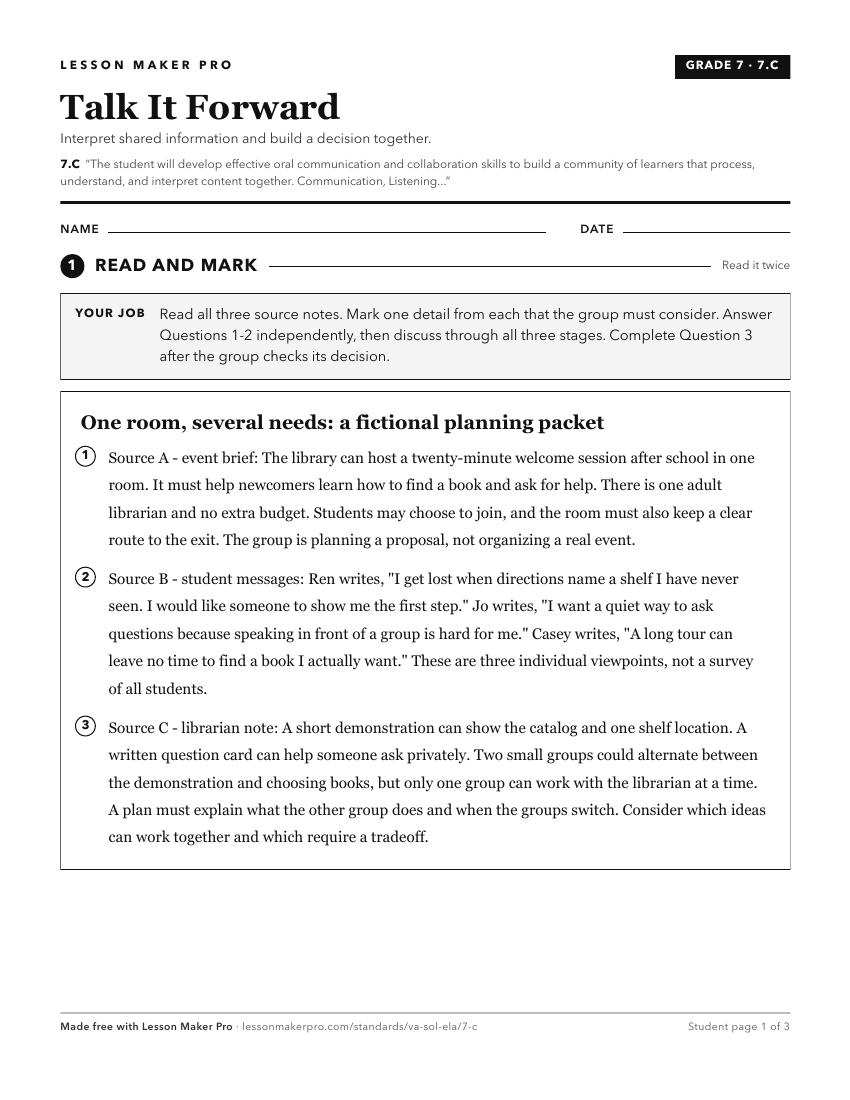
A ready-to-print activity worksheet aligned to 7.C, with an answer key for the teacher on its own page. No account needed.
PDF, US Letter, prints cleanly in black and white.
Download the worksheetKeep exploring
Related Standards
Turn this cluster into a lesson
Grade, subject, topic, and the complete cluster are prefilled. Create one free, no account needed.
Also for this cluster:Make a WorksheetMake a QuizMake a Sub Lesson