Virginia SOL 5.C
SOL Standard (Knowledge and Skills Cluster)
The student will develop effective oral communication and collaboration skills to build a community of learners that process, understand, and interpret content together.
Virginia Standards of Learning for English
Cluster contents
Knowledge and Skills in This Standard
5.C is a Standards of Learning standard. These are the knowledge and skills expectations under it.
- 5.C.1
Communication, Listening, and Collaboration
- 5.C.1.A.i
Listening actively and speaking using agreed-upon discussion rules.
- 5.C.1.A.ii
Respectfully demonstrating agreement or disagreement with others’ ideas.
- 5.C.1.A.iii
Asking and answering relevant questions to build on others’ ideas, clarify ideas, and acquire or confirm information.
- 5.C.1.A.iv
Summarizing the main ideas being discussed, using evidence, examples, and details to support opinions and conclusions.
- 5.C.1.B
Share responsibility for the learning based on assigned roles and/or task expectations.
- 5.C.2
Speaking and Presentation of Ideas
- 5.C.2.A.i
Using content specific vocabulary, appropriate fact,s and relevant descriptive details to support themes or central ideas.
- 5.C.2.A.ii
Demonstrating appropriate speaking techniques (e.g., adequate volume and clear pronunciation) suitable to the audience, purpose, and situations.
- 5.C.2.A.iii
Using facial expressions and gestures to support, accentuate, or dramatize the message during oral presentations.
- 5.C.2.A.iv
Demonstrating awareness of and sensitivity to the appropriate use of words (e.g., avoiding stereotypes, multiple meanings of words).
- 5.C.2.A.v
Encouraging audience participation through planned interactions (e.g., questioning, discussion, gathering responses, and movement).
- 5.C.3
Integrating Multimodal Literacies
- 5.C.3.A
Select, organize, and create engaging presentations that include multimedia components and visual displays.
- 5.C.3.B
Strategically use two or more interdependent modes of communication to convey the intended message and enhance the development of main ideas or themes.
- 5.C.4
Examining Media Messages
- 5.C.4.A
Deconstruct various types of media to identify the characteristics and determine the effectiveness of the intended messages.
- 5.C.4.B
Identify the purpose, intended audience, and credibility of information (e.g., auditory, visual, and written media messages) being presented.
- 5.C.4.C
Compare and contrast techniques used in a variety of media messages (e.g., animation, famous images and words, music and sound, photo-editing).
Teacher's field guide
What This Cluster Means
What Students Need to Do
- Students hold sustained discussions by listening, following group rules, asking relevant questions, sharing roles, and supporting conclusions with details. They present organized ideas clearly and use words, gestures, visuals, audio, or other media for a clear purpose. They also examine media for audience, purpose, credibility, and communication techniques.
What Mastery Looks Like
- During discussion, a student follows group rules, refers to a classmate’s point, asks a useful question, and summarizes the conclusion with evidence. The student gives an organized presentation with clear speech, accurate vocabulary, purposeful gestures, and helpful media. The student can identify a media message’s audience, purpose, credibility, and persuasive techniques.
Common Misconceptions
- Students may treat collaboration as simply taking turns, without building on or questioning ideas. They often add visuals that repeat words rather than strengthen the message. They may assume a polished or familiar source is automatically credible.
How to Assess It
- Give each student a print advertisement. Have students name its audience and purpose, cite one credibility clue, explain how words and visuals work together, then ask a partner one follow-up question.
Lesson moves
Ways to Teach It
Give teams a print ad, colored markers, and sticky notes to label audience, purpose, evidence, credibility, and image or word techniques.
After comparing two messages about the same topic, students write and discuss, "Which is more convincing, and what specific choices make it effective?"
Use role cards for speaker, questioner, evidence checker, and summarizer, then rotate roles after each two-minute discussion round.
Students create a one-minute school public service announcement with spoken words, one visual, purposeful gestures, and a planned audience question.
Free download
Printable 5.C Worksheet
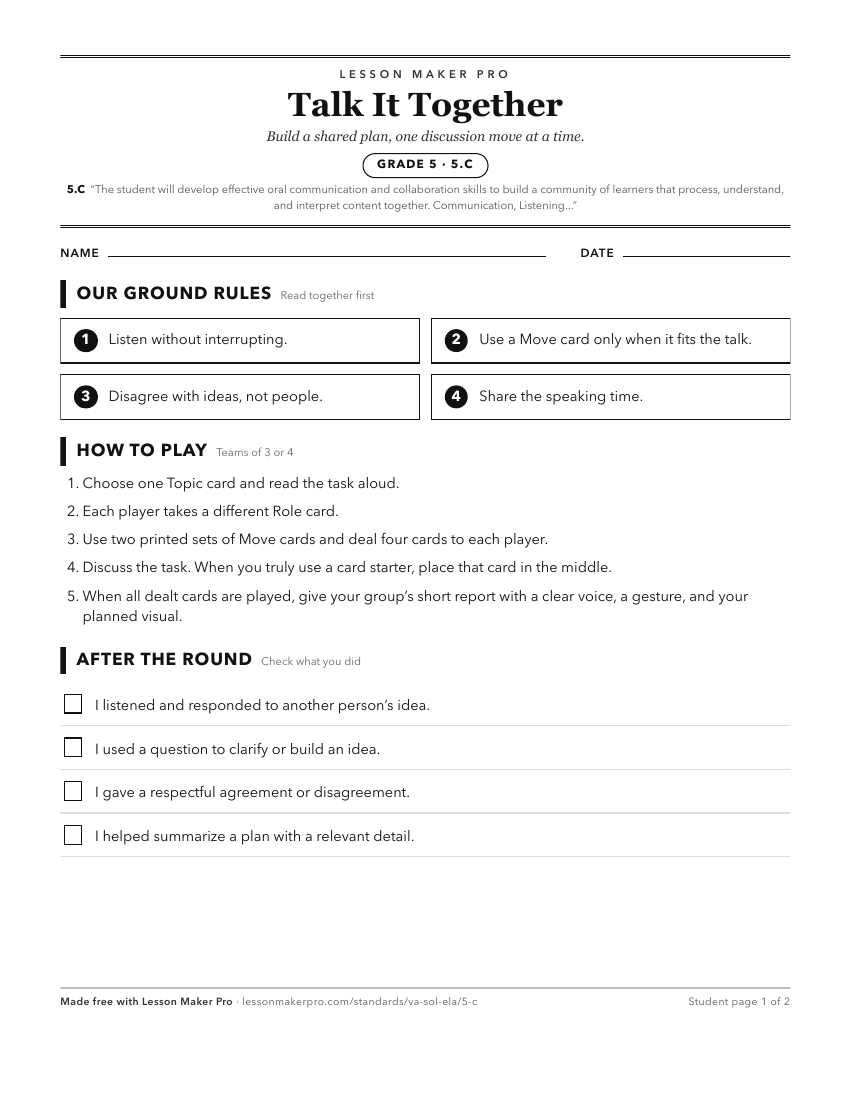
A ready-to-print activity worksheet aligned to 5.C, with an answer key for the teacher on its own page. No account needed.
PDF, US Letter, prints cleanly in black and white.
Download the worksheetKeep exploring
Related Standards
Turn this cluster into a lesson
Grade, subject, topic, and the complete cluster are prefilled. Create one free, no account needed.
Also for this cluster:Make a WorksheetMake a QuizMake a Sub Lesson