Virginia SOL 7.C.4.B
The Standard
Analyze media messages for facts, opinions, persuasive messages, word choice, and viewpoint.
Virginia Standards of Learning for English · Examining Media Messages
Teacher's field guide
What This Standard Means
What Students Need to Do
- Students separate checkable claims from personal judgments and unsupported statements. They explain how persuasive language and the creator’s viewpoint shape an audience’s response.
What Mastery Looks Like
- Students accurately classify claims and support their choices with details from the message. They identify the creator’s position and explain how specific language influences the audience.
Common Misconceptions
- Students may assume that statistics are always factual, even when no source is given. They may also confuse a viewpoint with the topic or miss opinions presented as neutral statements.
How to Assess It
- Display: “Our school deserves a better lunch menu. A student survey found that 68 percent want more fresh fruit.” Ask students to label each claim and explain how one word choice reveals viewpoint or persuasion.
Lesson moves
Ways to Teach It
Give pairs a printed advertisement and two highlighters to mark checkable claims in one color and opinion-based claims in another.
Ask students to rewrite a headline from two opposing viewpoints, then explain which words create each viewpoint.
Run a claim-sort relay using cards with facts, opinions, unsupported claims, and persuasive statements from sample media posts.
Have students examine a local business post and identify the audience, viewpoint, evidence, and language meant to influence customers.
Free download
Printable 7.C.4.B Worksheet
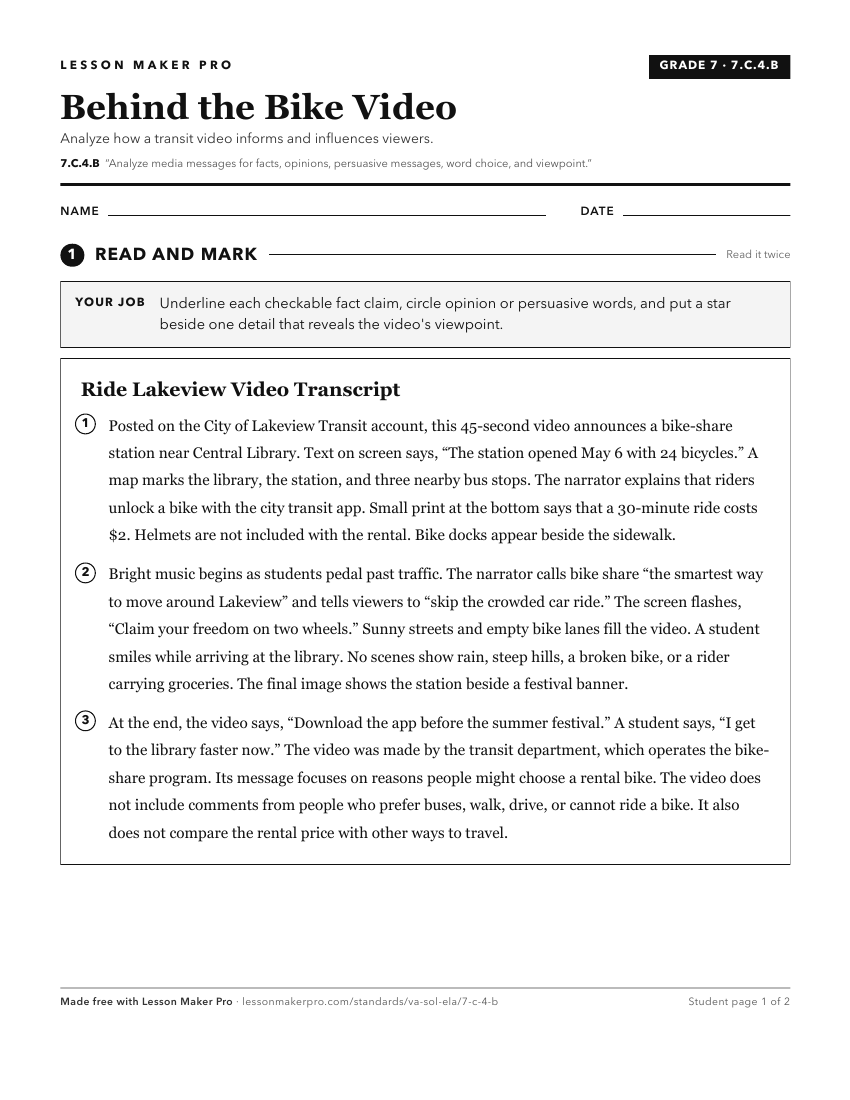
A ready-to-print activity worksheet aligned to 7.C.4.B, with an answer key for the teacher on its own page. No account needed.
PDF, US Letter, prints cleanly in black and white.
Download the worksheetKeep exploring
Related Standards
- 11.C.4.C
Analyze, compare, and contrast visual and verbal media messages for content (e.g., word choice and choice of information), intent (e.g., persuasive techniques),...
- 10.C.4.C
Examine and analyze how media messages are constructed based on varying opinions, values, and viewpoints.
- 10.C.4.B
Analyze, compare, and contrast visual and verbal media messages for content (e.g., word choice and choice of information), intent (e.g., persuasive techniques, ...
- 9.C.4.C
Evaluate the credibility, word choice, viewpoints, and bias in media presentations.
Turn this exact standard into a lesson
Grade, subject, topic, and the complete standard are prefilled. Create one free, no account needed.
Also for this standard:Make a WorksheetMake a QuizMake a Sub Lesson