Virginia SOL 12.C
SOL Standard (Knowledge and Skills Cluster)
The student will develop effective oral communication and collaboration skills to build a community of learners that process, understand, and interpret content together.
Virginia Standards of Learning for English
Cluster contents
Knowledge and Skills in This Standard
12.C is a Standards of Learning standard. These are the knowledge and skills expectations under it.
- 12.C.1
Communication, Listening, and Collaboration
- 12.C.1.A.i
Applying a variety of strategies to listen actively and speak purposefully and respectfully.
- 12.C.1.A.ii
Responding thoughtfully and tactfully with evidence to diverse perspectives.
- 12.C.1.A.iii
Summarizing points of agreement and disagreement.
- 12.C.1.A.iv
Selecting and applying multimodal tools to design and develop presentation content appropriate for topic and purpose.
- 12.C.1.A.v
Evaluating the content of presentations, including introduction, organization, strengths/weaknesses and evidence and reasoning, and conclusion.
- 12.C.1.A.vi
Using reflection to evaluate one's own role in the group process in small group activities.
- 12.C.2
Speaking and Presentation of Ideas
- 12.C.2.A.i
Selecting the modes and purposes for presentations and synthesizing multiple streams of information.
- 12.C.2.A.ii
Choosing appropriate vocabulary, language, and tone for a selected topic, purpose, context, and audience when speaking and presenting.
- 12.C.2.A.iii
Incorporating various rhetorical devices to enhance purpose and strengthening clarity of ideas.
- 12.C.2.A.iv
Anticipating and addressing alternative or opposing perspectives and counterclaims and rebuttals, as appropriate.
- 12.C.2.A.v
Monitoring audience engagement effectively and adjusting delivery accordingly during presentations.
- 12.C.2.A.vi
Evaluating the content and effectiveness of one's presentations, including the introduction, organization, strengths/weaknesses and evidence and reasoning, and ...
- 12.C.2.B
Memorize and recite an excerpt or monologue from a dramatic work portraying the emotions and motivations of the character through voice and body language that c...
- 12.C.3
Integrating Multimodal Literacies
- 12.C.3.A
Create and deliver planned, multimodal, interactive presentations collaboratively and individually for a variety of purposes and audiences.
- 12.C.3.B
Examine multimodal sources’ claims, arguments, ideas, and any point of personal bias by evaluating them for reliability and relevance to serve as credible suppo...
- 12.C.3.C
Synthesize multiple streams of information on the same or similar topic to create a summary or formulate a position.
- 12.C.3.D
Organize information to create media messages with visual, audio, and graphic components to convey meaning.
- 12.C.3.E
Provide appropriate citation of all content from external sources.
- 12.C.4
Examining Media Messages
- 12.C.4.A
Defend hypotheses about an author’s underlying values, viewpoints, and purposes and reflect on how they shape the content.
- 12.C.4.B
Analyze and critique the effectiveness of media messages by evaluating the purpose, evidence, and clarity for specific purposes with targeted audiences.
- 12.C.4.C
Analyze and evaluate how the media's use of symbolism, imagery, metaphor, and bias impacts the message.
- 12.C.4.D
Explain and analyze how values and viewpoints are included or excluded and how media influences beliefs, interpretations, and behaviors.
- 12.C.4.E
Analyze media to determine the cause-and-effect relationship(s) between media coverage and public opinion trends.
Teacher's field guide
What This Cluster Means
What Students Need to Do
- Students listen closely, build on others’ ideas, cite evidence, and name agreements and disagreements during sustained discussions. They plan and deliver multimodal presentations for a specific audience, using credible sources, citations, rhetorical choices, counterclaims, and responsive delivery. They also analyze how media choices, bias, values, and coverage shape meaning and public opinion.
What Mastery Looks Like
- A student can lead a discussion, respond tactfully to conflicting views, and reflect honestly on their group role. The student can combine speech, visuals, audio, and graphics into an organized presentation, then adjust delivery based on audience response. The student can judge source reliability and explain how purpose, bias, and media choices shape meaning.
Common Misconceptions
- Students often treat polite agreement as collaboration, summarize only their own view, or answer a counterclaim without evidence. They may add media as decoration, cite a webpage instead of the original source, or assume a polished source is reliable. They may name bias without showing how wording, framing, symbolism, or omitted views affect the audience.
How to Assess It
- Give students two short posts that frame the same issue differently. Ask them to deliver a 90-second claim using one cited detail, identify one bias or omission, answer a counterclaim, and name one delivery adjustment.
Lesson moves
Ways to Teach It
Give groups printed source cards, and have them rank reliability, build a three-slide argument, cite each source, and assign speaking roles.
Discuss: How do framing, imagery, omitted voices, and repeated coverage shape public opinion on one current issue?
Run a counterclaim relay where teams draw a claim card, give an evidence-based rebuttal, then summarize agreement and disagreement.
Compare a local news report, campaign post, and nonprofit infographic, then present which is most credible for a chosen audience and why.
Free download
Printable 12.C Worksheet
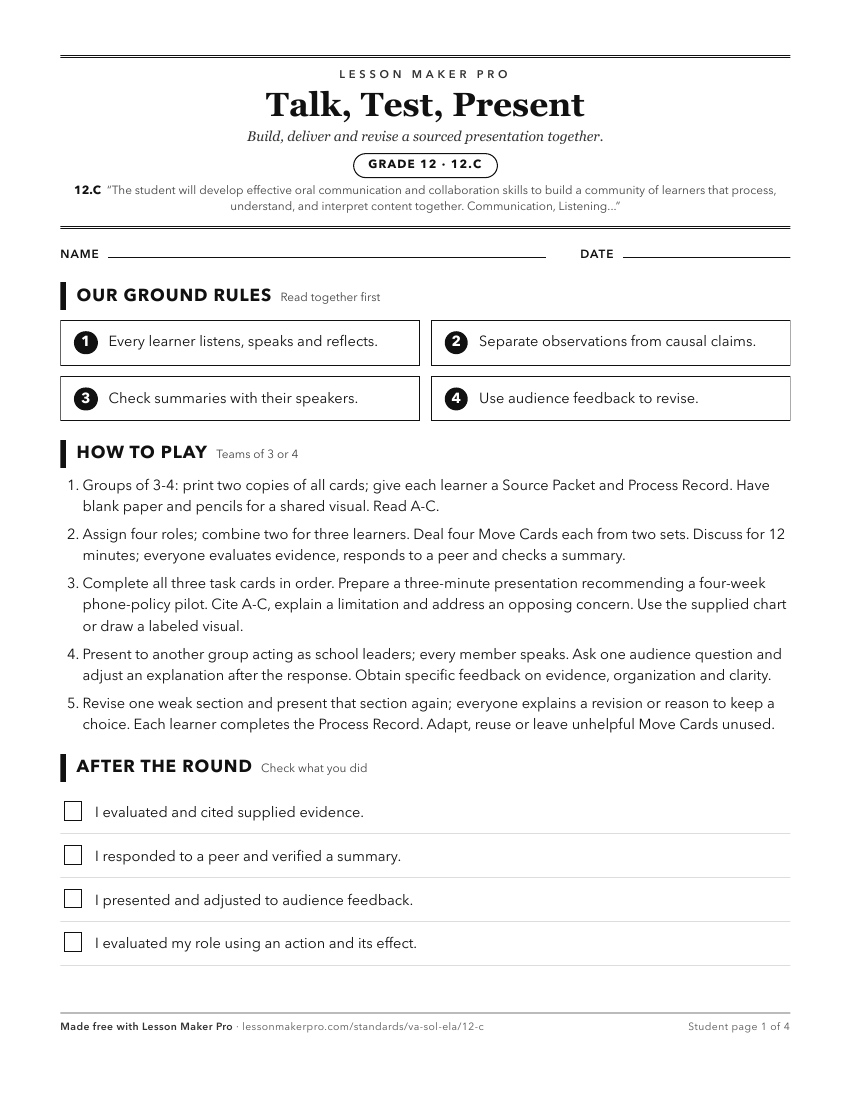
A ready-to-print activity worksheet aligned to 12.C, with an answer key for the teacher on its own page. No account needed.
PDF, US Letter, prints cleanly in black and white.
Download the worksheetKeep exploring
Related Standards
Turn this cluster into a lesson
Grade, subject, topic, and the complete cluster are prefilled. Create one free, no account needed.
Also for this cluster:Make a WorksheetMake a QuizMake a Sub Lesson