Virginia SOL 11.C
SOL Standard (Knowledge and Skills Cluster)
The student will develop effective oral communication and collaboration skills to build a community of learners that process, understand, and interpret content together.
Virginia Standards of Learning for English
Cluster contents
Knowledge and Skills in This Standard
11.C is a Standards of Learning standard. These are the knowledge and skills expectations under it.
- 11.C.1
Communication, Listening, and Collaboration
- 11.C.1.A.i
Applying a variety of strategies to listen actively and speak purposefully and respectfully.
- 11.C.1.A.ii
Demonstrating the ability to work effectively by coming to a consensus, exercising flexibility, making necessary compromises, and presenting alternate views.
- 11.C.1.A.iii
Responding thoughtfully and tactfully with evidence to diverse perspectives.
- 11.C.1.A.iv
Summarizing points of agreement and disagreement.
- 11.C.1.A.v
Assessing, evaluating critically, and using information accurately to fulfill a task.
- 11.C.1.A.vi
Using reflection to evaluate one's own role in the group process in small-group activities.
- 11.C.2
Speaking and Presentation of Ideas
- 11.C.2.A.i
Selecting the modes and purposes for presentations and synthesizing multiple streams of information.
- 11.C.2.A.ii
Choosing diction and tone appropriate to the topic, audience, and purpose.
- 11.C.2.A.iii
Using a variety of active listening and speaking strategies, with awareness of intent and impact of verbal and nonverbal cues.
- 11.C.2.A.iv
Utilizing rhetorical techniques (e.g., ethos, pathos, and logos), repetition, and figurative language to deliver a message.
- 11.C.2.A.v
Anticipating and addressing alternative or opposing perspectives and counterclaims using counter arguments and rebuttals, as appropriate.
- 11.C.2.A.vi
Evaluating the content and effectiveness of presentations; that includes the introduction, organization, strengths/weaknesses in evidence and reasoning, and con...
- 11.C.3
Integrating Multimodal Literacies
- 11.C.3.A
Create, publish, and deliver multimodal presentations and pieces aimed at a variety of audiences and with different purposes, incorporating spoken or written co...
- 11.C.3.B
Demonstrate understanding of multimodal literacy by identifying and evaluating elements such as authorship, format, audience, content, and purpose.
- 11.C.3.C
Monitor, organize, analyze, and synthesize multiple streams of simultaneous information to create a summary or formulate a position.
- 11.C.3.D
Ethically, purposefully, and strategically incorporate multimodal tools including the Internet and varying technology.
- 11.C.4
Examining Media Messages
- 11.C.4.A
Analyze the sources and viewpoint(s) of publications including advertisements, editorials, blogs, and websites.
- 11.C.4.B
Analyze and critique how media reach the targeted audience for specific purposes
- 11.C.4.C
Analyze, compare, and contrast visual and verbal media messages for content (e.g., word choice and choice of information), intent (e.g., persuasive techniques),...
Teacher's field guide
What This Cluster Means
What Students Need to Do
- Students listen closely, build on ideas, use evidence, and help a group reach a reasoned conclusion. They create and deliver organized presentations for a clear audience and purpose. They also compare media messages, judge sources, and combine information from several formats.
What Mastery Looks Like
- Students enter discussions prepared, cite accurate evidence, respond tactfully, and summarize agreements and disagreements. They present a clear claim with suitable tone, effective media, logical organization, and a fair rebuttal. They also evaluate sources and reflect honestly on their group role.
Common Misconceptions
- Students may treat discussion as taking turns rather than building a shared conclusion. They may confuse strong delivery with sound evidence, ignore counterclaims, or assume polished media are trustworthy.
How to Assess It
- Give students an editorial and a related social media image. Ask them to identify each source's audience and purpose, compare persuasive choices, state a supported position, and address one counterclaim.
Lesson moves
Ways to Teach It
Give groups evidence cards from an article, infographic, and video to sort, synthesize, and use in a two-minute presentation.
Discuss: Which speaker changed your thinking, and what specific words, evidence, or nonverbal cues made the response effective?
Run a rebuttal relay where teams draw claim cards, give an evidence-based counterargument, then summarize the strongest point from the opposing team.
Compare a company's print advertisement and social media post, then explain how each targets its audience through words, images, format, and tone.
Free download
Printable 11.C Worksheet
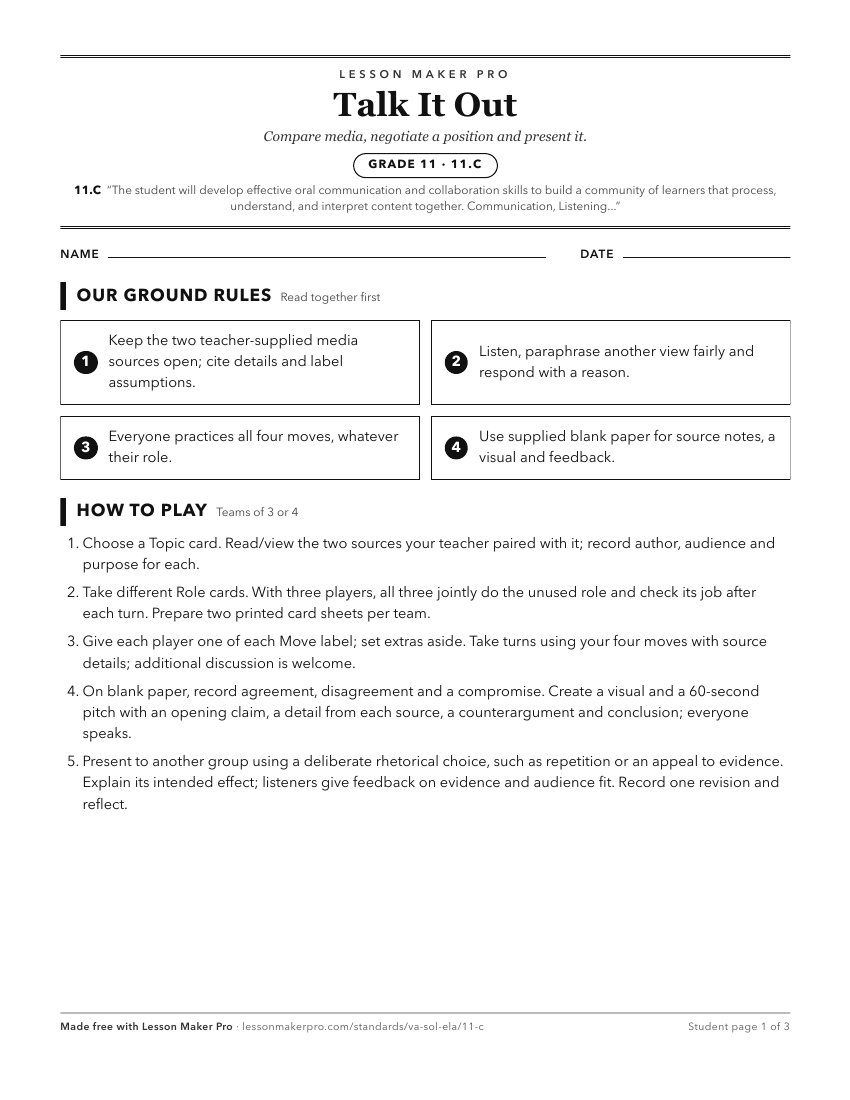
A ready-to-print activity worksheet aligned to 11.C, with an answer key for the teacher on its own page. No account needed.
PDF, US Letter, prints cleanly in black and white.
Download the worksheetKeep exploring
Related Standards
Turn this cluster into a lesson
Grade, subject, topic, and the complete cluster are prefilled. Create one free, no account needed.
Also for this cluster:Make a WorksheetMake a QuizMake a Sub Lesson