Virginia SOL 12.C.3
SOL Standard (Knowledge and Skills Cluster)
- 12.C
- The student will develop effective oral communication and collaboration skills to build a community of learners that process, understand, and interpret content together.
Integrating Multimodal Literacies Create and deliver planned, multimodal, interactive presentations collaboratively and individually for a variety of purposes and audiences. Examine multimodal sources’ claims, arguments, ideas, and any point of personal bias by evaluating them for reliability and relevance to serve as credible supporting evidence. Synthesize multiple streams of information on the same or similar topic to create a summary or formulate a position. Organize information to create media messages with visual, audio, and graphic components to convey meaning. Provide appropriate citation of all content from external sources.
Virginia Standards of Learning for English
Cluster contents
Knowledge and Skills in This Standard
12.C.3 is a Standards of Learning standard. These are the knowledge and skills expectations under it.
- 12.C.3.A
Create and deliver planned, multimodal, interactive presentations collaboratively and individually for a variety of purposes and audiences.
- 12.C.3.B
Examine multimodal sources’ claims, arguments, ideas, and any point of personal bias by evaluating them for reliability and relevance to serve as credible suppo...
- 12.C.3.C
Synthesize multiple streams of information on the same or similar topic to create a summary or formulate a position.
- 12.C.3.D
Organize information to create media messages with visual, audio, and graphic components to convey meaning.
- 12.C.3.E
Provide appropriate citation of all content from external sources.
Teacher's field guide
What This Cluster Means
What Students Need to Do
- Students plan and deliver presentations alone or with a group, using speech, text, visuals, audio, graphics, and audience interaction for a clear purpose. They judge sources for trustworthy evidence, relevance, and bias, then combine information from several sources into a summary or position. They organize each medium to support meaning and credit every borrowed quotation, image, sound, and data point.
What Mastery Looks Like
- A student can shape content, tone, visuals, audio, and audience interaction to fit a clear purpose. The student can explain why each source is reliable and relevant, while noting possible bias. Ideas from several sources form one clear message, with accurate citations for words, images, data, and sound.
Common Misconceptions
- Students may treat polished design, high view counts, or a familiar logo as proof that a source is trustworthy. They may list sources separately instead of combining ideas across them. They often add visuals, music, or data without explaining their purpose or citing them.
How to Assess It
- Give students two short articles and one chart about the same school issue. Ask them to state a position in three sentences, cite two details, identify one possible bias, and sketch one supporting slide.
Lesson moves
Ways to Teach It
Groups sort printed source cards by reliability and relevance, then build two slides using a chart, audio clip, and citations.
Discuss when a biased source can still be useful, then support your answer with one source detail and a warning for the audience.
Play a citation relay where teams fix missing credits for quotations, images, music, and data in sample slides.
Create a one minute school policy pitch with an audience poll, sourced visuals, and a closing call to action.
Free download
Printable 12.C.3 Worksheet
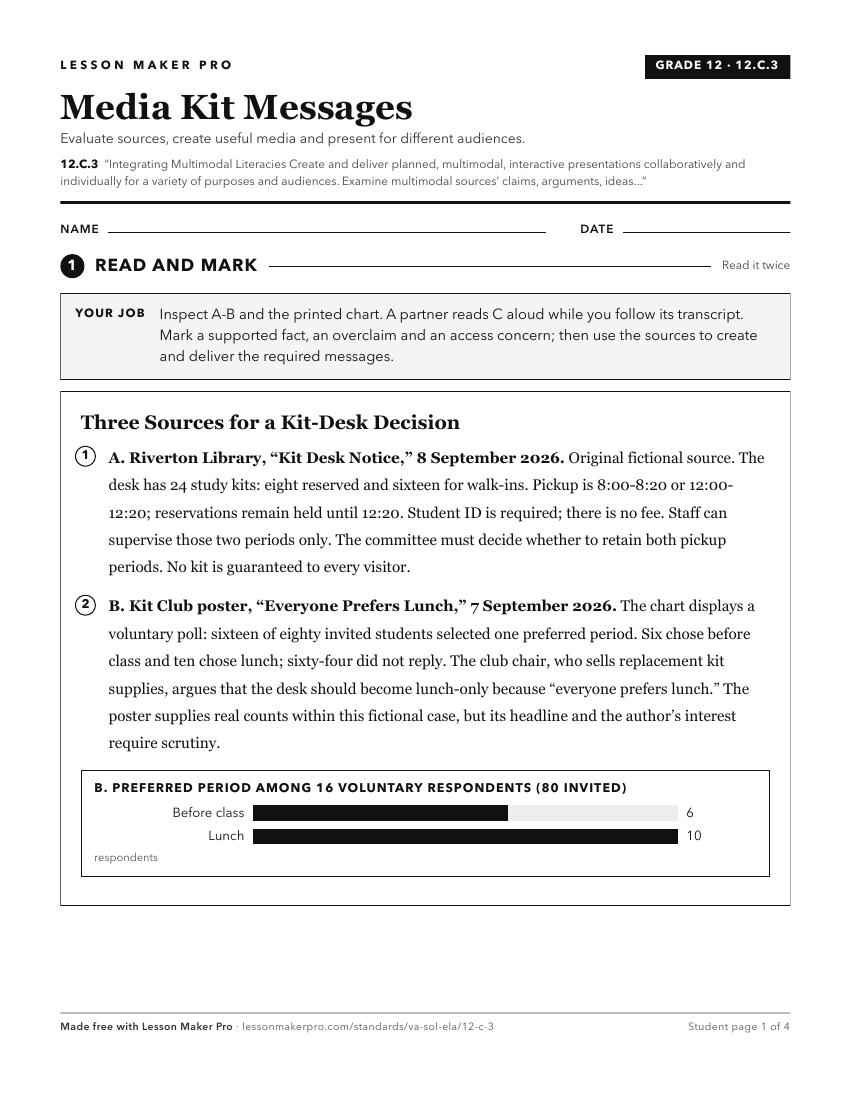
A ready-to-print activity worksheet aligned to 12.C.3, with an answer key for the teacher on its own page. No account needed.
PDF, US Letter, prints cleanly in black and white.
Download the worksheetKeep exploring
Related Standards
Turn this cluster into a lesson
Grade, subject, and topic are prefilled; the lesson picks the standards under this heading. Create one free, no account needed.
Also for this cluster:Make a WorksheetMake a QuizMake a Sub Lesson